Full text of a master's thesis examining early maladaptive schemas, psychological resilience and coping strategies in 324 adults living in Istanbul.
Master's Thesis · Istanbul Kent University, Institute of Graduate Education · 2022
Author: Eda ERKAN (under the surname used at the time of publication) · Supervisor: Assist. Prof. Dr. Fatih BAL · Department of Psychology, Clinical Psychology Programme · Council of Higher Education (YÖK) Thesis No: 755790The full text of the thesis is published on this page. The tables and appendices are reproduced as images taken from the original pages of the thesis so that the numerical values are preserved exactly. The table of contents and the list of tables are not included in the web version because they depend on page numbers.
Original PDF of the thesis · Open access record · YÖK National Thesis Center
DECLARATION
I hereby declare that scientific ethical rules were observed in the writing of this thesis, that works by others were cited in accordance with scientific norms wherever they were used, that no falsification was made in the data used, and that no part of this thesis has been submitted as another thesis study at this or any other university.
Eda ERKAN
10/08/2022
PREFACE
I extend my endless thanks to my supervisor, Assist. Prof. Dr. Fatih BAL, who shared his extensive knowledge and supported me with patience throughout the study, and to my family, who have been by my side at every step of my life up to now.
Eda ERKAN
10/08/2022
ABBREVIATIONS
- Cited in : Cited in (Akt.)
- Ed : Editor
- PIF : Personal Information Form (KBF)
- SCSS : Stress Coping Styles Scale (SBTÖ)
- SPSS : Statistical Package for the Social Sciences
- et al. : and others (Vd.) / and colleagues (Ve ark.)
- RSA : Resilience Scale for Adults (YPDÖ)
- YSQ : Young Schema Questionnaire (YŞÖ)
ABSTRACT (TURKISH VERSION)
Istanbul Kent University, Institute of Graduate Education - Abstract of Master's Thesis Title of the Thesis: The Relationship Between Early Maladaptive Schemas and Psychological Resilience and Stress Coping Styles in Adults
Author of the Thesis: Eda ERKAN Supervisor: Assist. Prof. Dr. Fatih BAL Date of Acceptance: 15/06/2022 Number of Pages: v (preliminary pages) + 83 (thesis) + 11 (Appendices**)** Department: Psychology Subfield: Clinical Psychology
The aim of this study is to examine the relationship between early maladaptive schemas and psychological resilience and coping skills in adults. In addition, the predictive effect of early maladaptive schemas on psychological resilience and coping skills was examined. Finally, the relationships between the socio-demographic characteristics of the adult participants, such as gender, income level, educational level and employment status, and the study variables, namely early maladaptive schemas, psychological resilience and coping skills, were analysed.
The sample of the study consists of a total of 324 adults living in Istanbul, 186 women and 138 men. The study was designed in accordance with the correlational survey model. A Personal Information Form, the Young Schema Questionnaire, the Resilience Scale for Adults and the Stress Coping Styles Scale were used as data collection instruments. The data obtained were analysed using parametric analysis methods in the SPSS-22 statistical programme.
According to the results of the analyses, the following findings were obtained: There is a significant relationship between early maladaptive schemas and psychological resilience and coping skills in adults. A significant relationship was found between psychological resilience and coping skills. Early maladaptive schemas have a predictive effect on psychological resilience and coping skills. According to the socio-demographic data, early maladaptive schemas differ significantly by gender, age, income level, employment status and educational level. Similarly, psychological resilience and coping skills differ significantly by gender, age, income level, employment status and educational level. The results obtained from the study are presented in the discussion section in light of the relevant literature.
Keywords: Schema, Early Maladaptive Schemas, Psychological Resilience, Stress, Stress Coping Styles
ABSTRACT
İstanbul Kent University Institute of Graduate Education-Abstract of Master's Thesis Title of the Thesis: The Relationship Between Early Maladaptive Schemas and Resilience and
Stress Coping Styles in Adults
Author: Eda ERKAN Supervisor: Dr. Lecturer Fatih BAL
Date: 15/06/2022 Nu. of pages: v (pre text) +83(thesis) +11 (App.) Department: Psychology Subfield: Clinical Psychology
The aim of this study is to examine the relationship between early maladaptive schemas and psychological resilience and coping skills in adults. In addition, the predictive effects of early maladaptive schemas on resilience and coping skills were investigated. Finally, the relationship between socio-demographic characteristics of adult individuals participating in the study, such as gender, income status, educational status, and employment status, and early maladaptive schemas, resilience and coping skills, which are working variables, were analyzed. The sample group of the research consists of 324 adult individuals, 186 women and 138 men, living in Istanbul. The research was designed in accordance with the relational screening model. Personal Information Form, Young Schema Scale, Adult Resilience Scale and Stress Coping Styles Scale were used as data collection tools in the study. The obtained data were analyzed by using parametric analysis methods in SPSS-22 statistical program.
According to the results obtained from the analyzes, the following findings were reached: There is a significant relationship between early maladaptive schemas and psychological resilience and coping skills in adults. A significant relationship was found between psychological resilience and the ability to cope with stress. Early maladaptive schemas have a predictive effect on resilience and coping skills. According to socio-demographic data, early maladaptive schemas differ significantly according to gender, age, income status, employment status and education level. Similarly, psychological resilience and ability to cope with stress differ significantly according to gender, age, income status, employment status and educational status. The results obtained as a result of the research are presented in the discussion section of the study in the light of the relevant literature.
Keywords: Schema, Early maladaptive schemas, Resilience, Stress, Stress Coping Styles
INTRODUCTION
Human development from childhood onwards shapes behaviour. Many studies are carried out to explain human behaviour and to reveal the reasons behind it, and different theories have been put forward. Early maladaptive schemas, which fall within the framework of cognitive theory, are one of these and constitute one of the main research topics of this study.
Early maladaptive schemas include the traumas and negative experiences that an individual has in the early stages of life (Nilüfer & Çınarbaş, 2018). Early maladaptive schemas emerge in childhood and spread to every area of life. All of this makes it important to explain early maladaptive schemas, which may produce negative consequences for human life in the future. Schemas are described as cognitive structures that form the source of emotions and behaviours. Early maladaptive schemas, in turn, emerge and develop under the influence of traumatic experiences in childhood and negative events in life. Early maladaptive schemas are a concept used in explaining personality and mood disorders (Konukçu, Akkoyunlu, & Türkçapar, 2013).
This study examines the effect of the learning that early maladaptive schemas bring about in the early years on psychological resilience levels and coping skills in the face of stressful life events encountered in adulthood. Psychological resilience is thought to be at a good level when individuals display adaptive coping skills in the face of significant stressors such as trauma, threat, tragedy, or family and relationship difficulties, serious health problems, workplace and financial problems (Tusaie & Dyer, 2004). Psychological resilience can be defined as possessing the whole set of adaptive and effective coping skills in the face of stressors. In this respect, some studies suggest that both biological and environmental factors are related to psychological resilience. On the other hand, some studies have argued that psychological resilience comprises skills that can be learned and that, over time, individuals can become psychologically resilient people (Kömürcü & Pekak, 2017).
Stress is defined in different ways by many theories. According to cognitive behavioural theory, from which early schemas originate, emotional responses to stressful life events, as in the phenomenological model of stress, are based on cognitive appraisals. In addition, cognitive schemas that already exist in individuals also play an important role in coping with stressful experiences. Cognitive theory holds that, in the information-processing process, appraisals of experiences become automatic as a result of their repetition in the face of particular experiences. As a result of these repetitions, individuals respond to new experiences with similar automatic emotional, cognitive and behavioural reactions through selective attention. In this respect, the main determinants are self-related cognitive schemas. For this reason, according to this approach, there is no objective evaluation of the situations one faces. Core beliefs play an important role in evaluating information about stress-producing experiences, in selecting information and in including it in the cognitive process. These core beliefs and cognitive distortions make it harder for individuals to adapt when coping with stressful experiences. Consequently, according to this approach, the main determinants of every kind of response an individual gives to stressful experiences are cognitive appraisals (Pretzer, Beck, & Newman, 2002). This theory identifies certain systematic cognitive thinking styles as direct determinants of emotional experiences. Cognitive behavioural theory addresses these styles under the headings of early maladaptive schemas and core beliefs. These schemas form particular ways of thinking. These particular systematic ways of thinking, in turn, constitute a risk factor for individuals in the face of stressful experiences. As can be seen, it is emphasised that early maladaptive schemas have an effect on skills in adult life. Accordingly, this study examines how coping with the stressful life events that may be continually encountered in life, and the level of psychological resilience in the face of these stressful events, are affected by early maladaptive schemas.
Purpose of the Study
The purpose of this study is to examine the relationship between early maladaptive schemas and psychological resilience and coping skills in adults. In addition, it aims to examine the relationship of the study variables (early maladaptive schemas, psychological resilience and coping with stress) with participants' socio-demographic characteristics such as gender, age, educational level and economic status.
Hypotheses
1.There is a significant relationship between early maladaptive schemas and psychological resilience in adults.
2.There is a significant relationship between early maladaptive schemas and coping skills in adults.
3.Early maladaptive schemas have a predictive effect on psychological resilience and coping skills in adults.
4. Psychological resilience and coping skills differ significantly by gender in adults.
5. Psychological resilience and coping skills differ significantly by economic status and educational level in adults.
Assumptions
1. It is assumed that the sample of the study represents the population.
2. It is assumed that the measurement instruments in the scale set of the study measured the characteristics they were intended to measure reliably and validly.
3. It is assumed that the participants answered the questions in the scale set completely, accurately and impartially.
Limitations
1. This study is limited to 324 adults living in Istanbul who were reached through digital means.
2. The findings obtained in the study are limited to the characteristics that the data collection instruments in the scale set were able to measure.
CHAPTER 1: THEORETICAL FRAMEWORK
1.1. Early Maladaptive Schemas
1.1.1. The Concept of Schema
Mental patterns that have a significant influence on an individual's information-processing skills and that have an enduring structure are defined as schemas. A schema is described as a mental model that influences the evaluation of sensory information held in the individual's mind, shapes how that information is encoded into long-term memory, has a determining effect on how the stored information is processed again, and also shapes behavioural responses. Although it contains various components, the schema is defined as the basic conceptualised unit of knowledge. Schemas, which influence our cognitive, emotional and behavioural processes throughout life, begin to form from an early age (Türkçapar, 2014).
In cognitive therapy, schemas are described as core beliefs about how the world works. Aaron Beck states that maladaptive early schemas such as unlovability, failure and loss form during early childhood. According to developmental psychology, children model themselves on their parents' schemas by imitating them. In addition, parents' child-rearing attitudes also influence the formation of children's schemas (Leahy, 2010). Schemas relate to labelling, classifying, interpreting and evaluating objects and events and attributing meaning to them (Beck & Emery, 2015). The way we perceive life is the way we feel, and the way we feel is the way we live. This is because people feel according to how they think. In other words, the heartbeat comes from the brain. We give direction to our emotions through the way we interpret the life we live and what we have (Yabancı, 2016). Put differently, schemas are organised structures of knowledge that influence how we perceive, interpret and remember information.
Cognitive therapists take a particular interest in schemas because schemas work like filters that influence the way people perceive themselves and their relationship with the world (Kramer et al., 2012). Applied fields such as clinical psychology, social psychology, school psychology and industrial psychology also place emphasis on cognitive factors. The interactions we have with others in early childhood have important effects on our emotions in adult life. If rejection and shame were experienced in childhood, then as an adult one is more likely to feel rejected and ashamed even when other people have no intentional attitude (Jacob et al., 2017). People with emotional problems, for their part, tend to distort reality. Schemas cause us to evaluate certain situations in exaggerated and distorted ways. Schemas are lifelong patterns or themes. Schemas are self-defeating. Schemas fight to survive.
One of the other factors that influence the development of schemas is temperament. Temperament is inborn. It is our emotional makeup and determines how we respond to events. Despite the ultimate genetic origin that determines the prototypes of human behaviour, there is also strong evidence for innate behaviour patterns and for certain types of a relatively stable temperament. These inborn characteristics can be seen as tendencies that are either extinguished or emphasised through experience (Beck, 2008). Temperament is, in a sense, defined as variation, in quality and quantity, in the particular and rather limited emotional reactions that are specific to a person in daily life. Getting bored easily, becoming angry, being cheerful, being active or inactive and so on are characteristics that vary from one individual to another. Through our interaction with the environment, these characteristics form a personality trait. In short, it is shaped by heredity and environment (Köknel, 2014).
1.1.2. Early Maladaptive Schemas
Maladaptive schemas form as a result of inadequately met needs during early childhood and adolescence. The resulting maladaptive schemas are described as mental patterns made up of emotions, memories, and bodily and cognitive sensations that recur throughout life and that contain the individual's beliefs about both themselves and their environment. Depending on the schemas that form when caregivers do not meet these needs, individuals try to meet their needs in inappropriate ways. As age advances, interaction with the environment causes schemas to have an automatic effect. Schemas that form at later stages are weaker than those that form at earlier stages (Young et al., 2003).
When early maladaptive schemas are activated, memories experienced in childhood are generally replayed and the person relives the same scenes (Soygüt, Karaosmanoğlu, & Çakır, 2009;). Because they feel familiar and well known to the person after the schemas have formed, people give automatic responses in line with their schemas to the experiences they encounter throughout life (Young et al., 2003). The strength of schemas has a determining effect on how much the outcome of the event the person experiences will affect them. To give an example, if a person frequently experienced serious abandonment or rejection by caregivers in the early period, the emotional deprivation and abandonment schemas are highly likely to form. Depending on their schemas, these individuals tend to constantly expect rejection and to respond strongly because of intense distress. Accordingly, in proportion to the strength of the schemas, the schema
- can be triggered to that extent. Four different early life experiences that lead to the acquisition of maladaptive schemas and speed up their development have been observed (Rafaeli et al., 2013);
1- The frustration of the child's needs that should have been met.
2- Harm to and endangerment of the child as a result of experiencing traumatic events.
3- The excessive provision of good things.
4- The child's identification with individuals the child regards as important, and selective internalisation.
In addition, it is stated that the formation of schemas speeds up when emotional temperament interacts with traumatising experiences. Studies on maladaptive schemas have revealed that there are 5 schema domains and 18 maladaptive schemas (Rafaeli et al., 2013).
1.1.3. Schema Domains and Early Maladaptive Schemas
1.1.3.1. Disconnection/Rejection Domain
People who have a schema in this domain believe that their needs for trust, love, compassion, security, acceptance, loyalty and so on, even if they are being met now, will come to an end one day, and that this could happen at any moment. In the family life of people who have a schema in the disconnection and rejection domain, attitudes such as being exclusionary, withholding love and care, keeping a distance and being abusive are generally seen (Young et al., 2003).
Abandonment/Instability: People with this schema feel constantly insecure in their relationships. They believe that the emotional gratifications they receive from the person they are in a relationship with, such as trust, love and security, will no longer be provided. In people with this schema, the ... established during the therapy process
Mistrust/Abuse: People with this schema believe that they will be mistreated, deceived and, in a sense, abused in their relationships.
Emotional Deprivation: If a person has this schema, they believe that the emotional support they need will not be met by the people they are in relationships with. Emotional deprivation appears in three forms. These are deprivation of nurturance, deprivation of empathy and deprivation of protection. The fourth schema seen in the disconnection/rejection domain is:
Defectiveness/Shame: People with this schema see themselves as defective, inadequate, worthless and unwanted.
Social Isolation/Alienation: If a person has this schema, they will not feel that they belong to any group, place or environment. They believe that other people will exclude them in one way or another (Young et al., 2003).
1.1.3.2. Impaired Autonomy and Performance Domain
Individuals with schemas in the Impaired Autonomy and Performance domain cannot act on their own and cannot remain separate from their caregivers. In childhood, these individuals were overprotected and had all their needs excessively met by their caregivers, or alternatively their caregivers took no interest in them at all. For this reason, their self-confidence has not developed much, their ability to get things done on their own has remained weak, and their own identity has not formed. These individuals have difficulty coping with challenges, handling their affairs on their own, taking responsibility and leading an independent life from their families. There are 4 schemas in this domain (Young et al., 2003):
Dependence/Incompetence: Individuals with this schema have difficulty managing their lives without help. They believe that they cannot manage their responsibilities, cannot solve their problems practically without help, and cannot make the right decisions independently.
Vulnerability to Harm or Illness: Individuals have an intense fear and expectation that a catastrophe they will be unable to control may strike at any moment. The fears relate to external catastrophes (earthquakes, elevators falling, plane crashes), medical catastrophes (illnesses) and emotional catastrophes (going crazy).
Enmeshment/Undeveloped Self: Individuals with this schema are excessively involved and close with other people, generally their parents, in a way that harms their development. For this reason, they cannot achieve individuation or form an identity. They believe that they cannot be happy or cope without the support of others.
Failure: This schema involves an intense belief that the person will not succeed, will fail where success is expected, and is inadequate compared with their peers. The person mostly sees themselves as stupid, clumsy, untalented and unsuccessful (Young et al., 2003).
1.1.3.3. Impaired Limits Domain
Individuals with schemas in the impaired limits domain have difficulty respecting the rights of others, cooperating, keeping their word, or setting and achieving realistic personal goals. These are associated with deficiencies in personal limits, personal responsibilities and sustaining long-term behaviours. The early family environments of people with these schemas have a structure that shows excessive tolerance, spoils children and does not give children responsibilities appropriate to their age. It can be said that these are family structures that lack appropriate confrontation and discipline and are far removed from limits. The parents of individuals with schemas in the impaired limits domain did not behave in ways that would model, for their children, behaviours such as entering into mutual cooperation or setting goals (Arntz & Jacob, 2016). The Entitlement/Grandiosity and Insufficient Self-Control/Self-Discipline schemas are found in this domain.
Entitlement/Grandiosity: Individuals with the entitlement schema believe that they are superior to other people and have special rights and privileges. These people lack empathy and consider themselves right in every situation. They behave as they wish without thinking of other people and are stubborn in this respect. They are excessively focused on gaining competence and power. They want to dominate other people and, accordingly, are constantly in competition.
Insufficient Self-Control and Self-Discipline: Individuals with this schema avoid setting goals and taking the responsibilities necessary to reach their goals. They have difficulty controlling their impulses and emotions. There is a tendency to avoid feelings such as confrontation and discomfort excessively. Their family structures generally do not teach skills of control and restraint. It may also be seen in family structures that place excessive importance on control (Arntz & Jacob, 2016).
1.1.3.4. Other-Directedness Domain
Individuals with schemas in this domain, out of concerns such as gaining approval, continuing to be loved and avoiding retaliation, focus on the needs of others more than on their own needs and put effort into meeting those needs. As a result, they cause their own emotional needs to go unmet. Because caregivers raise their children with conditional acceptance and conditional love, these children limit important aspects of themselves in order to receive love, attention and acceptance. The parents' needs come before the children's needs. There are 3 schemas in this domain (Simeone, Roediger, & Stevens, 2017):
Subjugation: The person hands over their own control to others in order to avoid abandonment, retaliation and anger. Subjugation has 2 types, and involves the suppression of needs (the person's wishes and preferences) and of emotions (reactions such as anger). Individuals believe that their own needs and emotions are unimportant.
Self-Sacrifice: In order to maintain their emotional bond with others, to be rid of guilt and to spare others pain, individuals knowingly and willingly ignore their own needs and happiness and strive to meet the needs of the other person. These individuals are excessively sensitive to the pain of others and may sometimes become angry because they feel that their own needs are not being met sufficiently.
Approval-Seeking/Recognition-Seeking: For individuals with this schema, what others think is more important, and in order to gain their approval they disregard their secure and authentic sense of self. They have self-esteem only if they receive approval from others. Social status, money, appearance and achievement are very important for gaining approval, and for this reason they focus on these excessively (Simeone, Roediger, & Stevens, 2017).
1.1.3.5. Overvigilance and Inhibition Domain
The general characteristic of people who have a schema in this domain is that they exercise excessive control over their own emotions, thoughts and behaviours. This is because such people try to avoid mistakes and to comply fully with rules. They ignore or postpone their own wishes and needs, happiness and expectations. The family structures in which this schema emerges are often families with punishing, harsh or rigid attitudes. In these families there is frequently a perfectionist structure and rules are applied to the letter. Relaxing and similar attitudes are put in second place. They believe that if this stance is not maintained, something will go wrong, and this is generally taught to the child as well (Young & Klosko, 2012).
Pessimism: People with the pessimism schema find it very hard to see the positive aspects of their lives, while finding the negative aspects is quite easy. They constantly believe that something will go wrong in their private, social or work lives and that everything will turn out terribly. For this reason, people with this schema are often anxious by nature.
Over-responsibility and Emotional Inhibition: A person with this schema suppresses their emotions in order to be loved or to prevent a possible problem.
Unrelenting Standards: When a person has this schema, they believe that they must succeed at all costs in order to avoid criticism and judgement. They are also critical themselves. They have great difficulty enjoying themselves, relaxing, and feeling satisfied with success or anything else. The family attitudes that cause this schema to form are characterised by rigid rules, perfectionism and difficulty in noticing any achievement.
Punitiveness Schema: People with this schema believe that people must be punished without fail for the mistakes they make. These people have great difficulty forgiving or accepting a wrong, their own included. For this reason, they may adopt a merciless, angry or punishing attitude (Young & Klosko, 2012).
1.1.4. Characteristics of Early Maladaptive Schemas
Early maladaptive schemas are cognitive structures that begin in the first years of childhood, are repeated throughout life and have a self-damaging quality. This structure affects the individual's cognition, emotions, social interaction and behaviour patterns and creates a pervasive life pattern (Boysan, 2012).
Maladaptive schemas are personal evaluations that individuals make as a result of repeated negative experiences in childhood or adolescence, and they generally have a psychologically wearing quality. These personal evaluations become the basic criteria for the inferences individuals will make about themselves and the world.
Young and colleagues (2003) described the characteristics of early maladaptive schemas as follows:
- Because they spread to many different areas of life, they are generalisable.
- They consist of memories, emotions, cognitions and bodily sensations.
- They are related to the individual's interpersonal relationships.
- They develop in childhood and adolescence.
- They become more complex and detailed in structure over the individual's lifetime.
- They impair the individual's functioning.
1.1.5. Effects and Manifestations of Early Maladaptive Schemas
It is stated that psychological problems such as depression, anxiety and personality disorders emerge under the influence of early maladaptive schemas. Indeed, it is known that there are numerous studies addressing the relationship between early maladaptive schemas and psychological problems such as depression and anxiety (Sarıtaş Atalar & Gençöz, 2015: 41). The psychological effects and manifestations of early maladaptive schemas increase the importance of the subject.
The effects and manifestations of early maladaptive schemas are listed as follows (Eldoğan & Barışkın, 2014):
- Emotional deprivation is observed.
- Suppressed emotions are seen.
- A sense of mistrust increases.
- Defects become pronounced.
- Failures emerge.
- Abandonment is seen.
- Dependence occurs.
- A pessimistic approach shows itself.
- Resistance cannot be shown against threats.
- The level of self-control remains inadequate.
- Punishments are seen.
- Self-sacrificing behaviour is observed.
- Approval-seeking becomes pronounced.
- High standards are expected.
As can be understood from the items listed above, the areas of influence of early maladaptive schemas cover a very wide range. The potential for them to show themselves in many areas of an individual's life makes these consequences even more important.
Besides affecting people's emotions and thoughts, schemas also affect their behaviours (Yıldız, 2017: 18). This point, which makes it possible to infer that early maladaptive schemas affect people in many ways, also indicates that their effects continue to be observed in the ongoing processes of life. It can therefore be said that, as a result of the experiences lived, early maladaptive schemas shape all of life's experiences.
1.1.6. Maladaptive Coping Styles and Responses
Individuals tend to cope with the events that trigger their schemas and with the schemas themselves. When a schema is activated, it leads to negative emotions. The maladaptive types of coping that pave the way for these schemas to persist cause the schemas to keep troubling the individual and to keep recurring. Schema coping styles are addressed under three headings: "schema avoidance", "schema overcompensation" and "schema surrender". Schema coping styles are described as behaviours that individuals have developed in order to cope with the negative experiences they went through in childhood (Anlı & Can, 2017).
Schema Surrender: Schema surrender is defined as the individual's submission to their schema. People whose coping style is schema surrender directly feel the pain that the schema brings. To give an example, an individual with an abandonment schema chooses someone who will eventually abandon them. Jacob and colleagues described an individual's yielding to their schemas and behaving according to the rules of their schemas as schema surrender (Jacob, van Genderen, & Seebauer, 2014). Individuals who surrender to their schemas display behaviours that confirm their schemas. Schema therapy states that individuals who surrender to their schemas have behaviour patterns that simply obstruct them in meeting their emotional needs.
Schema Avoidance: Individuals with the schema avoidance coping style tend to avoid their schemas and the situations that might trigger them. This avoidance conflicts significantly with some individuals' ability to gain the love they need, to find fulfilment in their working lives or to enjoy daily activities, and becomes quite pervasive in their lives. This coping style is related to individuals not wanting to feel the emotions that their schemas bring up (Rafaeli et al., 2013). People who use schema avoidance try to stay away from thoughts related to their schemas. An individual who believes they are ugly because of a defectiveness schema tries to avoid this by not looking in the mirror. Behaviour is reinforced by escaping from these feared situations. Although displaying these behaviours reduces the anxiety brought by the schema for a short time, in the long term it causes the schema and the related emotions to gain strength. Individuals with schema avoidance generally tend to avoid close relationships and work problems because of the possibility that their schemas will be triggered. When there is no possibility of schema triggering, they may appear perfectly normal (Young et al., 2003).
Schema Overcompensation: Individuals with the schema overcompensation coping style tend to do the opposite of their schemas. For example, an individual who believes that people do not like them may demand excessively that people like them. Although overcompensating for a schema has the characteristic of temporarily alleviating the emotions the schema brings, it does not bring about treatment of the schema. Individuals whose coping style is schema overcompensation try to develop emotions, thoughts and behaviours that display the exact opposite of the schema. Although fighting against the schema is a good thing in itself, individuals who overcompensate exaggerate this and remain stuck at the point of going on the attack (Jacob, van Genderen, & Seebauer, 2014).
1.2. Psychological Resilience
The ability of individuals to recover and overcome the difficulties and hardships they experience in their lives is called psychological resilience. The phenomenon of psychological resilience has been the subject of many areas of research in psychology. Research on the subject has concentrated on two phenomena. The first phenomenon identified is that some individuals pull themselves together and overcome challenging life experiences. The second is based on the view that psychological resilience causes psychopathology (Çetin, Yeloğlu, & Basım, 2015).
It is stated that trauma, tragedy, threat, family-related difficulties and problems experienced in relationships lead to stress. The ability to overcome, adapt to or recover from these sources of stress is defined as psychological resilience. Serious health problems, work-related difficulties and financial problems are also regarded as stressors (Çam & Büyükbayram, 2017). In addition, psychological resilience refers to a number of personality characteristics of individuals. These personality characteristics include qualities such as recovering quickly, overcoming difficulties, gaining resistance, and being robust and flexible (Gürgan, 2010).
An individual's perception of risk in their life influences the development of psychological resilience. The reason these risk factors are seen as a first condition is that they make it possible to begin early work on reducing and eliminating the expected negative effects (Gürgan, 2010). In this context, a stress factor must have been encountered beforehand for psychological resilience to develop. In this way, the risks the stress factor would give rise to will be prevented early from creating negative situations (Çam & Büyükbayram, 2017).
There are many definitions of the subject. Hunter addressed psychological resilience as a process of achievement and adaptation. According to Luthans and colleagues, psychological resilience is defined as individuals encountering obstacles, uncertainty, pressure and many adverse situations and being able to overcome them (Polatçı et al., 2017). Luthans also approached this concept from a positive organisational perspective, describing psychological resilience as the positive psychological capacity that individuals possess to bounce back from the difficulties they encounter because of uncertainty, failure, conflict and increased responsibility (Luthans, 2002).
Psychological resilience can be defined as aligning the process, capability and outcomes with success in the face of the difficulties and hardships an individual experiences (Masten, 2001). The development of psychological resilience enables individuals to be strong and resistant in the face of positive and negative events, and expresses this state. The development of psychological resilience is an important process in achieving recovery, focusing on success and sustaining one's goals. The individual is always in a risky and stressful living environment. In order to adapt to the adversities this risky environment will bring and to reach positive outcomes, psychological resilience needs to be strong. In this context, psychological resilience is a source of resistance against the difficulties brought about by stressful life events (Polatçı et al., 2017).
When the definitions are considered, they concentrate on three variables. These variables are expressed as having good development in the face of high-risk situations, maintaining positive competence despite stress, and being able to recover easily from the traumas caused by negative events. These variables indicate the shared characteristics in explaining psychological resilience (Yöndem & Bahtiyar, 2016).
1.2.1. Dimensions of Psychological Resilience
Friborg et al. (2003) listed the dimensions of psychological resilience as self-confidence, realistic goals, planning ability, social competence, social resources, and family support and cohesion. The first dimension, self-confidence, refers to the ability of an individual who encounters suddenly developing stressful situations to cope with them. The second dimension, realistic goals, refers to the individual setting realistic and attainable goals for themselves and knowing how to progress towards them. Another dimension, planning ability, consists of the person being able to make plans in line with their goal and having a belief that they will reach success by using their time effectively. The social competence dimension that follows represents skills relating to the person's ability to form social relationships with other people. The social resources dimension consists of the individual's ability to receive support from social support groups such as family and friends. The family support and cohesion dimension consists of the person's value system matching their family's value system and the person feeling happy with their family. Maddi (2007) lists the dimensions of psychological resilience as commitment, control and challenge, while Kobasa (1979) expresses the dimensions of psychological resilience as control, commitment and challenge. There are also studies stating that the dimensions of psychological resilience are not clearly distinguished from one another (Funk & Houston, 1987; Motan, 2009; Sezgin, 2012).
Commitment Dimension: The commitment dimension relates to the person's active participation in life (Sezgin, 2012). While Kobasa (1979) defines the commitment dimension as the individual's tendency to involve themselves in different areas of life, Maddi (2004) defines it as the person believing in and valuing themselves and, together with this, taking an active role in life and receiving and giving emotional support when necessary. In the commitment dimension, the individual is expected to find meaning in life and to be attached to their life accordingly. With this commitment, the person takes an active role in their life and performs positively in order to improve it (Durak, 2002). People with the commitment dimension are stronger in struggling against stressful events thanks to their attachment to family, social and work life (Maddi, 2004; Terzi, 2008). When they encounter these stressful situations, they overcome problems instead of running away. Together with the commitment dimension, the person is expected to approach the negative situations encountered in life with optimism (Klag & Bradley, 2004).
Control Dimension: The control dimension consists of thoughts and behaviours based on the person's belief that they have an influence on the events in their life and can change those events. According to the control dimension, control of one's life is in one's own hands, and for this reason the individual struggles when problems are encountered. The control dimension includes the ability to make free choices, courage, self-discipline, self-control, autonomy, motivation and success (Maddi, 2004; Motan & Gençöz, 2009). For this reason, people with the control dimension aim to change the course of events instead of waiting hopelessly in the face of challenging life events (Maddi, 2004).
Challenge Dimension: In the challenge dimension, it is stated that the individual's belief in change in their life supports the individual's development and in this way helps the individual to discover life (Maddi, 2004). In the challenge dimension, the individual should see changes in life as opportunities for self-improvement and should be able to adapt to these changes. People with the challenge dimension evaluate the changes that occur in their lives as part of the normal flow of life, and by taking these changes seriously they know how to cope with stress in stressful situations and which resources to draw on (Terzi, 2008). With the challenge dimension, the individual gains learning by doing and living, through interaction with their environment. The challenge dimension is linked to personality characteristics such as openness to novelty, perseverance, optimism and determination (Gençöz & Motan, 2009). People with high levels of the challenge dimension are therefore more flexible and more active than other people and have higher problem-solving skills (Holt et al., 1987).
Although the dimensions described appear independent of one another, they interact. For people to have genuine psychological resilience, they need to have all of these dimensions. This is because those who are high in the control dimension but low in the other dimensions are unwilling to spend time and effort learning from the experiences and emotions related to the individual and to events, even if they want to determine outcomes. In other words, if one or two dimensions are low, the presence of a single high dimension on its own is not sufficient for coping strategies (Maddi, 2002).
1.2.2. Factors Influencing Psychological Resilience
The factors that influence psychological resilience are as important as the dimensions of psychological resilience. The factors that influence psychological resilience are protective factors, risk factors and positive outcome factors (Erarslan, 2014).
Protective factors are described as factors that reduce or prevent the likelihood of undesirable situations occurring. Protective factors are classified as environmental, familial and individual factors (Masten, 2001). Environmental factors include the person having strong social relationships. Positive friendships, receiving support in school and work life, and having a positive role model are listed as environmental factors. Familial protective factors include the individual having strong family relationships. A positive mother-child relationship, living with the family and parents' high educational level are listed as familial protective factors. Individual protective factors relate to the individual's positive personality characteristics. They are listed as effective problem-solving ability, a positive self-perception, intelligence, an effective sense of responsibility and humour (Motan & Gençöz, 2009).
Risk factors are defined as factors that increase the likelihood of possible negative situations occurring and the severity of those negative situations. Like protective factors, risk factors are classified as environmental, familial and individual factors (Haase, 2004). Individual risk factors are listed as premature birth, chronic illnesses and negative life events, while familial risk factors are listed as adolescent parenthood, parental bereavement, parental divorce and parental psychopathology or illness. Environmental risk factors, in turn, are listed as traumatic events affecting a large part of society such as war, natural disasters and epidemics, low socioeconomic level, child neglect and abuse, family problems and violence (Gizir, 2007).
Positive outcome is another factor influencing psychological resilience, and is described as the individual successfully completing developmental tasks and being in line with developmental stages (Karaırmak, 2006). It is listed as fulfilling developmental tasks, social competence, rule-abiding behaviour, psychological health and not being prone to delinquency, engaging in age-appropriate activities, and self-acceptance.
1.3. Coping with Stress
1.3.1. Stress
In everyday life, individuals face many stressors. Although stress is not a desirable state for individuals, it is also fundamental to life. Stress is a state of strain in which individuals need to adapt to tension and change (Köroğlu, 2015).
The concept of stress derives from the Latin word 'Estrictia' and the French word 'Estrece'; throughout history it has been used with meanings such as strain, pressure, disaster, tension, trouble, distress and grief. In the 19th century, the French physiologist Claude Bernard addressed the present-day meaning of the concept of stress by saying that diseases occur when the balance in individuals' internal structure is disturbed. Walter B. Cannon used the concept of stress while examining fight-or-flight reactions in his laboratory. In 1925, Hans Selye examined stress symptoms and responses through animal experiments. According to Lazarus and Folkman, stress arises when the individual is strained by environmental factors and feels in danger as a result (Yanık, 2019).
In daily life, individuals frequently face stressful situations. However, stress does not always affect individuals negatively. It is known to motivate individuals to work, to make them pursue new goals and to spur them into creating new ideas and products (Baltaş & Baltaş, 2015). Positive stress helps the individual make decisions in daily life, provides energy, increases the individual's motivation and performance, and provides alertness (Çelik & Muhammet, 2021). Negative stress, on the other hand, is a state that arises as a result of the individual's challenging life experiences. It lowers the individual's quality of life and reduces productivity, causing failure and low performance (Gürhan, 2016).
As a result of his studies, Selye showed that in the face of stress individuals produce certain psychological and physical symptoms and display a "fight or flight" response. In the face of this stress, individuals' balance is disturbed and a stress response occurs. This stress response is called "Selye's General Adaptation Syndrome". It consists of the alarm, resistance and exhaustion stages. The alarm stage is the period in which, once stress is perceived, a number of changes are seen in the body in order to re-establish and maintain balance in the organism. These changes are as follows (Gürhan, 2016):
1. Stored fat and sugar are released into the blood to provide the necessary energy.
2. The respiratory rate increases to take in more oxygen and raise energy.
3. Red blood cells in the blood increase to carry oxygen to the brain and muscles in order to enable the struggle.
4. Blood pressure rises so that blood reaches the necessary places in the organism.
5. The blood clotting mechanism becomes active in order to reduce blood loss against possible injuries.
6. Digestion slows down.
7. The pupils dilate in order to strengthen perception and improve vision.
8. Sensations towards the external environment increase.
9. The pituitary gland is stimulated.
Depending on its severity, the duration of exposure and the response given, stress causes mental health to deteriorate. Stress has psychological and behavioural consequences that affect mental health. Among the psychological consequences of stress on individuals are tension, anxiety, depression, worry, pessimism, distress and difficulty concentrating; among its behavioural consequences are increased smoking and alcohol use and emotional and sudden decisions, which can negatively affect individuals' mental health (Slavich, 2016).
1.3.2. Ways of Coping with Stress
The behavioural and cognitive efforts that individuals use to reduce the distress associated with troubling and challenging life events are regarded as ways of coping. Folkman and Lazarus (1984) explained these ways of coping under two headings: emotion-focused and problem-focused. The person making efforts to change the stress-producing situation or factors indicates that they are using the problem-focused coping method. In the second way, emotion-focused coping, the individual tries to reduce the emotional effects created by the stressful event. Denial, seeking social support and avoidance are some of these efforts. This strategy is preferred more when the stressors cannot be changed. Problem-focused coping shows better adjustment to life stress and trauma (Votta & Manion, 2003). On the other hand, the emotion-focused coping method can also reduce the effects of stress (Dempsey, Overstreet, & Moely, 2000).
Although many theorists have different ways of classifying coping styles, it is stated that the emotion-oriented/passive style and problem-oriented/active style theory developed by Lazarus and Folkman is the most developed theory (Slavich, 2016). The studies on coping styles carried out in our country by Şahin and Durak (1995) were also carried out in line with the theory of coping styles explained by Folkman and Lazarus. As a result of these studies, coping styles, which are examined in two main groups as problem-oriented/active and emotion-oriented/passive, are examined in a total of 5 subcategories within themselves. It is stated that, of these approaches, the problem-focused approach consists of three categories, namely the "self-confident approach", the "optimistic approach" and the "seeking social support approach", while the other approach, the emotion-oriented approach, consists of two categories, the "helpless approach" and the "submissive approach" (Votta & Manion, 2003).
Self-confident approach: The self-confident approach refers to the individual having self-belief that they have the strength to cope with the difficult situation they have encountered.
Another approach, the optimistic approach, is a stress coping style that involves seeing, in a stressful situation, what one is going through from its positive sides.
Seeking social support is described as a stress coping method in which the individual, when under stress, expects support from their social environment and tries to reduce the effects of the stress they experience by sharing it with those around them.
Helpless approach: This is expressed as a stress coping style in which, when faced with stress, the individual believes they cannot cope and therefore develops an accepting style.
Submissive approach: This approach is described as a stress coping method in which the individual accepts the negative situations and defeat brought by stress without struggling against the stress (Şahin & Durak, 1995).
Eryılmaz (2009) stated that the tendency to cope with stress is evaluated in two main groups. In the first group, coping with stress includes problem-focused methods, which involve direct coping with stress and in which cognitive activities are used to solve the problem in a realistic way. In this style the person focuses on the problem and tries to find answers about possible solutions. The other group involves being able to regulate the emotions related to the stress-producing situation without creating any other change. In other words, these are emotion-focused coping methods. In the coping that can be obtained while structuring in this style, emotional preferences are often directed towards alleviating or changing the effects brought by stress. Breathing exercises, relaxation techniques and physical exercise are among the bodily ways (Eryılmaz, 2009).
Bodily Ways
These ways make it possible to bring the negative effects of stress on the body under control by acting on the central nervous system and the sympathetic nervous system. Bodily ways are listed as breathing exercises, physical exercise, relaxation techniques, eating habits, rest and sleep. Some studies carried out in the clinical field have shown that a moderate level of stress stimulates personal outcomes. However, excessive stress negatively affects personal performance, physical health and quality of life. It is known that stress is closely related to physical functioning (Körükçü & Kukulu, 2015).
Physical Exercise
Physical exercise methods have an important role in strengthening stress coping skills. In addition, physical exercise also has an effect on behaviours, the prevention of diseases, care and feeling well (Körükcü & Kukulu, 2015).
The main aim of these exercises is to regulate metabolic processes and oxygen distribution, to increase strength, to contribute to endurance, to lower body fat percentage and to improve muscle and joint movements. Physical exercises are performed by following the steps of warm-up, exercise and cool-down (Tel & Terakye, 2000).
Relaxation Methods
These exercises aim at physical relaxation, at naturally facilitating the parasympathetic nervous transition, and then at mental relaxation. Relaxation exercises are one of the important ways of slowing the functions of the body such as emotions like fear and excitement, palpitations and spasms, and of slowing down thought performance (Tel & Terakye, 2000).
The stress to which one is exposed in life causes the individual to tense up and the muscles to contract. These relaxation exercises make these contracted muscle groups relax. These exercises can be listed as rapid and deep relaxation, meditation and biofeedback (Yasemin & Karabulut, 2018).
CHAPTER 2: METHOD
2.1. Research Model
This study is research prepared with a cross-sectional design and in the correlational survey model. Studies that aim to examine how multiple variables change together for a single group included in the study are in accordance with the correlational survey model. It is also a descriptive study in that it describes the participants' socio-demographic characteristics such as gender and age. In summary, the model of the study is a descriptive study with a cross-sectional design and in the correlational survey model (Karasar, 2012).
2.2. Sample of the Study
The sample of this study consisted of a total of 324 adults, 138 men and 186 women, living in the province of Istanbul in 2021. The following two criteria were determined as inclusion criteria for the study:
- Being over 18 years of age
- Not having a psychiatric diagnosis
2.3. Data Collection Instruments
2.3.1. Personal Information Form
A self-report form will be prepared by the researcher in order to collect the participants' demographic information such as age, gender, education, marital status, occupation and income level.
2.3.2. Young Schema Questionnaire
The scale is the Turkish adaptation of the short form 3 of the Young Schema Questionnaire (YSQ-SF3) (YŞÖ-KF 3). The original version of this scale, developed by Young and colleagues (2003), contains 16 schemas and 205 items. The short form later created by Cecero and colleagues (2004) consists of 15 schemas and 75 items. The scale used in this study took the form adapted by adding the punitiveness, pessimism and approval-seeking schemas (Young, 2003). Following the validity and reliability study carried out in Turkey, the scale took the form used in this study. The adaptation study was conducted with 1,071 participants aged between 17 and 35. Of the participants, 597 were women (55.7%) and 469 were men (43.8%). Five participants did not state their gender (0.5%). Analyses of the components of the scale were carried out using the Equamax rotation method, and the cut-off point was set at .33. As a result of the study, the scale was found to consist of 14 schema dimensions and 5 schema domains (Soygüt, Karaosmanoğlu, & Çakır, 2009). Reliability values varied between r = .66 and .82 (p<.01) for Pearson correlation coefficients for the schema dimensions, and between r = .66 and .83 (p<.01) for the schema domains. The scale consists of 90 items. It is a Likert-type scale rated from 1 (completely untrue of me) to 6 (describes me perfectly). Participants are asked to rate each item from 1 to 6 in the way that suits them best. A high score is known to indicate the intensity of the relevant maladaptive schema. The schema dimensions of this scale, as adapted by Soygüt and colleagues, and their items are as follows: Entitlement/Insufficient Self-Control (68, 69, 15, 50, 32, 51, 22), Abandonment (2, 20, 28, 38, 74), Enmeshment/Dependence (63, 81, 9, 79, 7, 64, 10, 25, 82), Emotional Deprivation (1, 19, 37, 55, 73), Social Isolation/Mistrust (3, 4, 40, 57, 58, 75, 76), Defectiveness/Shame (23, 41, 43, 59, 77, 90), Self-Sacrifice (83, 47, 29, 65, 11), Vulnerability to Harm or Illness (62, 71, 44, 21, 39), Unrelenting Standards (31, 13, 14), Pessimism (35, 17, 8, 80, 26), Failure (6, 24, 33, 42, 60, 78), Emotional Inhibition (12, 30, 48, 66, 84), Approval-Seeking (88, 52, 70, 56, 34, 16), Punitiveness (54, 72, 18, 53, 49, 89).
2.3.3. Stress Coping Styles Scale (SCSS)
This scale, developed by Lazarus and Folkman (1980), aims to measure ways of coping with stressful situations. In the adaptation study of the scale, which originally had 66 items, Şahin and Durak (1995) reduced the number of items to 30. The scale consists of the submissive approach (5, 13, 15, 17, 21, 24), self-confident approach (8, 10, 14, 16, 20, 23, 26), helpless approach (3, 7, 11, 19, 22, 25, 27, 28), optimistic approach (2, 4, 6, 12, 18) and seeking social support (1, 9, 29, 30) approaches. Items 1 and 9 on the scale are reverse scored. The scale is scored from 0 to 3 (0 = 0% (not used at all), 1 = 30%, 2 = 70%, 3 = 100% (used often)). Subscale scores are obtained by dividing the scores from the items that make up each subscale by the number of items. The Turkish validity and reliability study of the scale was conducted by Şahin and Durak (1995), and the Cronbach's alpha internal consistency coefficients were found to range between 0.49 and 0.68 for the optimistic approach subscale, 0.62 and 0.80 for the self-confident approach subscale, 0.64 and 0.73 for the helpless approach subscale, 0.47 and 0.72 for the submissive approach subscale, and 0.45 and 0.47 for the seeking social support subscale (Şahin & Durak, 1995).
2.3.4. Resilience Scale for Adults
The Turkish adaptation study of the Resilience Scale for Adults, developed by Friborg and colleagues (2005), was carried out by Basım and Çetin (2011). The scale consists of a total of six dimensions: structured style, perception of future, family cohesion, perception of self, social competence and social resources. The scale contains 33 items. In the reliability study of the Resilience Scale for Adults, the Pearson correlation coefficients were determined as .72 for Perception of Self, .75 for Perception of Future, .78 for Structured Style, .81 for Family Cohesion and .77 for Social Resources. In the validity study, the confirmatory factor analysis showed that the six-factor structure explains a total of 57% of the variance.
2.4. Data Analysis
Before the analysis began, the data were collected online on the Google Forms platform. The data obtained were then coded and transferred to SPSS 25 and made ready for analysis. The total and subscale scores of the scales were calculated first. The normality of the distributions of these scales and subscales was then analysed. The kurtosis and skewness values were within the reference range of -2 to +2. According to these values, the data showed a normal distribution (George & Mallery, 2010).
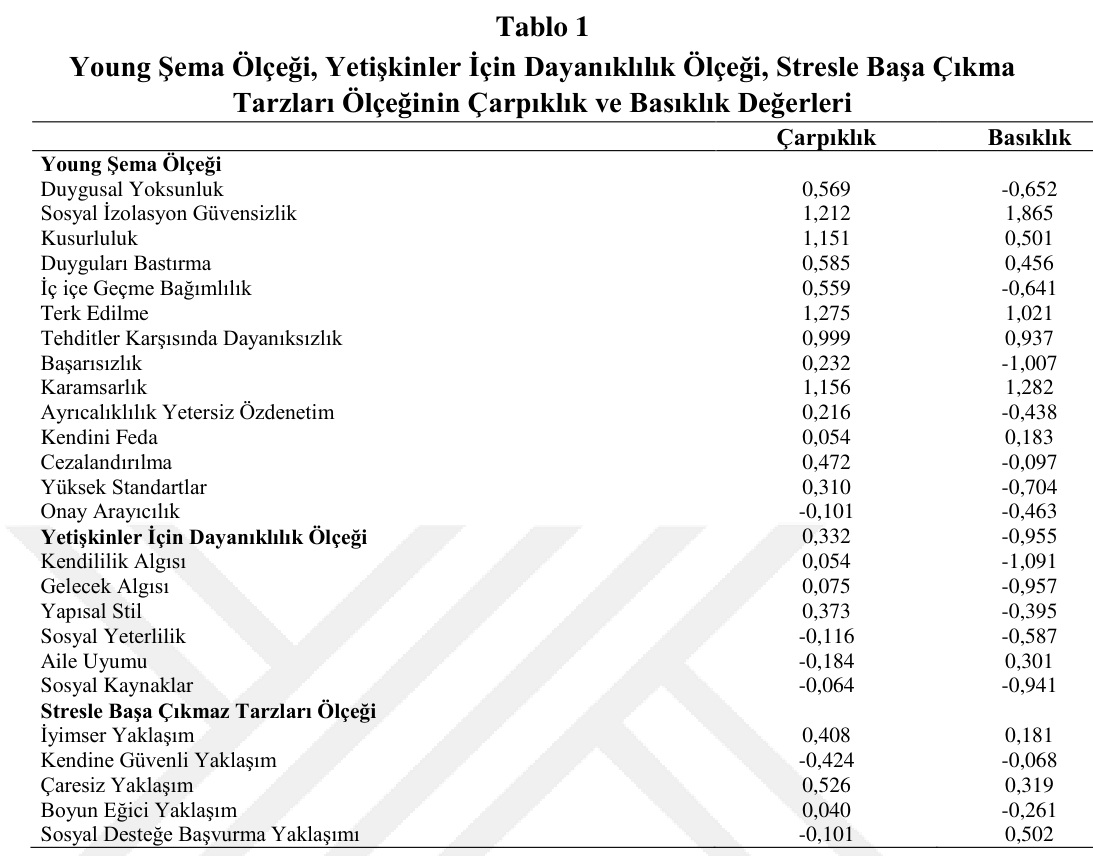
When we examine the kurtosis and skewness table for the scales and subscales above, it is seen that all values remain within the reference range. According to this result, the assumption of normal distribution is satisfied for all scales and subscales. Pearson correlation analysis was used to evaluate the relationships between them. To compare them in terms of socio-demographic variables, the Independent Samples t-test and One-Way Analysis of Variance (ANOVA) were used. Predictive power was examined with multiple regression analysis. All analyses were carried out at a 95% confidence interval. The p value used as the significance level in the analyses is 0.05.

CHAPTER 3: FINDINGS
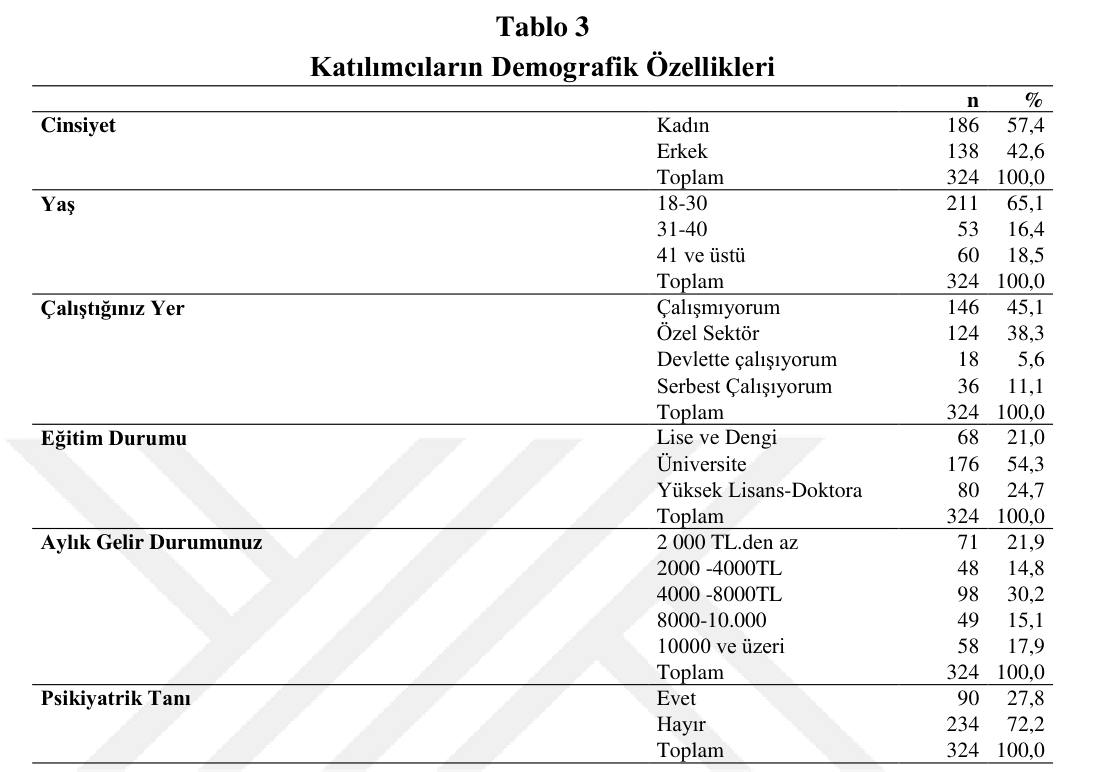
When we examine the findings, 57.4% of the participants were women and 42.6% were men; 65.1% were aged 18-30, 16% were aged 31-40 and 18.5% were aged 41 and over; 45.1% were not working, 38.3% worked in the private sector, 5.6% worked in the public sector and 11% were self-employed; 21% were high school graduates or equivalent, 54.3% were university graduates and 24.7% held a master's or doctoral degree; 21.9% had a monthly income of less than 2,000 TL, 14.8% had a monthly income between 2,000 and 4,000 TL, 30.2% had a monthly income between 4,000 and 8,000 TL, 15.1% had a monthly income between 8,000 and 10,000 TL and 17.9% had a monthly income of 10,000 TL and above; as for having received any psychiatric diagnosis, 27.8% had received a psychiatric diagnosis and 72.2% had not.
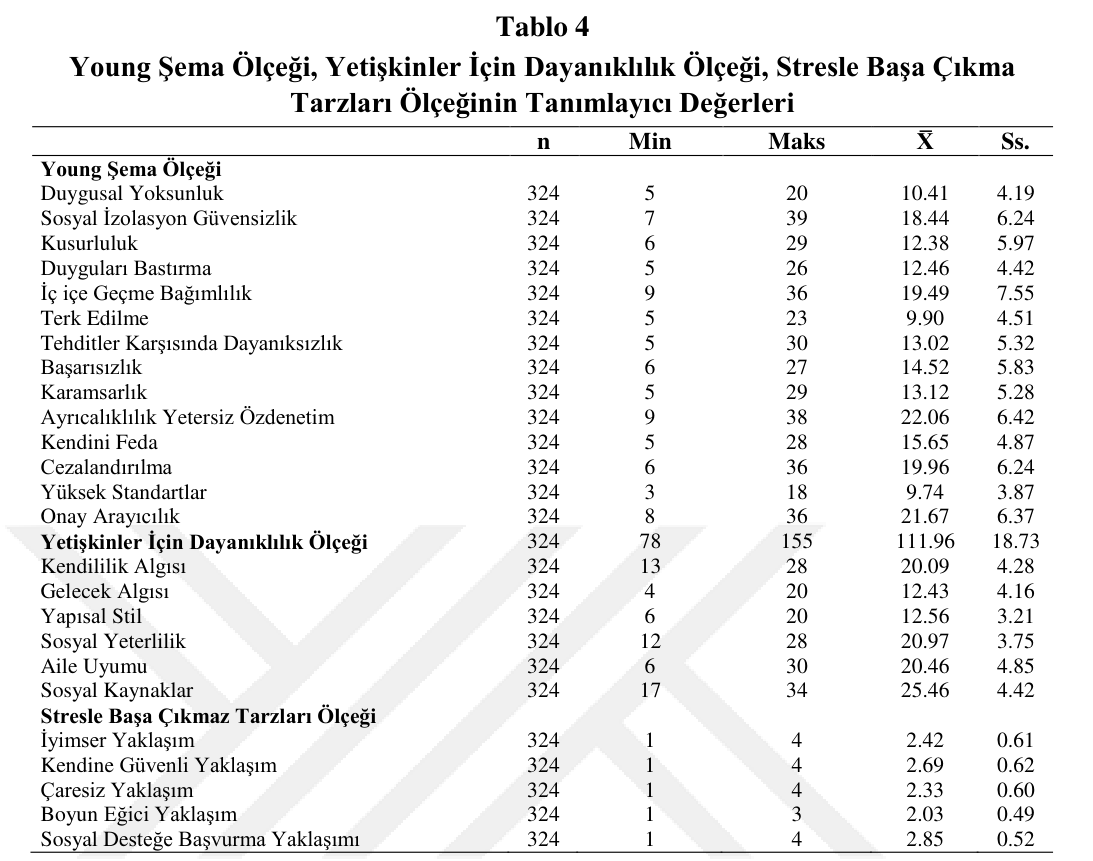
The means of the scales are as follows: Vulnerability to Harm or Illness (X̅=13.02, SD=5.32), Emotional Deprivation (X̅=10.41, SD=4.19), Punitiveness (X̅=19.96, SD=6.24), Entitlement/Insufficient Self-Control (X̅=22.06, SD=6.42), Defectiveness (X̅=12.38, SD=5.97), Abandonment (X̅=9.90, SD=4.51), Approval-Seeking (X̅=21.67, SD=6.37), Social Isolation/Mistrust (X̅=18.44, SD=6.24), Emotional Inhibition (X̅=12.46, SD=4.42), Enmeshment/Dependence (X̅=19.49, SD=7.55), Failure (X̅=14.52, SD=5.83), Pessimism (X̅=13.12, SD=5.28) and Self-Sacrifice (X̅=15.65, SD=4.87). Unrelenting Standards (X̅=9.74, SD=3.87), the Resilience Scale for Adults mean (X̅=111.96, SD=18.73), the perception of self mean (X̅=20.09, SD=4.28), the perception of future mean (X̅=12.43, SD=4.16), the structured style mean (X̅=12.56, SD=3.21), the social competence mean (X̅=20.97, SD=3.75), the family cohesion mean (X̅=20.46, SD=4.85), the social resources mean (X̅=25.46, SD=4.42), the optimistic approach mean (X̅=2.42, SD=0.61), the self-confident approach mean (X̅=2.69, SD=0.62), the helpless approach mean (X̅=2.33, SD=0.60), the submissive approach mean (X̅=2.03, SD=0.49) and the seeking social support approach mean (X̅=2.85, SD=0.52) are observed.
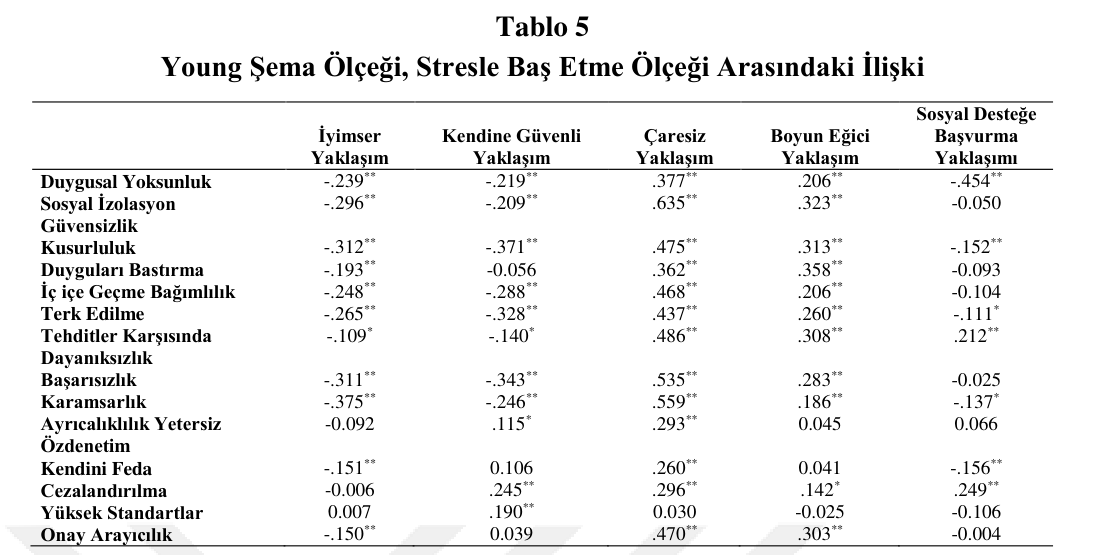
**p<0.01 *p<0.05 Test used: Pearson Correlation Test
It was found that there was a weak, negative relationship between Emotional Deprivation and the optimistic approach (r=.-239, p<0.01), a weak, negative relationship between Social Isolation/Mistrust and the optimistic approach (r=.-296, p<0.01), a moderate, negative relationship between Defectiveness and the optimistic approach (r=.-312, p<0.01), a weak, negative relationship between Emotional Inhibition and the optimistic approach (r=.-193, p<0.01), a weak, negative relationship between Enmeshment/Dependence and the optimistic approach (r=.- 248, p<0.01), a negative, weak relationship between Abandonment and the optimistic approach (r=.- 265, p<0.01), a negative, weak relationship between Vulnerability to Harm or Illness and the optimistic approach (r=.-109, p<0.01), a negative, moderate relationship between Failure and the optimistic approach (r=.-311, p<0.01), a negative, moderate relationship between Pessimism and the optimistic approach (r=.-375, p<0.01), a negative, weak relationship between Self-Sacrifice and the optimistic approach (r=.-151, p<0.01), and a negative, weak relationship between Approval-Seeking and the optimistic approach (r=.-150, p<0.01).
It was determined that there was a weak, negative relationship between Emotional Deprivation and the self-confident approach (r=.-219, p<0.01), a negative, weak relationship between Social Isolation/Mistrust and the self-confident approach (r=.-209, p<0.01), a negative, weak relationship between Defectiveness and the self-confident approach (r=.-371, p<0.01), a negative, weak relationship between Enmeshment/Dependence and the self-confident approach (r=.-288, p<0.01), a negative, moderate relationship between Abandonment and the self-confident approach (r=.-328, p<0.01), a negative, weak relationship between Vulnerability to Harm or Illness and the self-confident approach (r=.-140, p<0.01), a negative, moderate relationship between Failure and the self-confident approach (r=.-343, p<0.01), between Pessimism and the self-confident approach (r=.-246, p<0.01), a positive, weak relationship between Entitlement/Insufficient Self-Control and the self-confident approach (r=.115, p<0.01), a positive, weak relationship between Punitiveness and the self-confident approach (r=.245, p<0.01) and a positive, weak relationship between Unrelenting Standards and the self-confident approach (r=.190, p<0.01).
A positive, moderate relationship was found between Emotional Deprivation and the helpless approach (r=.377, p<0.01), between Social Isolation/Mistrust and the helpless approach (r=.635, p<0.01), between Defectiveness and the helpless approach (r=.475, p<0.01), between Emotional Inhibition and the helpless approach (r=.362, p<0.01), between Enmeshment/Dependence and the helpless approach (r=.468, p<0.01), between Abandonment and the helpless approach (r=.437, p<0.01), between Vulnerability to Harm or Illness and the helpless approach (r=.486, p<0.01), between Failure and the helpless approach (r=.535, p<0.01), between Pessimism and the helpless approach (r=.559, p<0.01), and a positive, weak relationship between Entitlement/Insufficient Self-Control and the helpless approach (r=.293, p<0.01), between Self-Sacrifice and the helpless approach (r=.260, p<0.01), and between Punitiveness and the helpless approach (r=.296, p<0.01), and a positive, moderate relationship between Approval-Seeking and the helpless approach (r=.470, p<0.01).
A positive, weak relationship was found between Emotional Deprivation and the submissive approach (r=.206, p<0.01), a positive, moderate relationship between Social Isolation/Mistrust and the submissive approach (r=.323, p<0.01), between Defectiveness and the submissive approach (r=.313, p<0.01), and between Emotional Inhibition and the submissive approach (r=.358, p<0.01), a positive, weak relationship between Enmeshment/Dependence and the submissive approach (r=.206, p<0.01), and between Abandonment and the submissive approach (r=.260, p<0.01), a positive, moderate relationship between Vulnerability to Harm or Illness and the submissive approach (r=.308, p<0.01), and between Failure and the submissive approach (r=.283, p<0.01), a positive, weak relationship between Pessimism and the submissive approach (r=.186, p<0.01), and between Punitiveness and the submissive approach (r=.142, p<0.01), and a positive, moderate relationship between Approval-Seeking and the submissive approach (r=.303, p<0.01).
The relationship between Emotional Deprivation and the seeking social support approach (r=.-454, p<0.01) was found to be negative and moderate, the relationship between Defectiveness and the seeking social support approach (r=.-152, p<0.01) negative and weak, the relationship between Abandonment and the seeking social support approach (r=.-111, p<0.01) negative and moderate, the relationship between Vulnerability to Harm or Illness and the seeking social support approach (r=.212, p<0.01) positive and moderate, the relationship between Pessimism and the seeking social support approach (r=.- 137, p<0.01) negative and weak, the relationship between Self-Sacrifice and the seeking social support approach (r=.-156, p<0.01) negative and weak, and the relationship between Punitiveness and the seeking social support approach (r=.249, p<0.01) positive and weak.
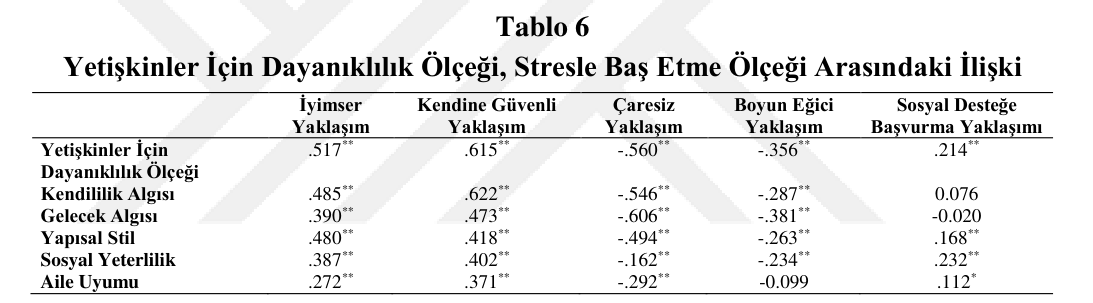
**p<0.01 *p<0.05 Test used: Pearson Correlation Test
The relationship between Resilience for Adults and the optimistic approach (r=.517, p<0.01) was found to be positive and moderate, the relationship between resilience for adults and the self-confident approach (r=.615, p<0.01) positive and moderate, the relationship between resilience for adults and the helpless approach (r=.-560, p<0.01) negative and moderate, the relationship between resilience for adults and the submissive approach (r=.-365, p<0.01) positive and moderate, and the relationship between resilience for adults and seeking social support (r=.214, p<0.01) negative and weak.
The relationship between Perception of Self and the optimistic approach (r=.485, p<0.01) was found to be positive and moderate, the relationship between perception of self and the self-confident approach (r=.622, p<0.01) positive and moderate, the relationship between perception of self and the helpless approach (r=.-546, p<0.01) negative and moderate, and the relationship between perception of self and the submissive approach (r=.-287,p<0.01) negative and weak.
The relationship between Perception of Future and the optimistic approach (r=.390, p<0.01) was found to be positive and moderate, the relationship between perception of future and the self-confident approach (r=.473, p<0.01) positive and moderate, the relationship between perception of future and the helpless approach (r=.-606, p<0.01) negative and moderate, and the relationship between perception and the submissive approach (r=.-381,p<0.01) negative and moderate.
The relationship between Structured Style and the optimistic approach (r=.480, p<0.01) was found to be positive and moderate, the relationship between structured style and the self-confident approach (r=.418, p<0.01) positive and moderate, the relationship between structured style and the helpless approach (r=.-494, p<0.01) negative and moderate, the relationship between structured style and the submissive approach (r=.-263, p<0.01) negative and weak, and the relationship between structured style and seeking social support (r=.168, p<0.01) positive and weak.
The relationship between Social Competence and the optimistic approach (r=.387, p<0.01) was found to be positive and moderate, the relationship between social competence and the self-confident approach (r=.402, p<0.01) positive and moderate, the relationship between social competence and the helpless approach (r=.-162, p<0.01) negative and weak, the relationship between social competence and the submissive approach (r=.-234, p<0.01) negative and weak, and the relationship between social competence and seeking social support (r=.232, p<0.01) positive and weak.
The relationship between Family Cohesion and the optimistic approach (r=.272, p<0.01) was found to be positive and weak, between family cohesion and the self-confident approach (r=.371, p<0.01) positive and moderate, between family cohesion and the helpless approach (r=.-292, p<0.01) negative and weak, and the relationship between family cohesion and seeking social support (r=.112, p<0.05) positive and weak.
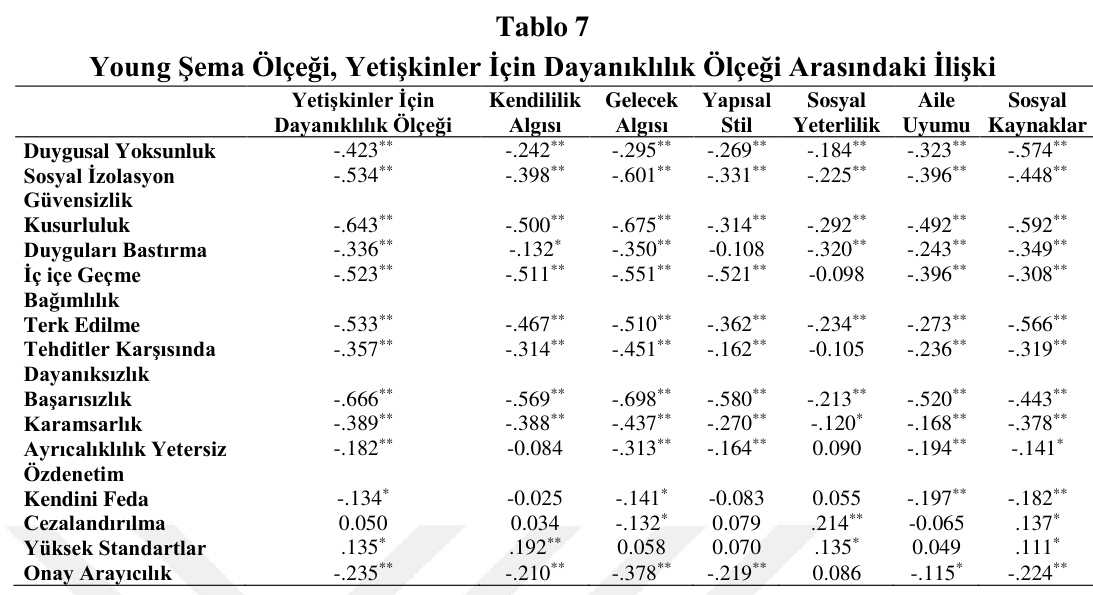
**p<0.01 *p<0.05 Test used: Pearson Correlation Test
The relationship between Emotional Deprivation and resilience for adults (r=.-423, p<0.01) was found to be negative and moderate, between emotional deprivation and perception of self (r=.-242, p<0.01) negative and weak, between emotional deprivation and perception of future (r=.-295, p<0.01) negative and weak, between emotional deprivation and structured style (r=.- 269, p<0.01) negative and weak, between emotional deprivation and social competence (r=.-184, p<0.01) negative and weak, between emotional deprivation and family cohesion (r=.-323, p<0.01) negative and moderate, and between emotional deprivation and social resources (r=.-574, p<0.01) negative and weak.
The relationship between Social Isolation and resilience for adults (r=.-534, p<0.01) was found to be negative and moderate, between social isolation and perception of self (r=.-398, p<0.01) negative and moderate, between social isolation and perception of future (r=.-601, p<0.01) negative and moderate, between social isolation and structured style (r=.-331, p<0.01) negative and moderate, between social isolation and social competence (r=.-225, p<0.01) negative and weak, between social isolation and family cohesion (r=.-396, p<0.01) negative and moderate, and between social isolation and social resources (r=.-448, p<0.01) negative and moderate.
The relationship between Defectiveness and resilience for adults (r=.-534, p<0.01) was found to be negative and moderate, between defectiveness and perception of self (r=.-398, p<0.01) negative and moderate, between defectiveness and perception of future (r=.-601, p<0.01) negative and moderate, between defectiveness and structured style (r=.-331, p<0.01) negative and moderate, between defectiveness and social competence (r=.-225, p<0.01) negative and weak, between defectiveness and family cohesion (r=.-396, p<0.01) negative and moderate, and between defectiveness and social resources (r=.-448, p<0.01) negative and moderate.
The relationship between Emotional Inhibition and resilience for adults (r=.-534, p<0.01) was found to be negative and moderate, between emotional inhibition and perception of self (r=.-398, p<0.01) negative and moderate, between emotional inhibition and perception of future (r=.-601, p<0.01) negative and moderate, between emotional inhibition and structured style (r=.-331, p<0.01) negative and moderate, between emotional inhibition and social competence (r=.- 225, p<0.01) negative and weak, between emotional inhibition and family cohesion (r=.-396, p<0.01) negative and weak, and between emotional inhibition and social resources (r=.-448, p<0.01) negative and moderate.
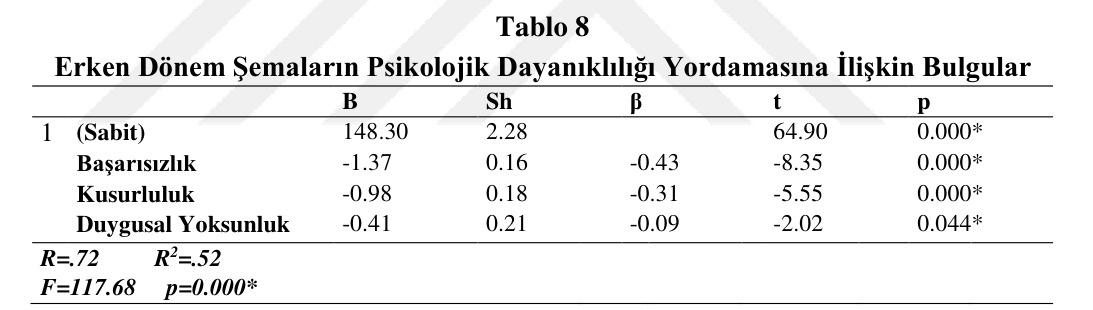
*p<0.05 Test used: Multiple Linear Regression Analysis; Stepwise Method
Failure, defectiveness and emotional deprivation were found to be significant predictors of psychological resilience (R=72, R2=.52, p<0.05). In the regression model that was created, the independent variables were found to explain 52% of the change in psychological resilience. When ranked by beta, the order is: failure (β=-.43), defectiveness (β=-.31), emotional deprivation (β=-.09). Failure, defectiveness and emotional deprivation were found to have a negative effect. According to the analysis results, the variable with the highest level of explanation of psychological resilience was found to be failure.
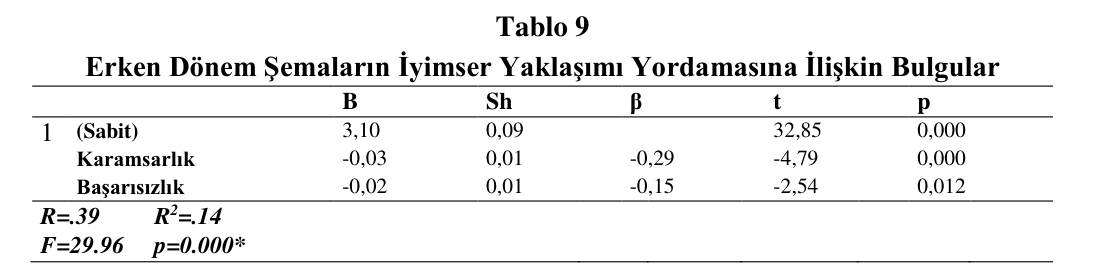
*p<0.05 Test used: Multiple Linear Regression Analysis; Stepwise Method
Pessimism and failure were found to be significant predictors of the optimistic approach (R=39, R2=.14, p<0.05). In the regression model that was created, the independent variables were found to explain 14% of the change in the optimistic approach. When ranked by beta, the order is: pessimism (β=-.29), failure (β=-.15). Pessimism and failure were found to have a negative effect. According to the analysis results, the variable with the highest level of explanation of the optimistic approach was found to be pessimism.
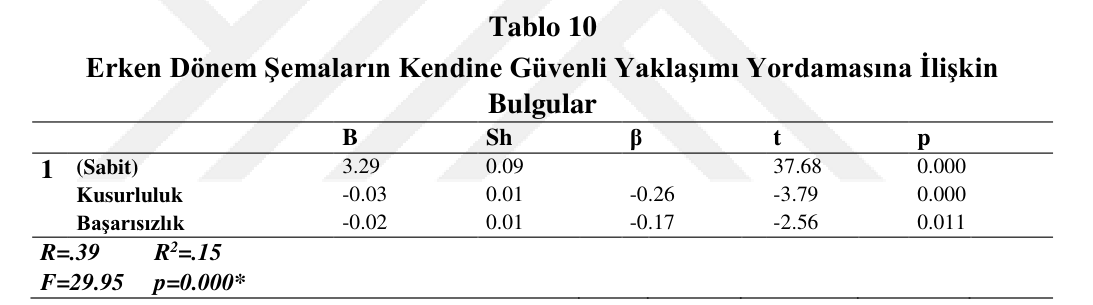
*p<0.05 Test used: Multiple Linear Regression Analysis; Stepwise Method
Defectiveness and failure were found to be significant predictors of the self-confident approach (R=39, R2=.15, p<0.05). In the regression model that was created, the independent variables were found to explain 15% of the change in the self-confident approach. When ranked by beta, the order is: defectiveness (β=-.26), failure (β=-.17). Defectiveness and failure were found to have a negative effect. According to the analysis results, the variable with the highest level of explanation of the self-confident approach was found to be defectiveness.
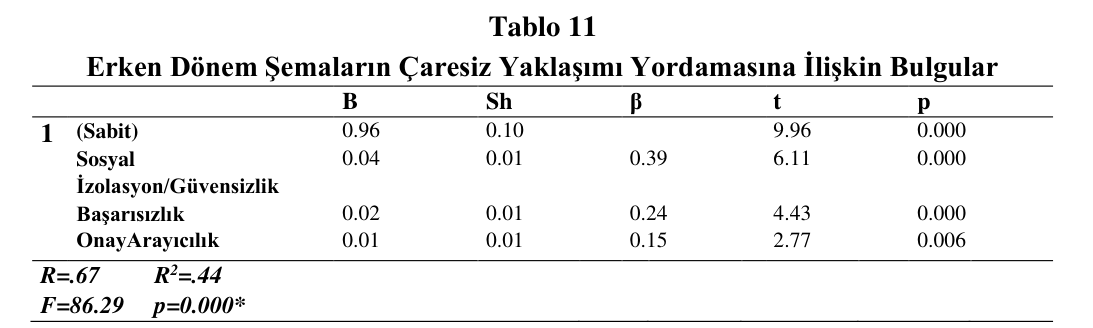
*p<0.05 Test used: Multiple Linear Regression Analysis; Stepwise Method
Social isolation/mistrust, failure and approval-seeking were found to be significant predictors of the helpless approach (R=67, R2=.44, p<0.05). In the regression model that was created, the independent variables were found to explain 44% of the change in the helpless approach. When ranked by beta, the order is: social isolation/mistrust (β=.39), failure (β=.24), approval-seeking (β=.15). Social isolation/mistrust, failure and approval-seeking were found to have a positive effect. According to the analysis results, the variable with the highest level of explanation of the helpless approach was found to be social isolation/mistrust.
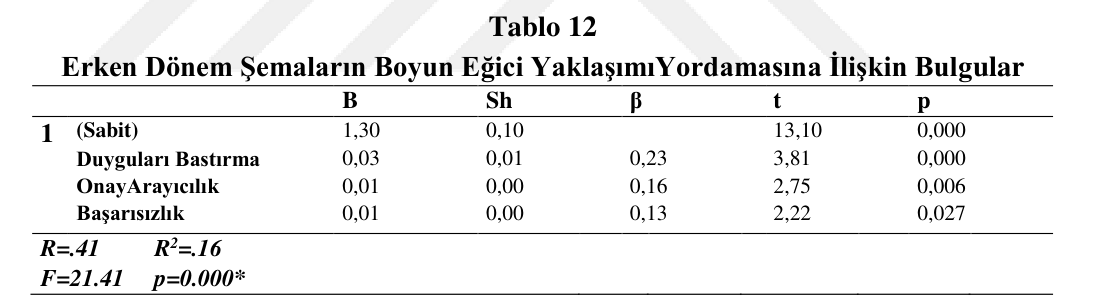
*p<0.05 Test used: Multiple Linear Regression Analysis; Stepwise Method
Emotional inhibition, approval-seeking and failure were found to be significant predictors of the submissive approach (R=41, R2=.16, p<0.05). In the regression model that was created, the independent variables were found to explain 16% of the change in the submissive approach. When ranked by beta, the order is: emotional inhibition (β=.23), approval-seeking (β=.16), failure (β=.13). Emotional inhibition, approval-seeking and failure were found to have a positive effect. According to the analysis results, the variable with the highest level of explanation of the submissive approach was found to be emotional inhibition.
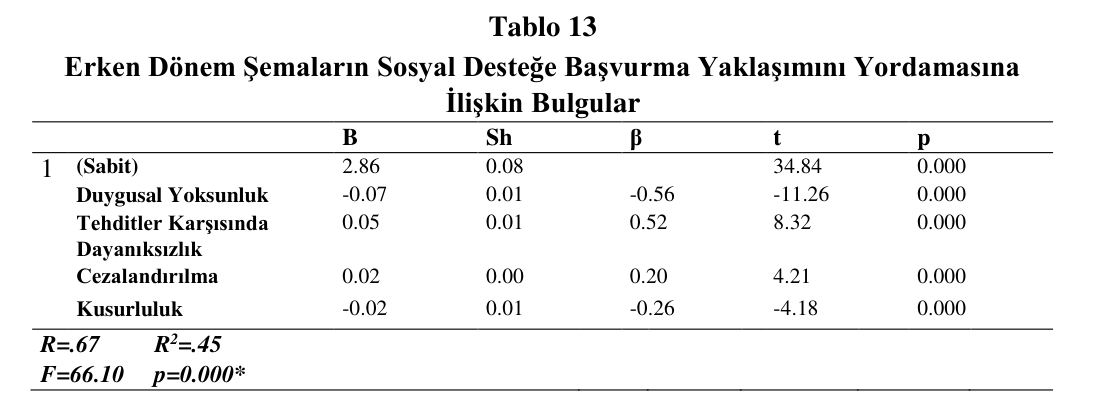
*p<0.05 Test used: Multiple Linear Regression Analysis; Stepwise Method
Emotional deprivation, vulnerability to harm or illness, punitiveness and defectiveness were found to be significant predictors of the seeking social support approach (R=67, R2=.45, p<0.05). In the regression model that was created, the independent variables were found to explain 45% of the change in the seeking social support approach. When ranked by beta, the order is: emotional deprivation (β=-.56), vulnerability to harm or illness (β=.52), defectiveness (β=-.26), punitiveness (β=.20). Emotional deprivation and defectiveness were found to have a negative effect, and vulnerability to harm or illness and punitiveness a positive effect. According to the analysis results, the variable with the highest level of explanation of the seeking social support approach was found to be emotional deprivation.
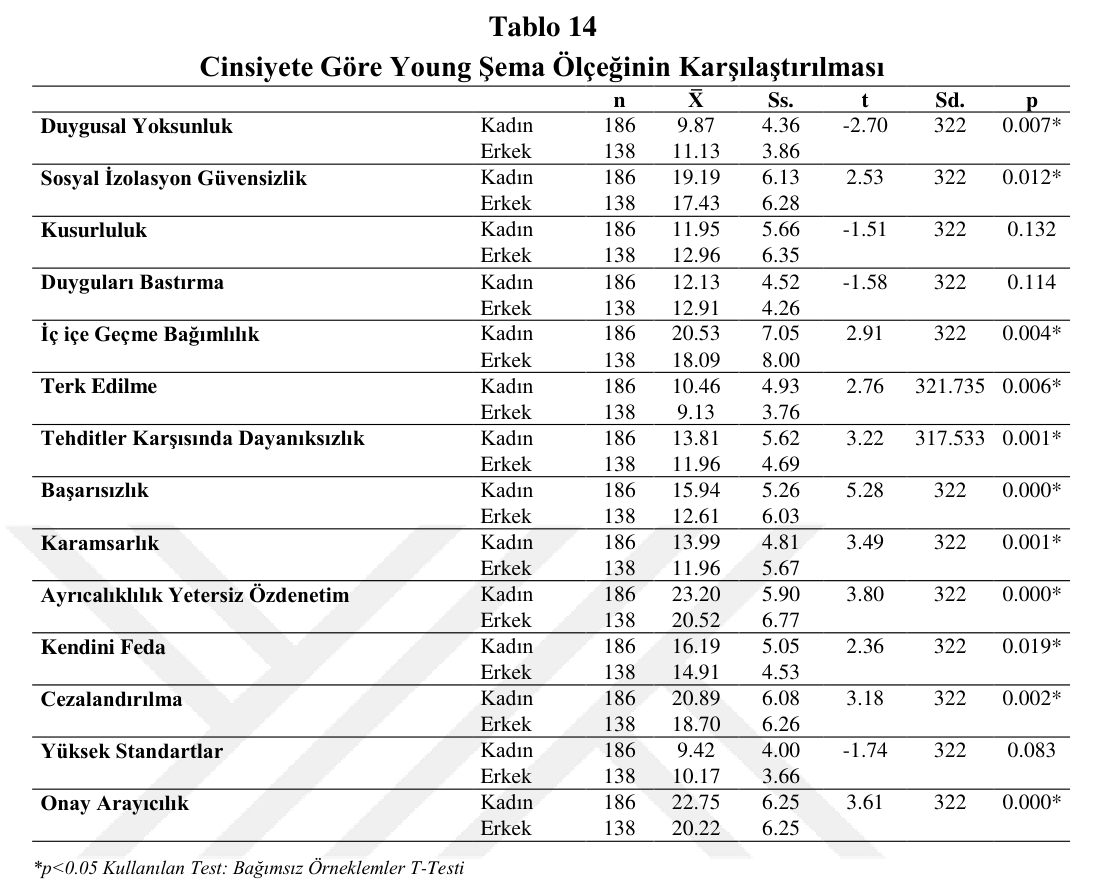
It was determined that the scores on the Defectiveness, Emotional Inhibition and Unrelenting Standards subscales did not differ by gender (p>0.05).
According to the results of the examination of the scores obtained from the Social Isolation/Mistrust subscale (t(322)=2.53, df=322, p<0.05), the Enmeshment/Dependence subscale (t(322)=2.91, df=322, p<0.05), the Abandonment subscale (t(321.735)=2.76, df=321.735, p<0.05), the Vulnerability to Harm or Illness subscale (t(317.533)=3.22, df=317.533, p<0.05), the Failure subscale (t(322)=5.28, df=322, p<0.05), the Pessimism subscale (t(322)=3.49, df=322, p<0.05), the Entitlement/Insufficient Self-Control subscale (t(322)=3.80, df=322, p<0.05), the Self-Sacrifice subscale (t(322)=2.36, df=322, p<0.05), the Punitiveness subscale (t(322)=3.18, df=322, p<0.05) and the Approval-Seeking subscale (t(322)=3.61, df=322, p<0.05) in terms of gender, it was found that women's scores were higher than men's.
According to the results of the examination of the scores obtained from the Emotional Deprivation subscale (t(322)=-2.70, df=322, p<0.05) in terms of gender, it was found that men's scores were higher than women's.
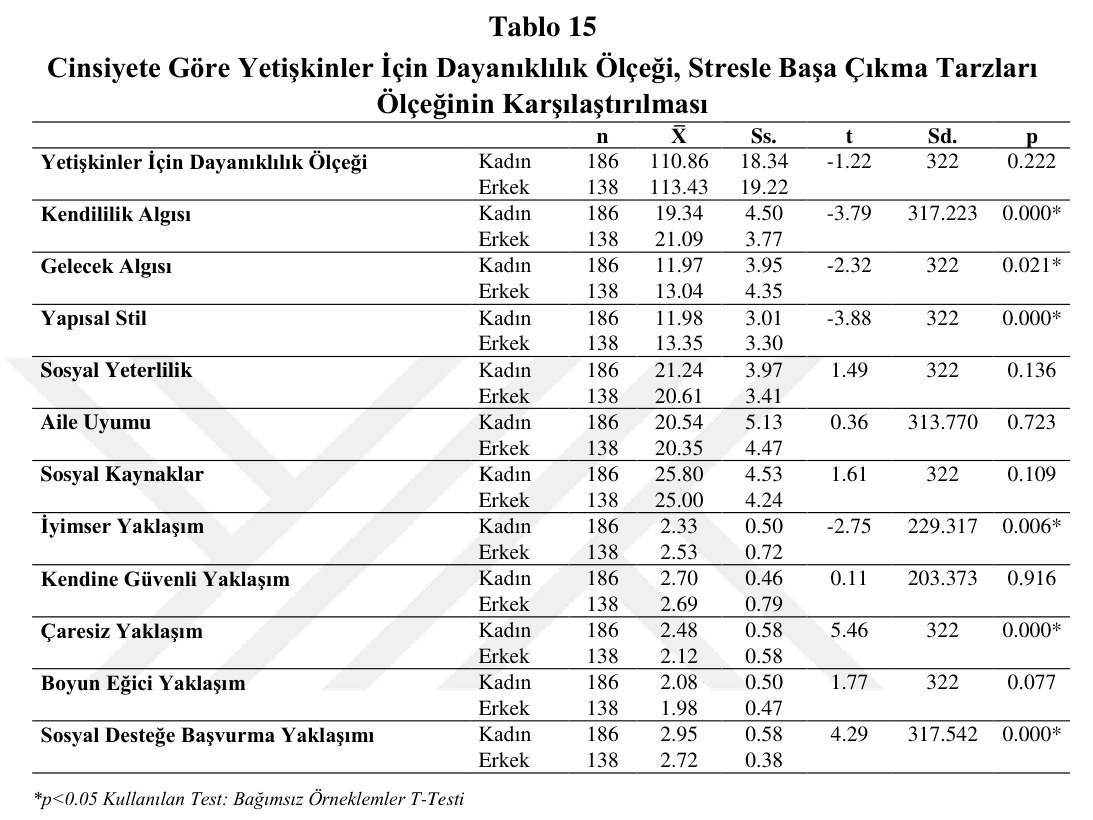
It was determined that the scores on the Resilience Scale for Adults, Social Competence, Family Cohesion, Social Resources, Self-Confident Approach and Submissive Approach subscales did not differ by gender (p>0.05).
According to the results of the examination of the scores obtained from the Helpless Approach subscale (t(322)=5.46, df=322, p<0.05) and the Seeking Social Support Approach subscale (t(317.542)=4.29, df=317.542, p<0.05) in terms of gender, it was found that women's scores were higher than men's.
According to the results of the examination of the scores obtained from the Perception of Self subscale (t(317.223)=-3.79, df=317.223, p<0.05), the Perception of Future subscale (t(322)=-2.32, df=322, p<0.05), the Structured Style subscale (t(322)=-3.88, df=322, p<0.05) and the Optimistic Approach subscale (t(229.317)=-2.75, df=229.317, p<0.05) in terms of gender, it was found that men's scores were higher than women's.
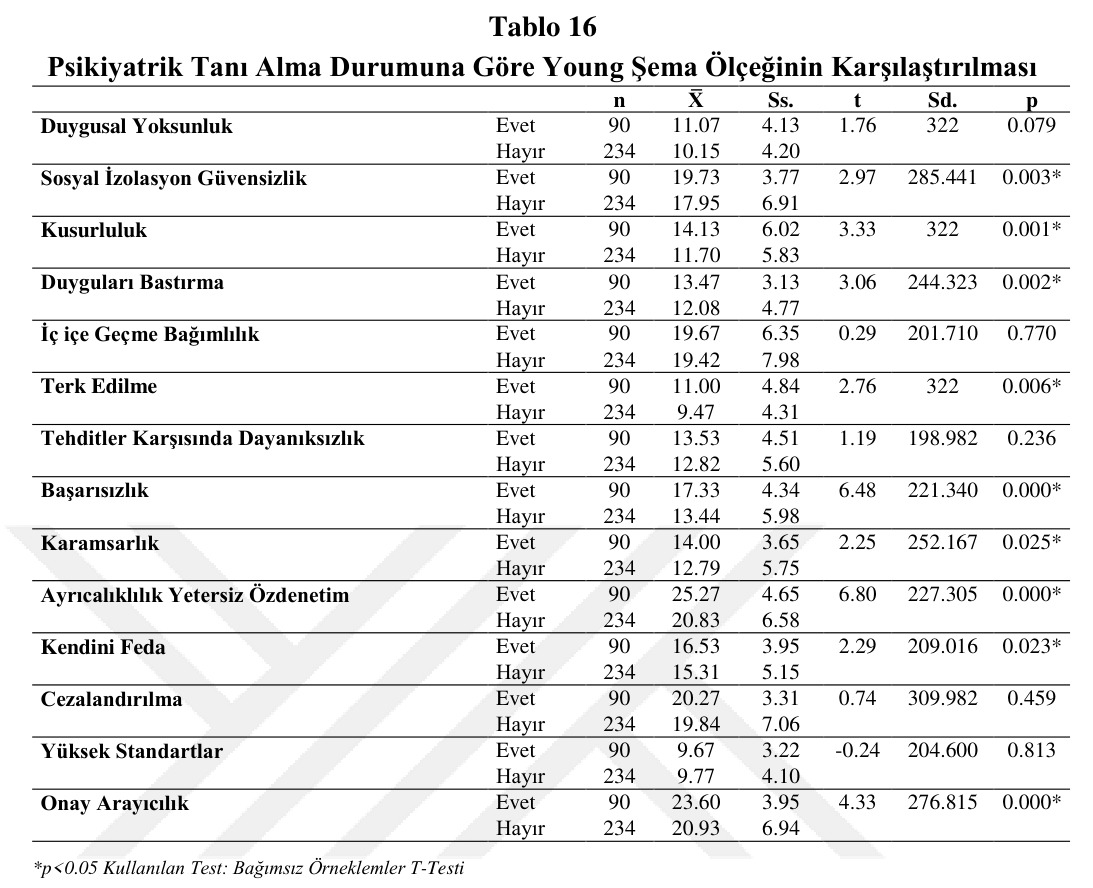
It was determined that the scores on the Emotional Deprivation, Enmeshment/Dependence, Vulnerability to Harm or Illness, Punitiveness and Unrelenting Standards subscales did not differ by psychiatric diagnosis status (p>0.05).
According to the results of the examination of the scores obtained from the Social Isolation/Mistrust subscale (t(285.441)=2.97, df=285.441, p<0.05), the Defectiveness subscale (t(322)=3.33, df=322, p<0.05), the Emotional Inhibition subscale (t(244.323)=3.06, df=244.323, p<0.05), the Abandonment subscale (t(322)=2.76, df=322, p<0.05), the Failure subscale (t(221.340)=6.48, df=221.340, p<0.05), the Pessimism subscale (t(252.167)=2.25, df=252.167, p<0.05), the Entitlement/Insufficient Self-Control subscale (t(227.305)=6.80, df=227.305, p<0.05), the Self-Sacrifice subscale (t(209.016)=2.29, df=209.016, p<0.05) and the Approval-Seeking subscale (t(276.815)=4.33, df=276.815, p<0.05) in terms of psychiatric diagnosis status, it was found that the scores of those who answered yes were higher than those of those who answered no.
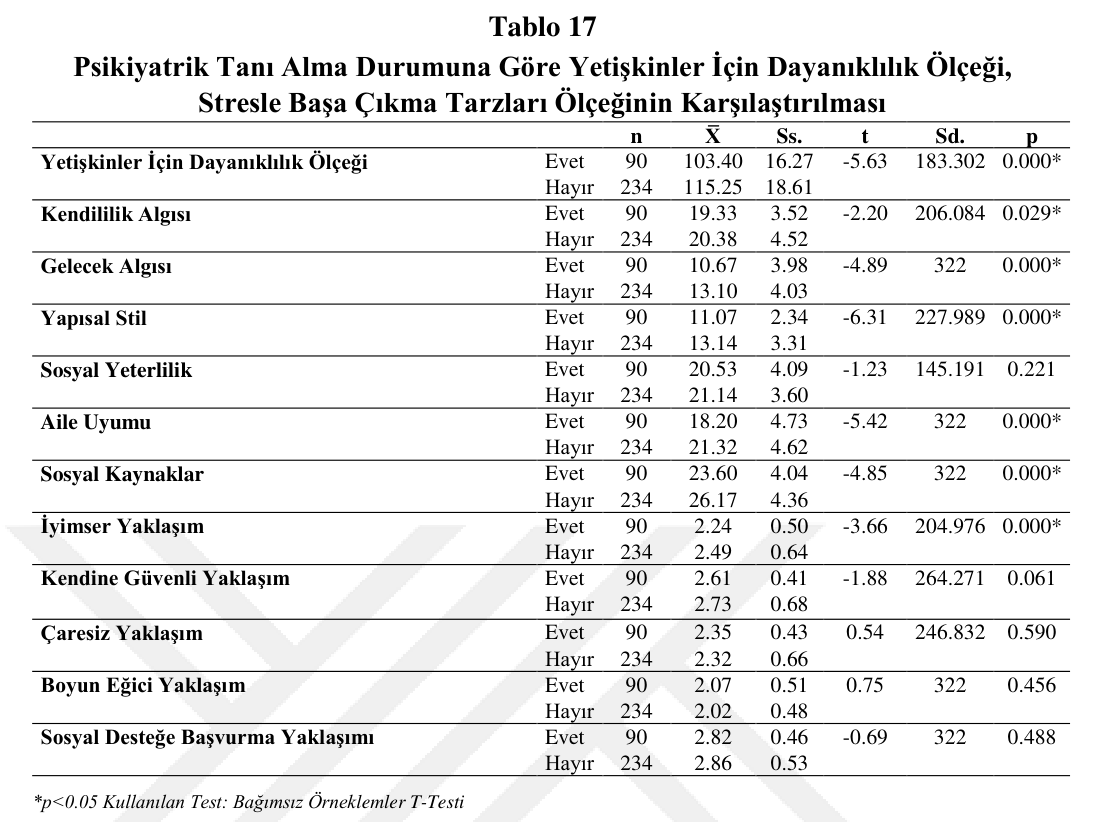
It was determined that the scores on the Social Competence, Self-Confident Approach, Helpless Approach, Submissive Approach and Seeking Social Support Approach subscales did not differ by psychiatric diagnosis status (p>0.05).
According to the results of the examination of the scores obtained from the Resilience Scale for Adults (t(183.302)=-5.63, df=183.302, p<0.05), the Perception of Self subscale (t(206.084)=-2.20, df=206.084, p<0.05), the Perception of Future subscale (t(322)=-4.89, df=322, p<0.05), the Structured Style subscale (t(227.989)=-6.31, df=227.989, p<0.05), the Family Cohesion subscale (t(322)=-5.42, df=322, p<0.05), the Social Resources subscale (t(322)=-4.85, df=322, p<0.05) and the Optimistic Approach subscale (t(204.976)=-3.66, df=204.976, p<0.05) in terms of psychiatric diagnosis status, it was found that the scores of those who answered no were higher than those of those who answered yes.
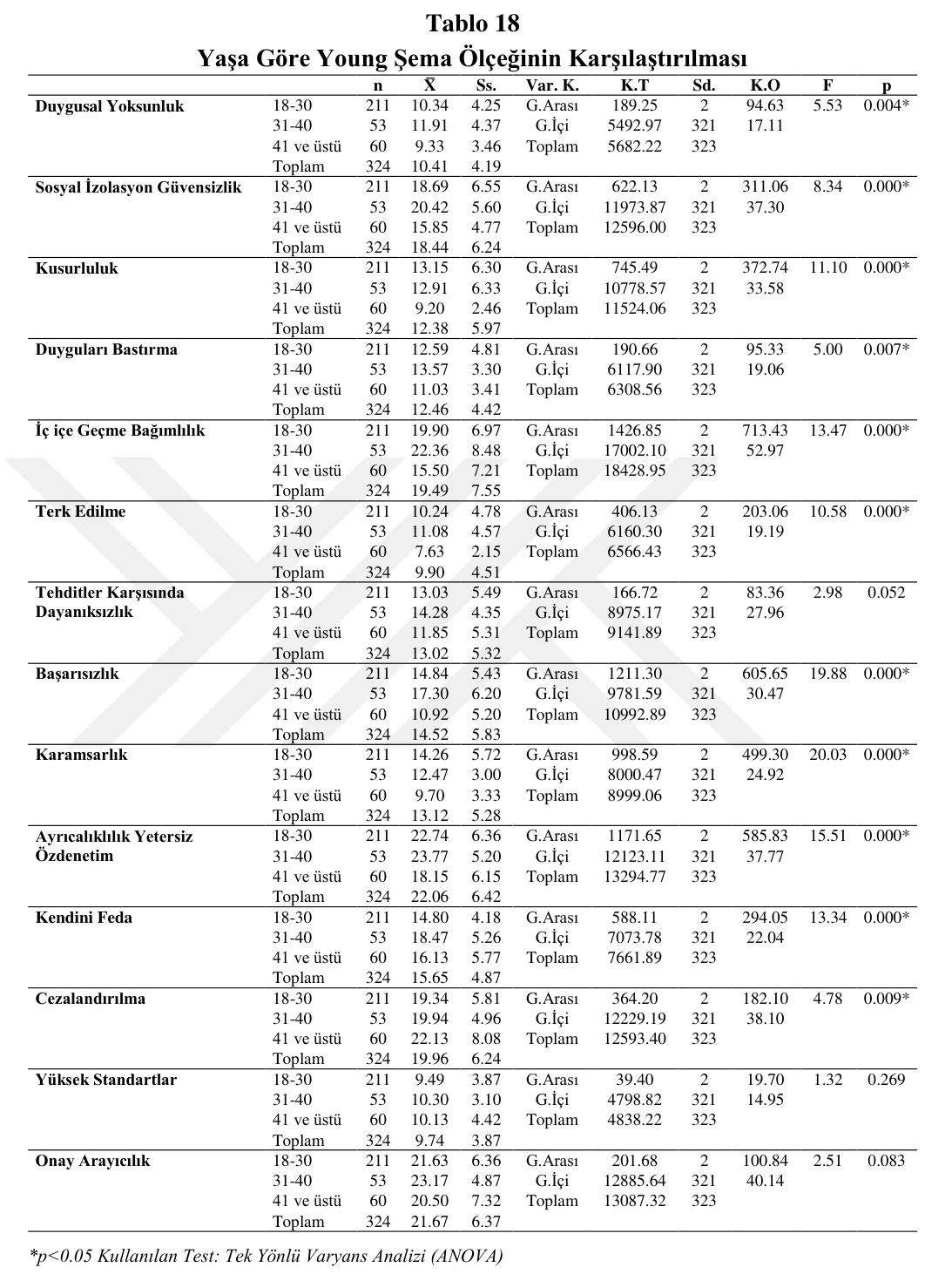
It was determined that the scores on the Vulnerability to Harm or Illness, Unrelenting Standards and Approval-Seeking subscales did not differ by age (p>0.05).
When the scores on the Emotional Deprivation subscale (F(2.321)=5.53, p<0.05) were compared by age, the means were found to differ significantly. According to Levene's test results, it was determined that the group variances were not homogeneously distributed (p>0.05). When the Tukey findings are examined, it is seen that those aged 31-40 had higher means than those aged 18-30 and those aged 41 and over.
When the scores on the Social Isolation/Mistrust subscale (F(2.321)=8.34, p<0.05) were compared by age, the means were found to differ significantly. According to Levene's test results, it was determined that the group variances were not homogeneously distributed (p>0.05). When the Tukey findings are examined, it is seen that those aged 18-30 and those aged 31-40 had higher means than those aged 41 and over.
When the scores on the Defectiveness subscale (F(2.321)=11.10, p<0.05) were compared by age, the means were found to differ significantly. According to Levene's test results, it was determined that the group variances were not homogeneously distributed (p>0.05). When the Games-Howell test findings are examined, it is seen that those aged 18-30 and those aged 31-40 had higher means than those aged 41 and over.
When the scores on the Emotional Inhibition subscale (F(2.321)=5.00, p<0.05) were compared by age, the means were found to differ significantly. According to Levene's test results, it was determined that the group variances were not homogeneously distributed (p>0.05). When the Games-Howell test findings are examined, it is seen that those aged 18-30 and those aged 31-40 had higher means than those aged 41 and over.
When the scores on the Enmeshment/Dependence subscale (F(2.321)=13.47, p<0.05) were compared by age, the means were found to differ significantly. According to Levene's test results, it was determined that the group variances were not homogeneously distributed (p>0.05). When the Games-Howell test findings are examined, it is seen that those aged 18-30 and those aged 31-40 had higher means than those aged 41 and over.
When the scores on the Abandonment subscale (F(2.321)=10.58, p<0.05) were compared by age, the means were found to differ significantly. According to Levene's test results, it was determined that the group variances were not homogeneously distributed (p>0.05). When the Games-Howell test findings are examined, it is seen that those aged 18-30 and those aged 31-40 had higher means than those aged 41 and over.
When the scores on the Failure subscale (F(2.321)=19.88, p<0.05) were compared by age, the means were found to differ significantly. According to Levene's test results, it was determined that the group variances were not homogeneously distributed (p>0.05). When the Games-Howell test findings are examined, it is seen that those aged 18-30 and those aged 31-40 had higher means than those aged 41 and over, and that those aged 31-40 had higher means than individuals aged 18-30.
When the scores on the Pessimism subscale (F(2.321)=20.03, p<0.05) were compared by age, the means were found to differ significantly. According to Levene's test results, it was determined that the group variances were not homogeneously distributed (p>0.05). When the Games-Howell test findings are examined, it is seen that those aged 18-30 and those aged 31-40 had higher means than those aged 41 and over, and that those aged 18-30 had higher means than individuals aged 31-40.
When the scores on the Entitlement/Insufficient Self-Control subscale (F(2.321)=15.51, p<0.05) were compared by age, the means were found to differ significantly. According to Levene's test results, it was determined that the group variances were not homogeneously distributed (p>0.05). When the Tukey findings are examined, it is seen that those aged 18-30 and those aged 31-40 had higher means than those aged 41 and over.
When the scores on the Self-Sacrifice subscale (F(2.321)=13.34, p<0.05) were compared by age, the means were found to differ significantly. According to Levene's test results, it was determined that the group variances were not homogeneously distributed (p>0.05). When the Games-Howell test findings are examined, it is seen that those aged 31-40 had higher means than individuals aged 18-30.
When the scores on the Punitiveness subscale (F(2.321)=4.78, p<0.05) were compared by age, the means were found to differ significantly. According to Levene's test results, it was determined that the group variances were not homogeneously distributed (p>0.05). When the Games-Howell test findings are examined, it is seen that those aged 41 and over had higher means than individuals aged 18-30.
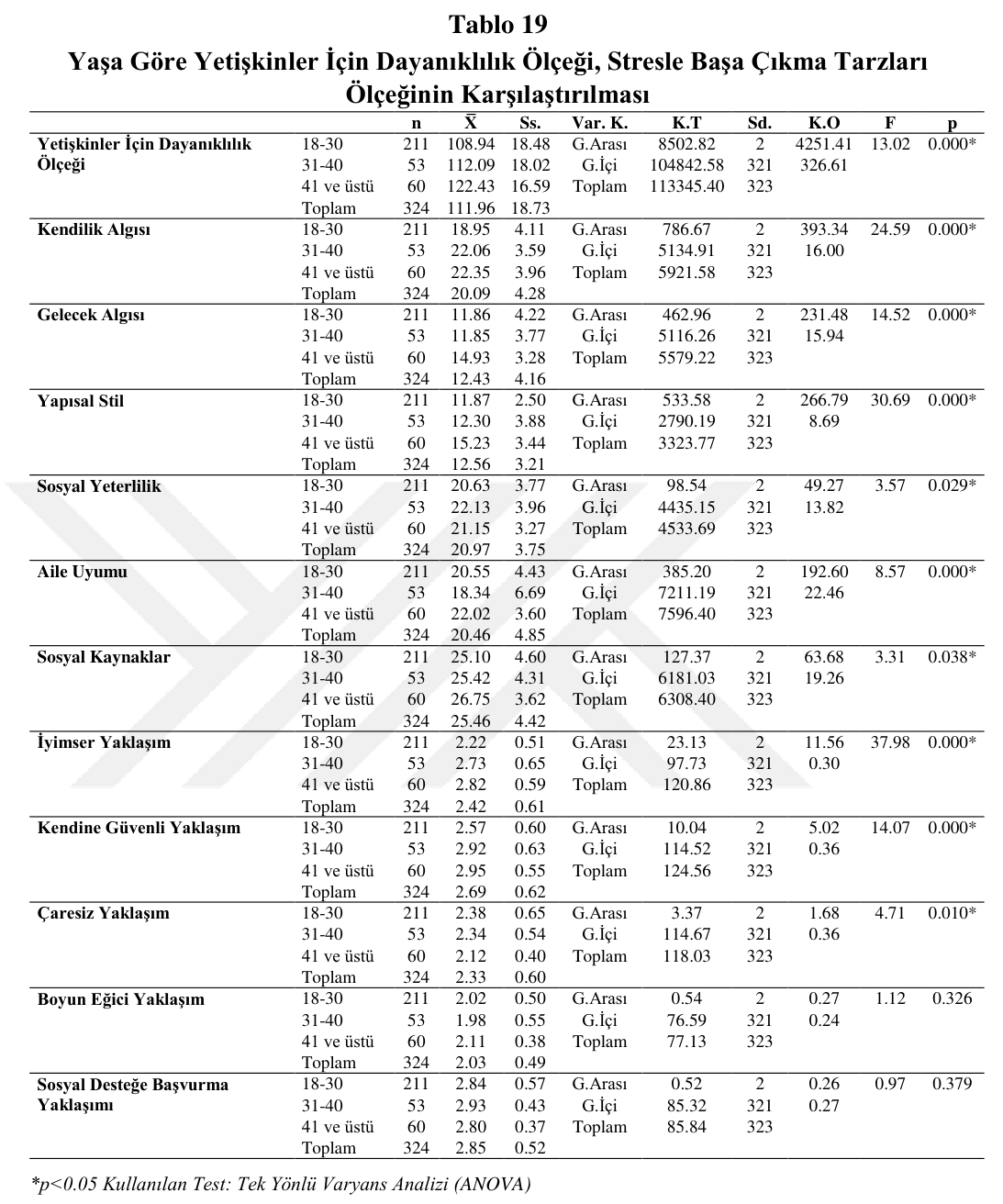
It was determined that the scores on the Submissive Approach and Seeking Social Support Approach subscales did not differ by age (p>0.05).
When the scores on the Resilience Scale for Adults (F(2.321)=13.02, p<0.05) were compared by age, the means were found to differ significantly. According to Levene's test results, it was determined that the group variances were not homogeneously distributed (p>0.05). When the Games-Howell test findings are examined, it is seen that those aged 41 and over had higher means than individuals aged 18-30 and 31-40.
When the scores on the Perception of Self subscale (F(2.321)=24.59, p<0.05) were compared by age, the means were found to differ significantly. According to Levene's test results, it was determined that the group variances were not homogeneously distributed (p>0.05). When the Tukey findings are examined, it is seen that those aged 31-40 and those aged 41 and over had higher means than individuals aged 18-30.
When the scores on the Perception of Future subscale (F(2.321)=14.52, p<0.05) were compared by age, the means were found to differ significantly. According to Levene's test results, it was determined that the group variances were not homogeneously distributed (p>0.05). When the Games-Howell test findings are examined, it is seen that those aged 41 and over had higher means than individuals aged 18-30 and 31-40.
When the scores on the Structured Style subscale (F(2.321)=30.69, p<0.05) were compared by age, the means were found to differ significantly. According to Levene's test results, it was determined that the group variances were not homogeneously distributed (p>0.05). When the Games-Howell test findings are examined, it is seen that those aged 41 and over had higher means than individuals aged 18-30 and 31-40.
When the scores on the Social Competence subscale (F(2.321)=3.57, p<0.05) were compared by age, the means were found to differ significantly. According to Levene's test results, it was determined that the group variances were not homogeneously distributed (p>0.05). When the Tukey findings are examined, it is seen that those aged 31-40 had higher means than individuals aged 18-30.
When the scores on the Family Cohesion subscale (F(2.321)=8.57, p<0.05) were compared by age, the means were found to differ significantly. According to Levene's test results, it was determined that the group variances were not homogeneously distributed (p>0.05). When the Games-Howell test findings are examined, it is seen that those aged 41 and over had higher means than individuals aged 18-30 and 31-40.
When the scores on the Social Resources subscale (F(2.321)=3.31, p<0.05) were compared by age, the means were found to differ significantly. According to Levene's test results, it was determined that the group variances were not homogeneously distributed (p>0.05). When the Games-Howell test findings are examined, it is seen that those aged 41 and over had higher means than individuals aged 18-30.
When the scores on the Optimistic Approach subscale (F(2.321)=37.98, p<0.05) were compared by age, the means were found to differ significantly. According to Levene's test results, it was determined that the group variances were not homogeneously distributed (p>0.05). When the Games-Howell test findings are examined, it is seen that those aged 31-40 and those aged 41 and over had higher means than individuals aged 18-30.
When the scores on the Self-Confident Approach subscale (F(2.321)=14.07, p<0.05) were compared by age, the means were found to differ significantly. According to Levene's test results, it was determined that the group variances were not homogeneously distributed (p>0.05). When the Tukey findings are examined, it is seen that those aged 31-40 and those aged 41 and over had higher means than individuals aged 18-30.
When the scores on the Helpless Approach subscale (F(2.321)=4.71, p<0.05) were compared by age, the means were found to differ significantly. According to Levene's test results, it was determined that the group variances were not homogeneously distributed (p>0.05). When the Games-Howell test findings are examined, it is seen that those aged 18-30 and those aged 31-40 had higher means than those aged 41 and over.
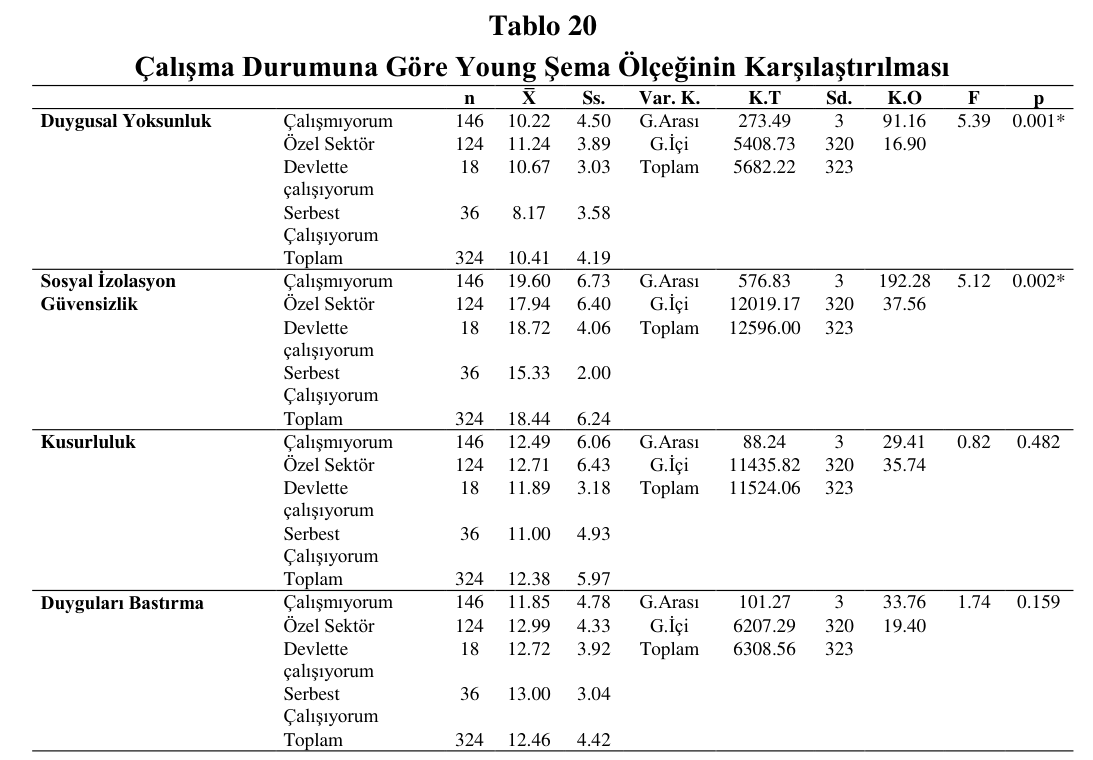
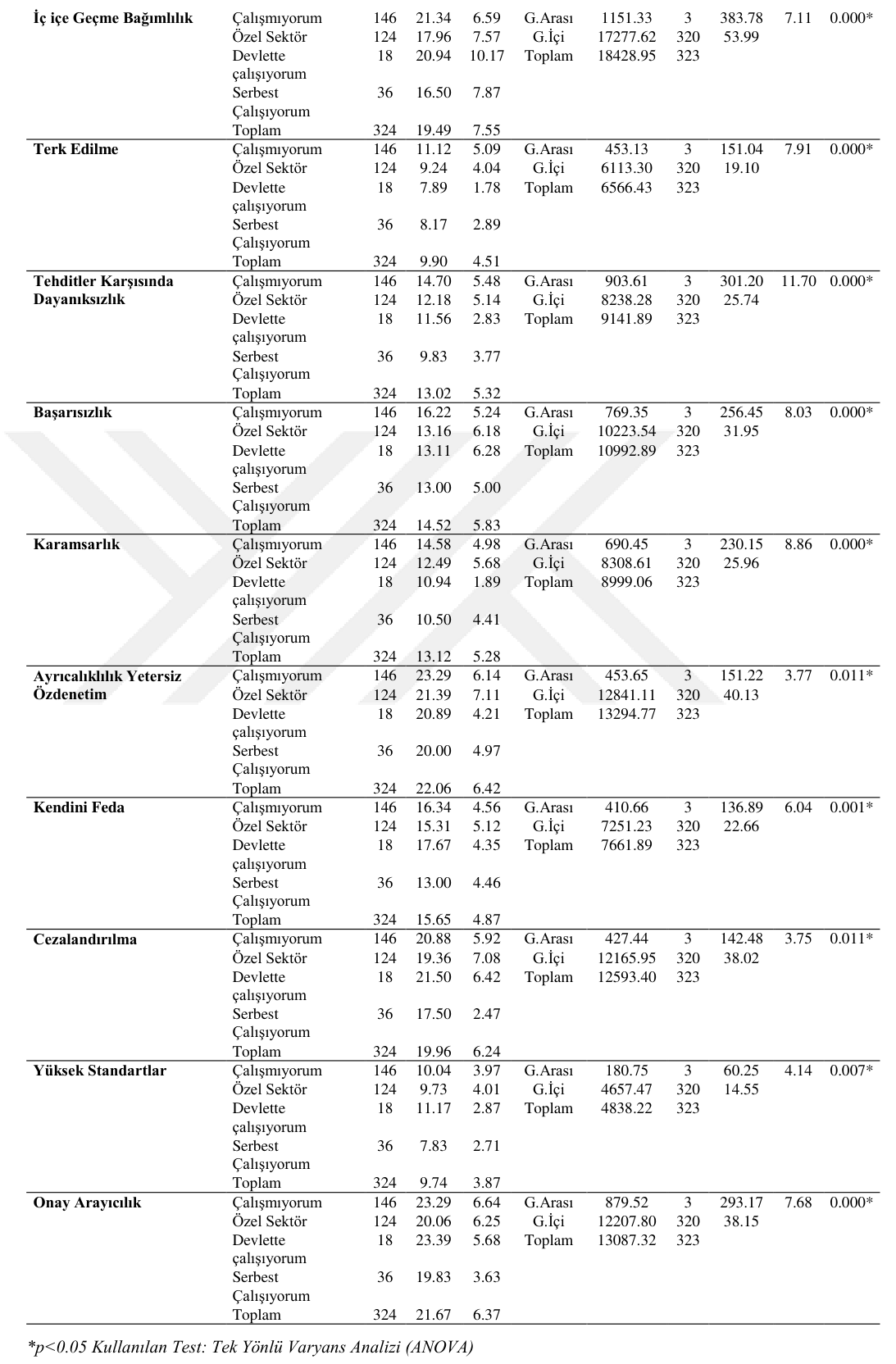
It was determined that the scores on the Defectiveness and Emotional Inhibition subscales did not differ by employment status (p>0.05).
When the scores on the Emotional Deprivation subscale (F(3.320)=5.39, p<0.05) were compared by employment status, the means were found to differ significantly. According to Levene's test results, it was determined that the group variances were not homogeneously distributed (p>0.05). When the Tukey findings are examined, it was found that those who were not working and those working in the private sector had higher means than the self-employed.
When the scores on the Social Isolation/Mistrust subscale (F(3.320)=5.12, p<0.05) were compared by employment status, the means were found to differ significantly. According to Levene's test results, it was determined that the group variances were not homogeneously distributed (p>0.05). When the Games-Howell test findings are examined, it was found that those who were not working had higher means than the self-employed.
When the scores on the Enmeshment/Dependence subscale (F(3.320)=7.11, p<0.05) were compared by employment status, the means were found to differ significantly. According to Levene's test results, it was determined that the group variances were not homogeneously distributed (p>0.05). When the Tukey findings are examined, it was found that those who were not working had higher means than the self-employed and those working in the private sector.
When the scores on the Abandonment subscale (F(3.320)=7.91, p<0.05) were compared by employment status, the means were found to differ significantly. According to Levene's test results, it was determined that the group variances were not homogeneously distributed (p>0.05). When the Games-Howell test findings are examined, it was found that those who were not working had higher means than those working in the public sector, the private sector and the self-employed.
When the scores on the Vulnerability to Harm or Illness subscale (F(3.320)=11.70, p<0.05) were compared by employment status, the means were found to differ significantly. According to Levene's test results, it was determined that the group variances were not homogeneously distributed (p>0.05). When the Tukey findings are examined, it was found that those who were not working had higher means than the self-employed and those working in the private sector.
When the scores on the Failure subscale (F(3.320)=8.03, p<0.05) were compared by employment status, the means were found to differ significantly. According to Levene's test results, it was determined that the group variances were not homogeneously distributed (p>0.05). When the Games-Howell test findings are examined, it was found that those who were not working had higher means than those working in the private sector and the self-employed.
When the scores on the Pessimism subscale (F(3.320)=8.86, p<0.05) were compared by employment status, the means were found to differ significantly. According to Levene's test results, it was determined that the group variances were not homogeneously distributed (p>0.05). When the Games-Howell test findings are examined, it was found that those who were not working had higher means than those working in the public sector, the private sector and the self-employed.
When the scores on the Entitlement/Insufficient Self-Control subscale (F(3.320)=3.77, p<0.05) were compared by employment status, the means were found to differ significantly. According to Levene's test results, it was determined that the group variances were not homogeneously distributed (p>0.05). When the Games-Howell test findings are examined, it was found that those who were not working had higher means than the self-employed.
When the scores on the Self-Sacrifice subscale (F(3.320)=6.04, p<0.05) were compared by employment status, the means were found to differ significantly. According to Levene's test results, it was determined that the group variances were not homogeneously distributed (p>0.05). When the Tukey findings are examined, it was found that those who were not working and those working in the public sector had higher means than the self-employed.
When the scores on the Punitiveness subscale (F(3.320)=3.75, p<0.05) were compared by employment status, the means were found to differ significantly. According to Levene's test results, it was determined that the group variances were not homogeneously distributed (p>0.05). When the Games-Howell test findings are examined, it was found that those who were not working had higher means than the self-employed.
When the scores on the Unrelenting Standards subscale (F(3.320)=4.14, p<0.05) were compared by employment status, the means were found to differ significantly. According to Levene's test results, it was determined that the group variances were not homogeneously distributed (p>0.05). When the Games-Howell test findings are examined, it was found that those who were not working and those working in the public sector and the private sector had higher means than the self-employed.
When the scores on the Approval-Seeking subscale (F(3.320)=7.68, p<0.05) were compared by employment status, the means were found to differ significantly. According to Levene's test results, it was determined that the group variances were not homogeneously distributed (p>0.05). When the Games-Howell test findings are examined, it was found that those who were not working had higher means than those working in the private sector and the self-employed.
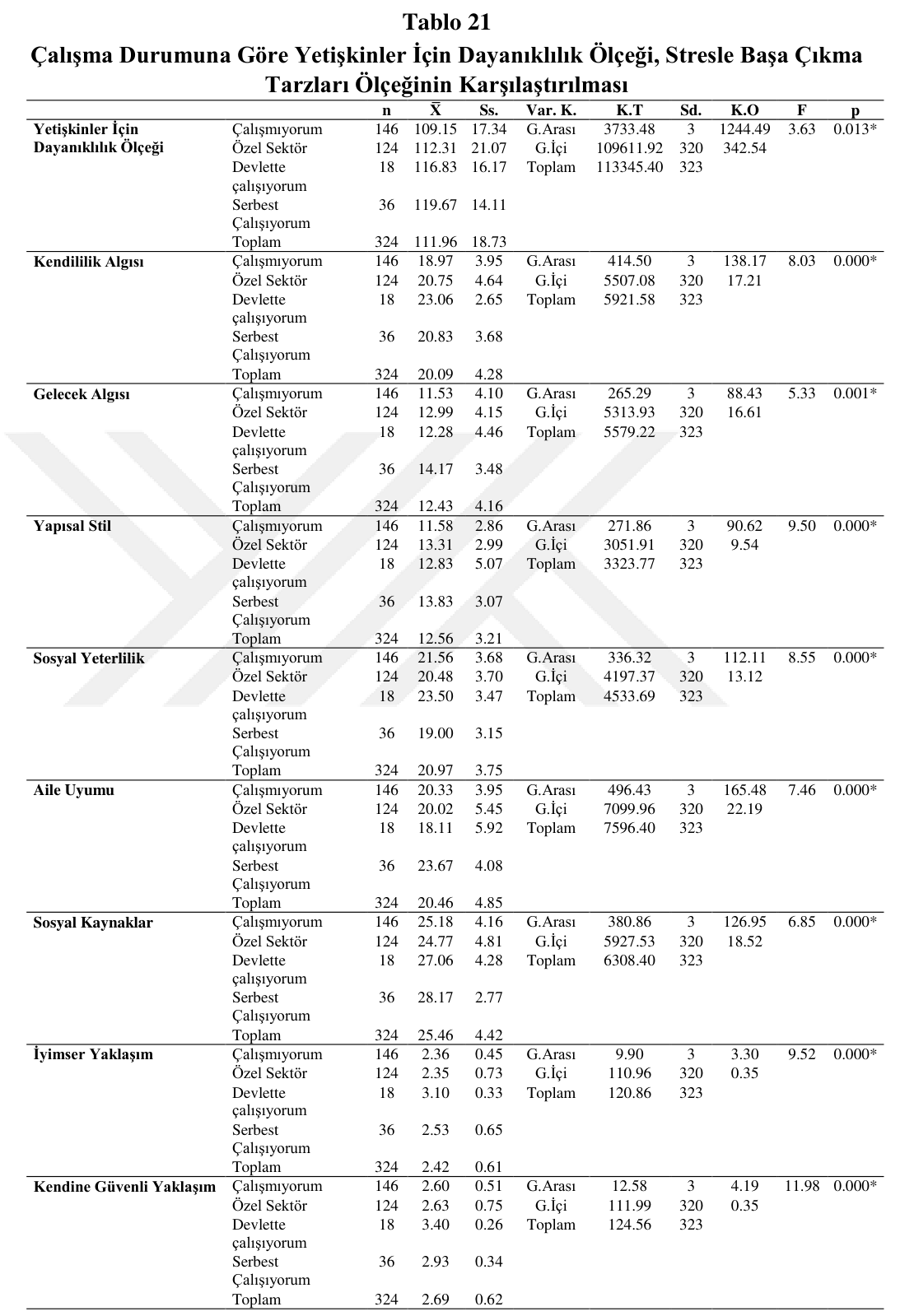
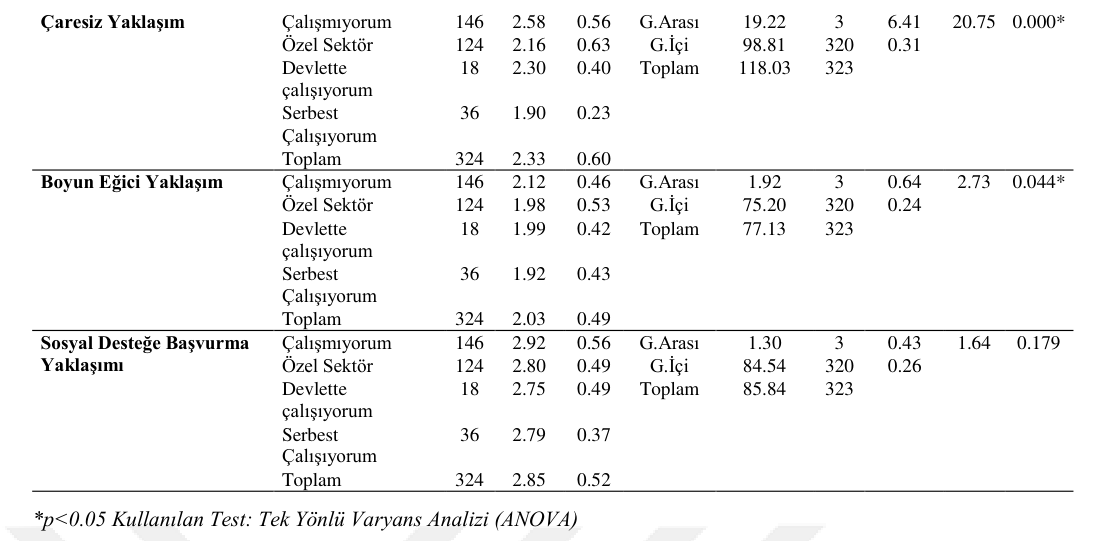
It was determined that the scores on the Seeking Social Support Approach subscale did not differ by employment status (p>0.05).
When the scores on the Resilience Scale for Adults (F(3.320)=3.63, p<0.05) were compared by employment status, the means were found to differ significantly. According to Levene's test results, it was determined that the group variances were not homogeneously distributed (p>0.05). When the Tukey findings are examined, it was found that the self-employed had higher means than those who were not working.
When the scores on the Perception of Self subscale (F(3.320)=8.03, p<0.05) were compared by employment status, the means were found to differ significantly. According to Levene's test results, it was determined that the group variances were not homogeneously distributed (p>0.05). When the Games-Howell test findings are examined, it was found that those working in the public sector, the private sector and the self-employed had higher means than those who were not working, and that those working in public institutions had higher means than those working in the private sector.
When the scores on the Perception of Future subscale (F(3.320)=5.33, p<0.05) were compared by employment status, the means were found to differ significantly. According to Levene's test results, it was determined that the group variances were not homogeneously distributed (p>0.05). When the Tukey findings are examined, it was found that those working in the private sector and the self-employed had higher means than those who were not working.
When the scores on the Structured Style subscale (F(3.320)=9.50, p<0.05) were compared by employment status, the means were found to differ significantly. According to Levene's test results, it was determined that the group variances were not homogeneously distributed (p>0.05). When the Games-Howell test findings are examined, it was found that those working in the private sector and the self-employed had higher means than those who were not working.
When the scores on the Social Competence subscale (F(3.320)=8.55, p<0.05) were compared by employment status, the means were found to differ significantly. According to Levene's test results, it was determined that the group variances were not homogeneously distributed (p>0.05). When the Tukey findings are examined, it was found that those who were not working had higher means than the self-employed, and that those working in public institutions had higher means than those working in the private sector and the self-employed.
When the scores on the Family Cohesion subscale (F(3.320)=7.46, p<0.05) were compared by employment status, the means were found to differ significantly. According to Levene's test results, it was determined that the group variances were not homogeneously distributed (p>0.05). When the Tukey findings are examined, it was found that the self-employed had higher means than those working in the public sector, those working in the private sector and those who were not working.
When the scores on the Social Resources subscale (F(3.320)=6.85, p<0.05) were compared by employment status, the means were found to differ significantly. According to Levene's test results, it was determined that the group variances were not homogeneously distributed (p>0.05). When the Games-Howell test findings are examined, it was found that the self-employed had higher means than those working in the private sector and those who were not working.
When the scores on the Optimistic Approach subscale (F(3.320)=9.52, p<0.05) were compared by employment status, the means were found to differ significantly. According to Levene's test results, it was determined that the group variances were not homogeneously distributed (p>0.05). When the Games-Howell test findings are examined, it was found that those working in public institutions had higher means than those working in the private sector, the self-employed and those who were not working.
When the scores on the Self-Confident Approach subscale (F(3.320)=11.98, p<0.05) were compared by employment status, the means were found to differ significantly. According to Levene's test results, it was determined that the group variances were not homogeneously distributed (p>0.05). When the Games-Howell test findings are examined, it was found that those working in public institutions had higher means than those working in the private sector, the self-employed and those who were not working, and that the self-employed had higher means than those working in the private sector and those who were not working.
When the scores on the Helpless Approach subscale (F(3.320)=20.75, p<0.05) were compared by employment status, the means were found to differ significantly. According to Levene's test results, it was determined that the group variances were not homogeneously distributed (p>0.05). When the Games-Howell test findings are examined, it was found that those who were not working had higher means than those working in the public sector, the private sector and the self-employed, and that those working in the private sector and public institutions had higher means than the self-employed.
When the scores on the Submissive Approach subscale (F(3.320)=2.73, p<0.05) were compared by employment status, the means were found to differ significantly. According to Levene's test results, it was determined that the group variances were not homogeneously distributed (p>0.05). When the Tukey findings are examined, it was found that those who were not working had higher means than those working in the public sector, the private sector and the self-employed.
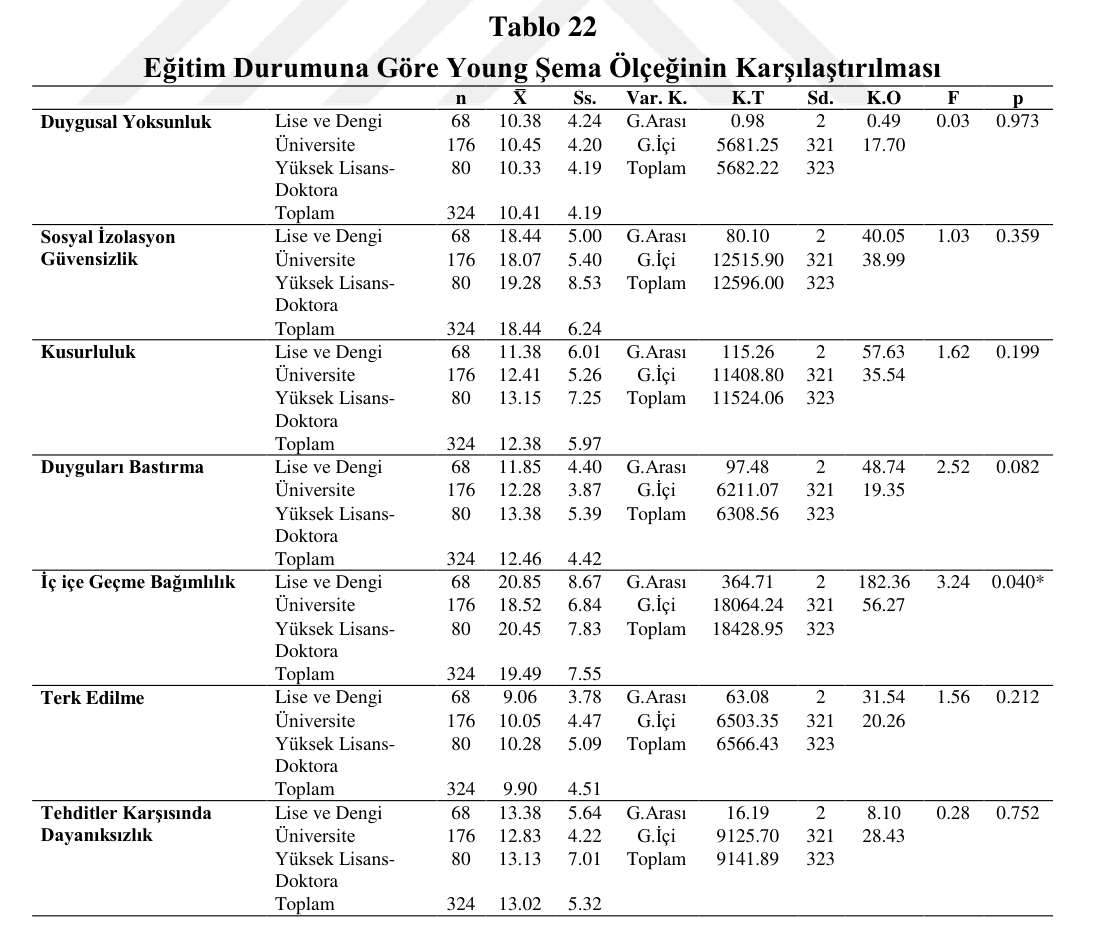
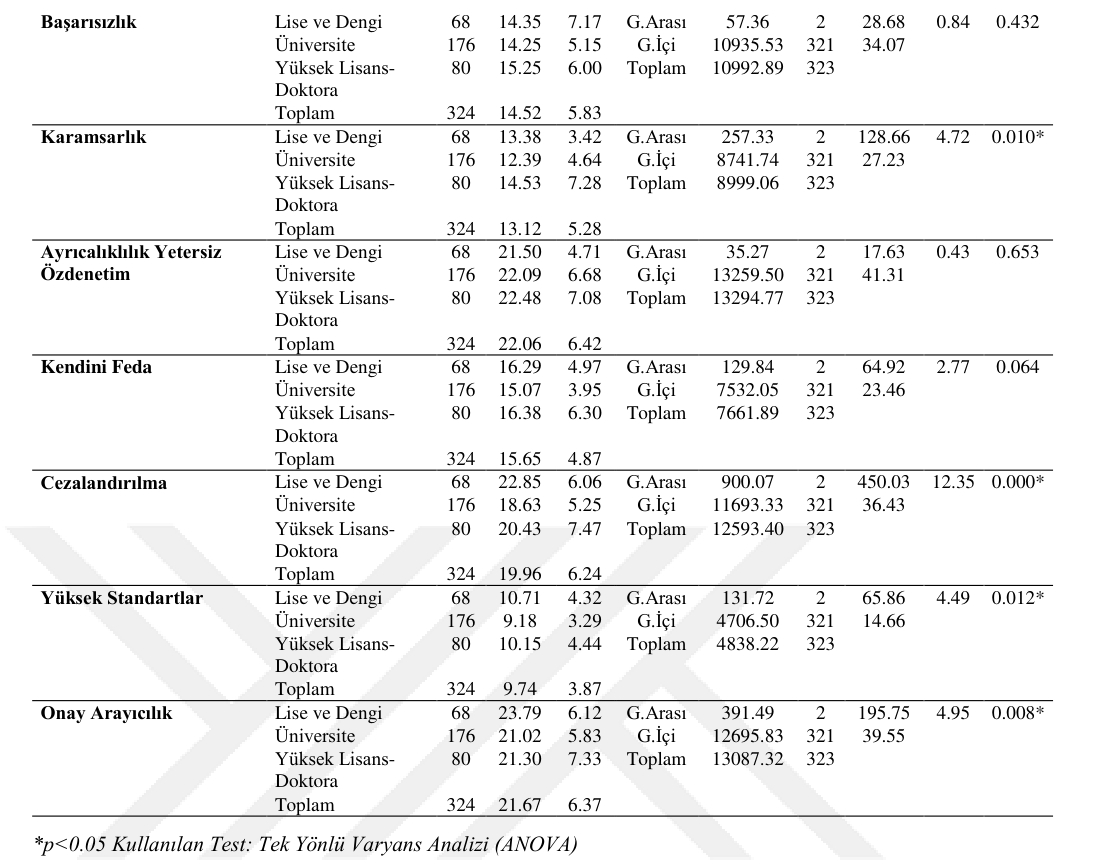
It was determined that the scores on the Emotional Deprivation, Social Isolation/Mistrust, Defectiveness, Emotional Inhibition, Abandonment, Vulnerability to Harm or Illness, Failure, Entitlement/Insufficient Self-Control and Self-Sacrifice subscales did not differ by employment status (p>0.05).
When the scores on the Enmeshment/Dependence subscale (F(2.321)=3.24, p<0.05) were compared by educational level, the means were found to differ significantly. According to Levene's test results, it was determined that the group variances were not homogeneously distributed (p>0.05). When the Games-Howell test findings are examined, it was found that high school graduates or equivalent had higher means than university graduates.
When the scores on the Pessimism subscale (F(2.321)=4.72, p<0.05) were compared by educational level, the means were found to differ significantly. According to Levene's test results, it was determined that the group variances were not homogeneously distributed (p>0.05). When the Games-Howell test findings are examined, it was found that those with a master's/doctoral degree had higher means than university graduates.
When the scores on the Punitiveness subscale (F(2.321)=12.35, p<0.05) were compared by educational level, the means were found to differ significantly. According to Levene's test results, it was determined that the group variances were not homogeneously distributed (p>0.05). When the Games-Howell test findings are examined, it was found that high school graduates or equivalent had higher means than university graduates.
When the scores on the Unrelenting Standards subscale (F(2.321)=4.49, p<0.05) were compared by educational level, the means were found to differ significantly. According to Levene's test results, it was determined that the group variances were not homogeneously distributed (p>0.05). When the Games-Howell test findings are examined, it was found that high school graduates or equivalent had higher means than university graduates.
When the scores on the Approval-Seeking subscale (F(2.321)=4.95, p<0.05) were compared by educational level, the means were found to differ significantly. According to Levene's test results, it was determined that the group variances were not homogeneously distributed (p>0.05). When the Games-Howell test findings are examined, it was found that high school graduates or equivalent had higher means than university graduates.
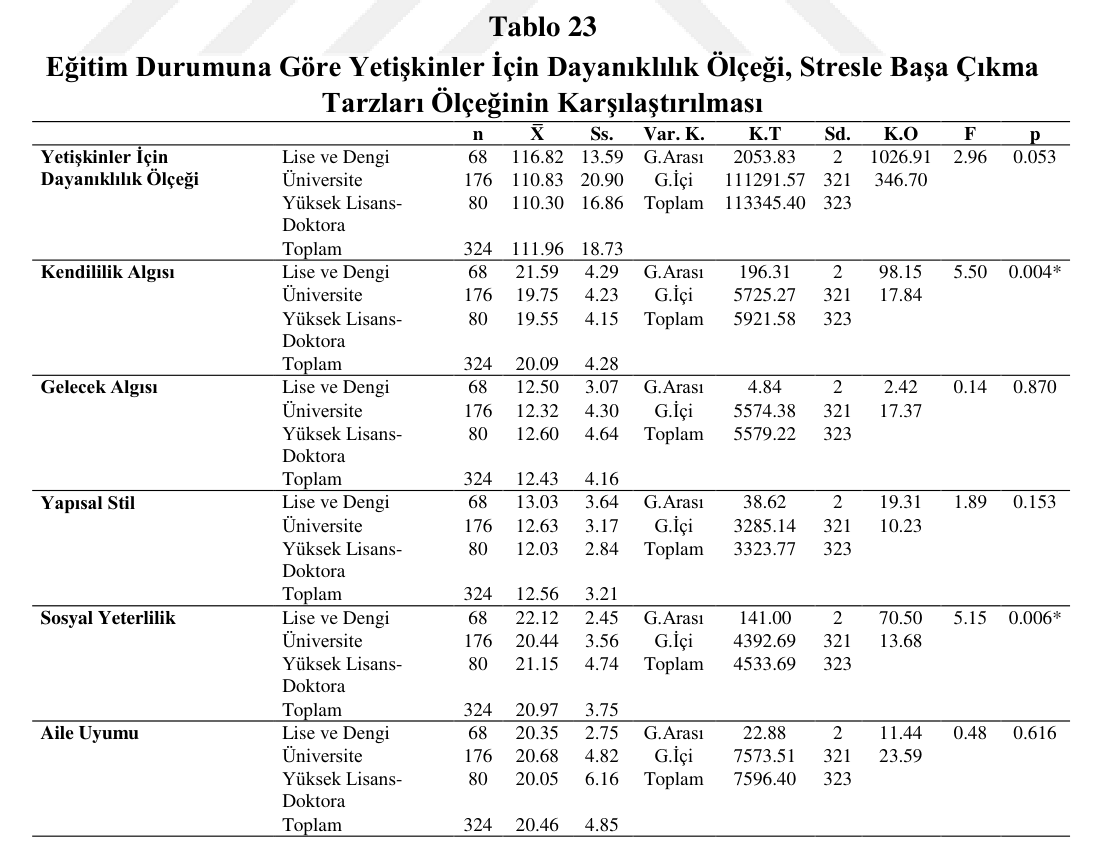
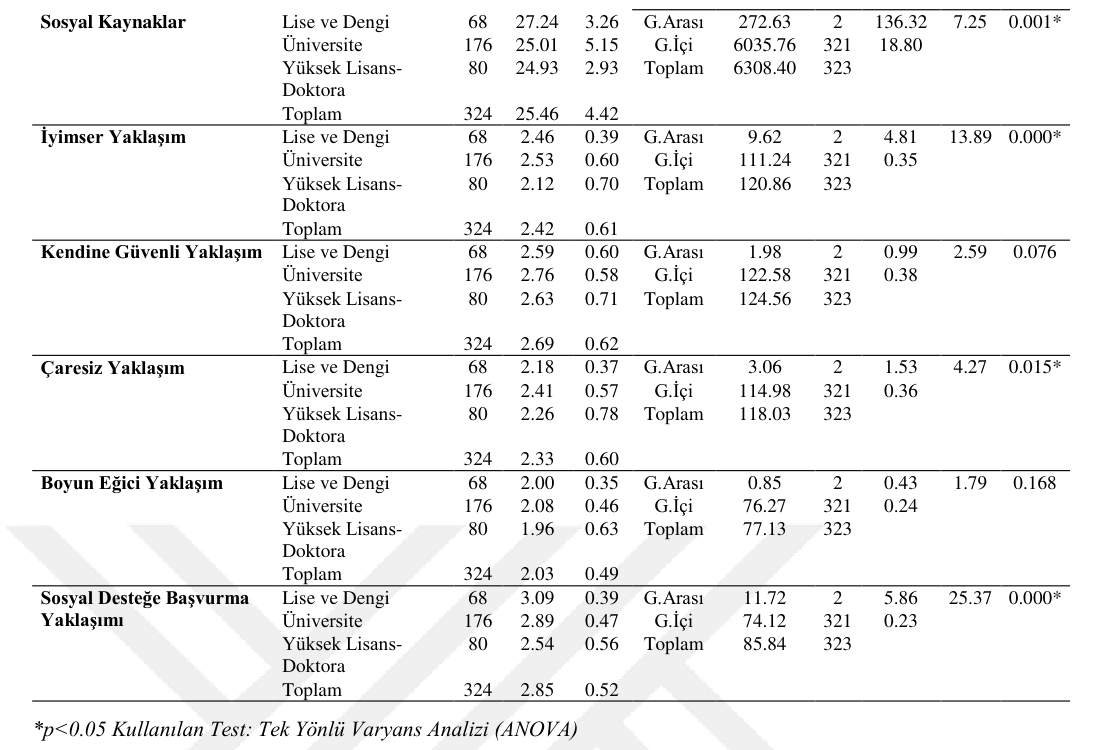
It was determined that the scores on the Resilience Scale for Adults, Perception of Future, Structured Style, Family Cohesion, Self-Confident Approach and Submissive Approach subscales did not differ by educational level (p>0.05).
When the scores on the Perception of Self subscale (F(2.321)=5.50, p<0.05) were compared by educational level, the means were found to differ significantly. According to Levene's test results, it was determined that the group variances were not homogeneously distributed (p>0.05). When the Tukey findings are examined, it was found that high school graduates or equivalent had higher means than university graduates and those with a master's/doctoral degree.
When the scores on the Social Competence subscale (F(2.321)=5.15, p<0.05) were compared by educational level, the means were found to differ significantly. According to Levene's test results, it was determined that the group variances were not homogeneously distributed (p>0.05). When the Games-Howell test findings are examined, it was found that high school graduates or equivalent had higher means than university graduates.
When the scores on the Social Resources subscale (F(2.321)=7.25, p<0.05) were compared by educational level, the means were found to differ significantly. According to Levene's test results, it was determined that the group variances were not homogeneously distributed (p>0.05). When the Games-Howell test findings are examined, it was found that high school graduates or equivalent had higher means than university graduates and those with a master's/doctoral degree.
When the scores on the Optimistic Approach subscale (F(2.321)=13.89, p<0.05) were compared by educational level, the means were found to differ significantly. According to Levene's test results, it was determined that the group variances were not homogeneously distributed (p>0.05). When the Games-Howell test findings are examined, it was found that university graduates and high school graduates or equivalent had higher means than those with a master's/doctoral degree.
When the scores on the Helpless Approach subscale (F(2.321)=4.27, p<0.05) were compared by educational level, the means were found to differ significantly. According to Levene's test results, it was determined that the group variances were not homogeneously distributed (p>0.05). When the Games-Howell test findings are examined, it was found that university graduates had higher means than high school graduates or equivalent.
When the scores on the Seeking Social Support Approach subscale (F(2.321)=25.37, p<0.05) were compared by educational level, the means were found to differ significantly. According to Levene's test results, it was determined that the group variances were not homogeneously distributed (p>0.05). When the Games-Howell test findings are examined, it was found that high school graduates or equivalent had higher means than university graduates and those with a master's/doctoral degree, and that university graduates had higher means than those with a master's/doctoral degree.
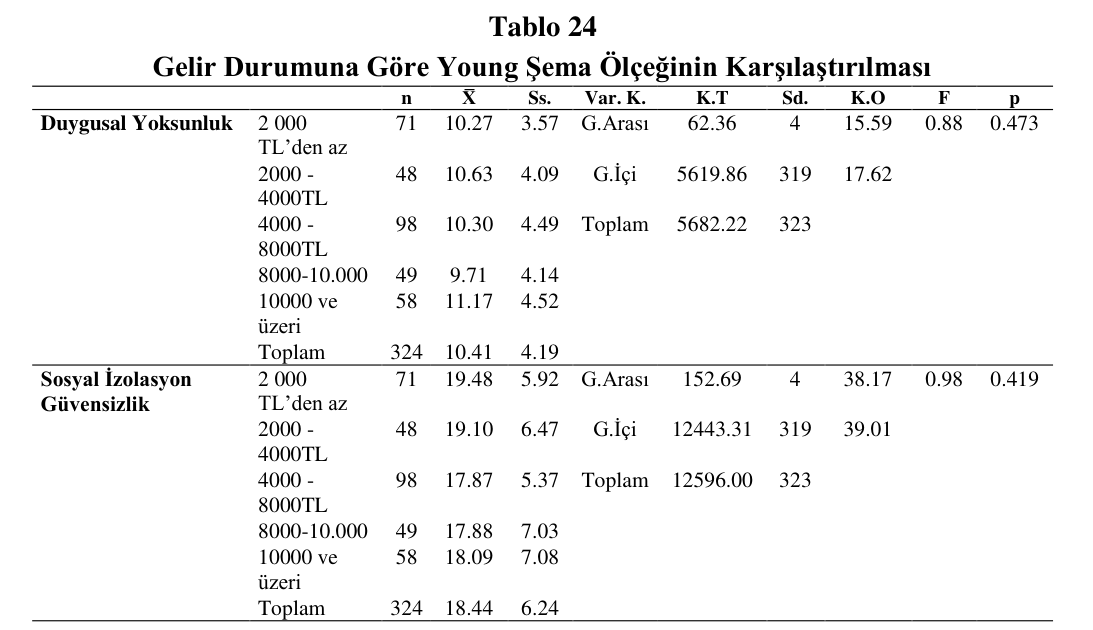
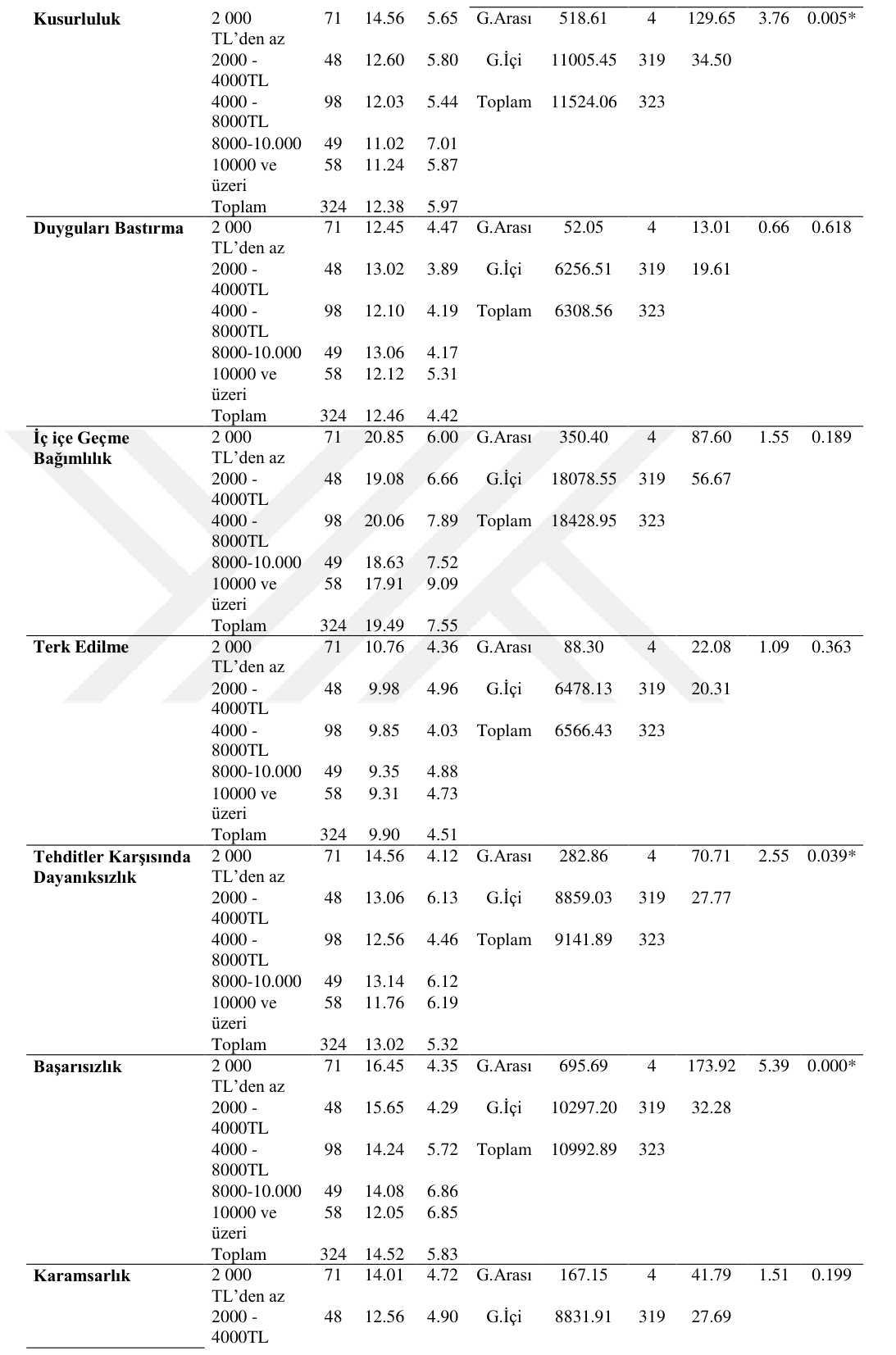
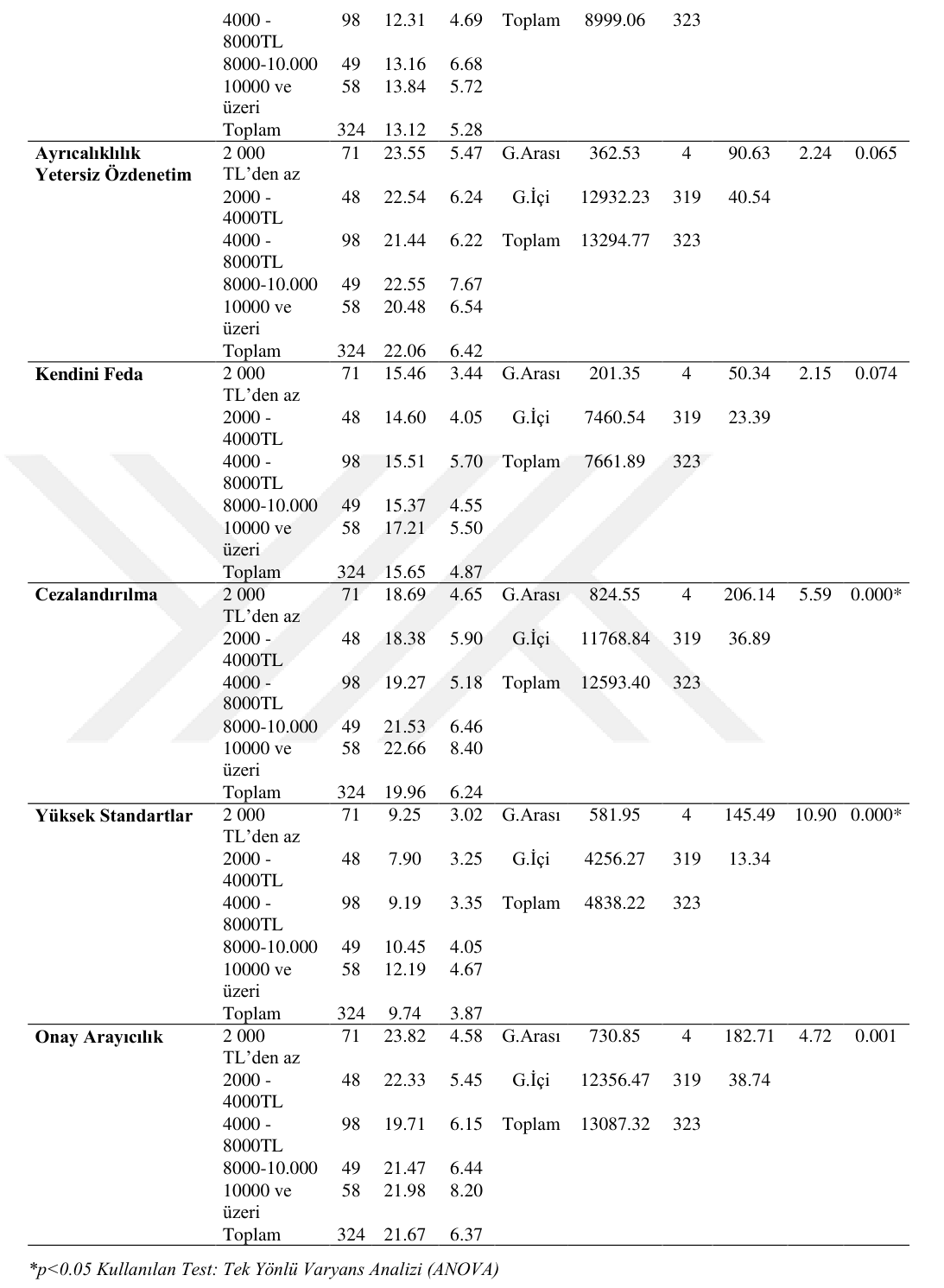
It was determined that the scores on the Emotional Deprivation, Social Isolation/Mistrust, Emotional Inhibition, Enmeshment/Dependence, Abandonment, Pessimism, Entitlement/Insufficient Self-Control, Self-Sacrifice and Approval-Seeking subscales did not differ by income level (p>0.05).
When the scores on the Defectiveness subscale (F(4.319)=3.76, p<0.05) were compared by income level, the means were found to differ significantly. According to Levene's test results, it was determined that the group variances were not homogeneously distributed (p>0.05). When the Tukey findings are examined, it was found that those with an income of less than 2000 TL had higher means than those with an income of 2000-4000 TL, 4000-8000 TL, 8000-10000 TL, and 10000 TL and above.
When the scores on the Vulnerability to Harm or Illness subscale (F(4.319)=2.55, p<0.05) were compared by income level, the means were found to differ significantly. According to Levene's test results, it was determined that the group variances were not homogeneously distributed (p>0.05). When the Games-Howell test findings are examined, it was found that those with an income of less than 2000 TL had higher means than those with an income of 4000-8000 TL and 10000 TL and above.
When the scores on the Failure subscale (F(4.319)=5.39, p<0.05) were compared by income level, the means were found to differ significantly. According to Levene's test results, it was determined that the group variances were not homogeneously distributed (p>0.05). When the Games-Howell test findings are examined, it was found that those with an income of less than 2000 TL had higher means than those with an income of 4000-8000 TL and 10000 TL and above, and that those with an income between 2000- 4000 TL had higher means than those with an income of 10000 TL and above.
When the scores on the Punitiveness subscale (F(4.319)=5.59, p<0.05) were compared by income level, the means were found to differ significantly. According to Levene's test results, it was determined that the group variances were not homogeneously distributed (p>0.05). When the Games-Howell test findings are examined, it was found that those with an income of 10000 TL and above had higher means than those with an income of less than 2000 TL and those with an income between 2000-4000 TL.
When the scores on the Unrelenting Standards subscale (F(4.319)=10.90, p<0.05) were compared by income level, the means were found to differ significantly. According to Levene's test results, it was determined that the group variances were not homogeneously distributed (p>0.05). When the Games-Howell test findings are examined, it was found that those with an income of 10000 TL and above had higher means than those with an income between 2000- 4000 TL, between 4000-8000 TL and less than 2000 TL.
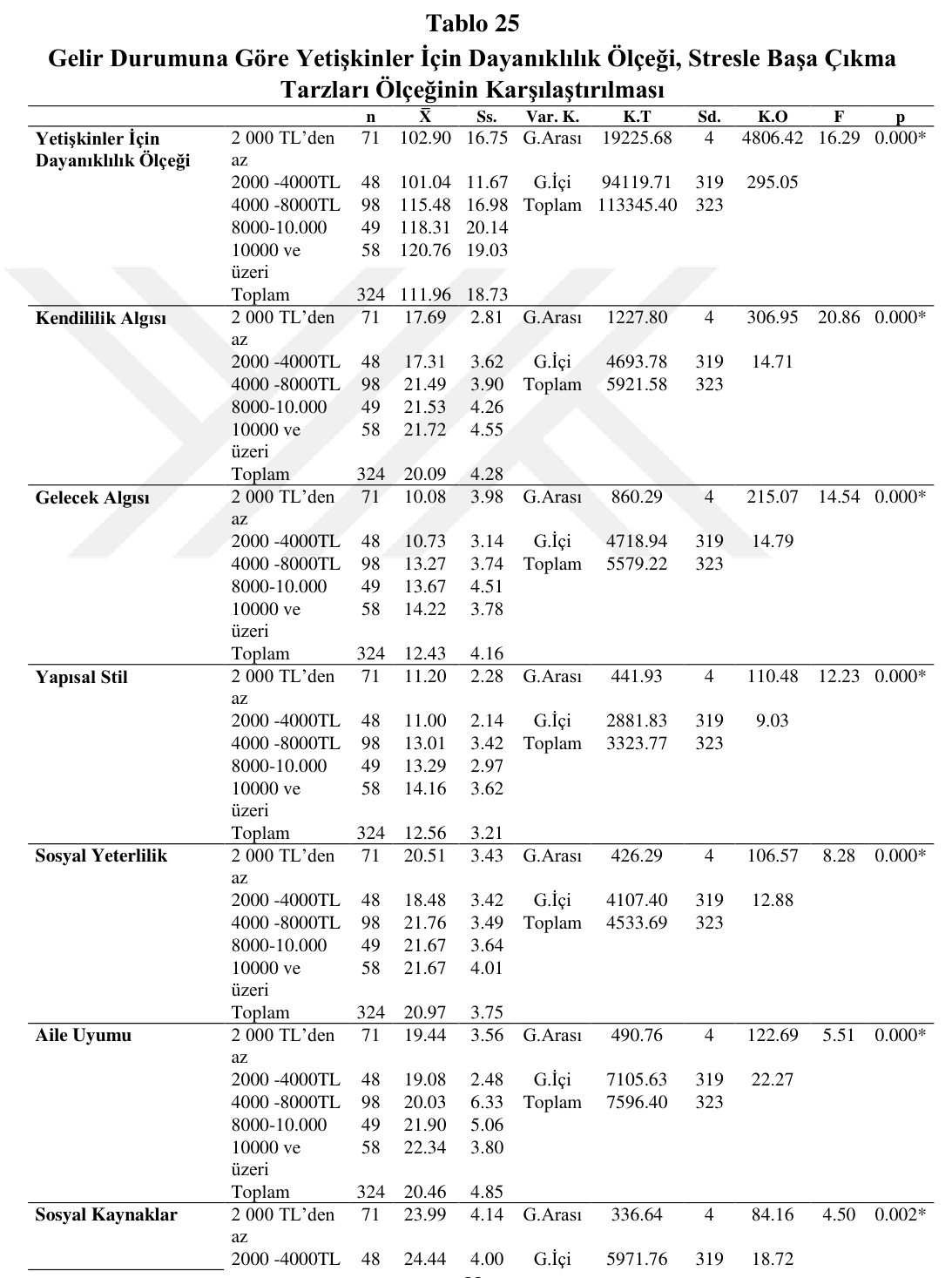
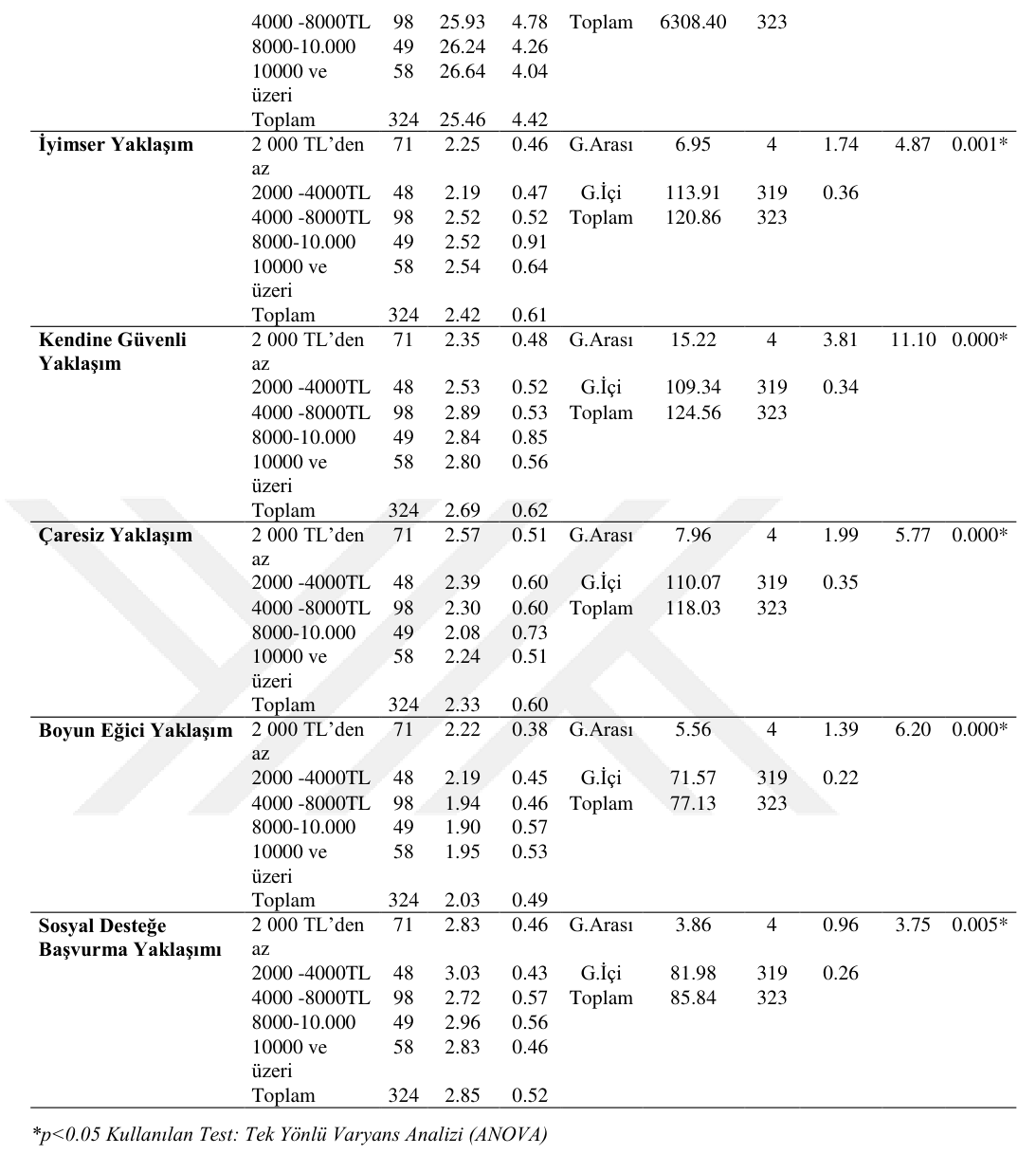
When the scores on the Resilience Scale for Adults (F(4.319)=16.29, p<0.05) were compared by income level, the means were found to differ significantly. According to Levene's test results, it was determined that the group variances were not homogeneously distributed (p>0.05). When the Games-Howell test findings are examined, it was found that those with an income between 4000-8000 TL, between 8000-1000 TL and of 10000 TL and above had higher means than those with an income between 2000-4000 TL and less than 2000 TL.
When the scores on the Perception of Self subscale (F(4.319)=20.86, p<0.05) were compared by income level, the means were found to differ significantly. According to Levene's test results, it was determined that the group variances were not homogeneously distributed (p>0.05). When the Games-Howell test findings are examined, it was found that those with an income between 4000-8000 TL, between 8000-1000 TL and of 10000 TL and above had higher means than those with an income between 2000-4000 TL and less than 2000 TL.
When the scores on the Perception of Future subscale (F(4.319)=14.54, p<0.05) were compared by income level, the means were found to differ significantly. According to Levene's test results, it was determined that the group variances were not homogeneously distributed (p>0.05). When the Games-Howell test findings are examined, it was found that those with an income between 4000-8000 TL, between 8000-1000 TL and of 10000 TL and above had higher means than those with an income between 2000-4000 TL and less than 2000 TL.
When the scores on the Structured Style subscale (F(4.319)=12.23, p<0.05) were compared by income level, the means were found to differ significantly. According to Levene's test results, it was determined that the group variances were not homogeneously distributed (p>0.05). When the Games-Howell test findings are examined, it was found that those with an income between 4000-8000 TL, between 8000-1000 TL and of 10000 TL and above had higher means than those with an income between 2000-4000 TL and less than 2000 TL.
When the scores on the Social Competence subscale (F(4.319)=8.28, p<0.05) were compared by income level, the means were found to differ significantly. According to Levene's test results, it was determined that the group variances were not homogeneously distributed (p>0.05). When the Tukey findings are examined, it was found that those with an income of less than 2000 TL, between 4000-8000 TL, between 8000-1000 TL and of 10000 TL and above had higher means than those with an income between 2000-4000 TL.
When the scores on the Family Cohesion subscale (F(4.319)=5.51, p<0.05) were compared by income level, the means were found to differ significantly. According to Levene's test results, it was determined that the group variances were not homogeneously distributed (p>0.05). When the Games-Howell test findings are examined, it was found that those with an income between 8000-1000 TL and of 10000 TL and above had higher means than those with an income between 2000-4000 TL and less than 2000 TL.
When the scores on the Social Resources subscale (F(4.319)=4.50, p<0.05) were compared by income level, the means were found to differ significantly. According to Levene's test results, it was determined that the group variances were not homogeneously distributed (p>0.05). When the Games-Howell test findings are examined, it was found that those with an income between 4000-8000 TL, between 8000-1000 TL and of 10000 TL and above had higher means than those with an income between 2000-4000 TL and less than 2000 TL.
When the scores on the Optimistic Approach subscale (F(4.319)=4.87, p<0.05) were compared by income level, the means were found to differ significantly. According to Levene's test results, it was determined that the group variances were not homogeneously distributed (p>0.05). When the Games-Howell test findings are examined, it was found that those with an income between 4000-8000 TL, between 8000-1000 TL and of 10000 TL and above had higher means than those with an income between 2000-4000 TL and less than 2000 TL.
When the scores on the Self-Confident Approach subscale (F(4.319)=11.10, p<0.05) were compared by income level, the means were found to differ significantly. According to Levene's test results, it was determined that the group variances were not homogeneously distributed (p>0.05). When the Games-Howell test findings are examined, it was found that those with an income between 4000-8000 TL, between 8000-1000 TL and of 10000 TL and above had higher means than those with an income between 2000-4000 TL and less than 2000 TL, and that those with an income between 4000-8000 TL had higher means than those with an income between 2000-4000 TL.
When the scores on the Helpless Approach subscale (F(4.319)=5.77, p<0.05) were compared by income level, the means were found to differ significantly. According to Levene's test results, it was determined that the group variances were not homogeneously distributed (p>0.05). When the Tukey findings are examined, it was found that those with an income of less than 2000 TL had higher means than those with an income between 2000-4000 TL, between 4000-8000 TL, between 8000-10000 TL and of 10000 TL and above.
When the scores on the Submissive Approach subscale (F(4.319)=6.20, p<0.05) were compared by income level, the means were found to differ significantly. According to Levene's test results, it was determined that the group variances were not homogeneously distributed (p>0.05). When the Games-Howell test findings are examined, it was found that those with an income of less than 2000 TL had higher means than those with an income between 2000-4000 TL, 4000-8000 TL, 8000-10000 TL and 10000 TL and above, and that those with an income between 2000-4000 TL had higher means than those with an income between 4000-8000 TL.
When the scores on the Seeking Social Support Approach subscale (F(4.319)=3.75, p<0.05) were compared by income level, the means were found to differ significantly. According to Levene's test results, it was determined that the group variances were not homogeneously distributed (p>0.05). When the Tukey findings are examined, it was found that those with an income between 2000-4000 TL had higher means than those with an income between 4000-8000 TL.
CONCLUSIONS AND RECOMMENDATIONS
The aim of this study is to examine the relationship between early maladaptive schemas and psychological resilience and coping skills in adults. In addition, the predictive effect of early maladaptive schemas on psychological resilience and coping skills was examined. Finally, the relationships between the socio-demographic characteristics of the adult participants, such as gender, income level, educational level and employment status, and the study variables, namely early maladaptive schemas, psychological resilience and coping skills, were analysed. In this section, the results are evaluated in line with the literature.
According to the results of the study, a negative relationship was found between the optimistic approach, self-confident approach and seeking social support approach, which are subdimensions of the stress coping scale, and early maladaptive schemas. A positive relationship was found between the other subdimensions, the helpless approach and the submissive approach, and early maladaptive schemas. According to the results, as early maladaptive schema scores increase, functional stress coping skills decrease. It is seen that there are studies in the relevant literature that support these results.
In the study by Thimm (2013), it was found that the subjugation and social isolation/alienation schemas were related to stress coping styles. In another study, Mayda (2020) found that the impaired autonomy and performance domain and the disconnection and rejection domain schemas showed a negative relationship with the self-confident approach, the optimistic approach and the seeking social support approach. In line with these results, the study by Babajani, Akrami, and Farahani (2014) reported that the approval-seeking, abandonment/instability, emotional deprivation, social isolation/alienation, subjugation and defectiveness schemas were positively related to emotion-focused coping styles. In the same study, the schemas mentioned showed a negative relationship with problem-focused coping styles. These findings showed that the impaired limits, disconnection and other-directedness schema domains negatively affect stress coping skills. Individuals with the disconnection schema domain have, in their early experiences, a cold family structure that does not meet their needs (Salimoğlu, 2015). Those with the impaired autonomy schema domain have, in their early experiences, enmeshed and overprotective family structures. These individuals have difficulty acting autonomously and have low self-confidence. Individuals in the unrelenting standards schema domain come from family structures that give approval and love conditionally. They were rewarded to the extent that they did what their families wanted, and encountered pressure when they stepped outside this (Roediger, 2015). It can be thought that these individuals were not allowed to act as autonomous individuals in their early experiences and that their needs were not met appropriately, and that for this reason they could not develop active/problem-focused coping styles. Since, from childhood onwards, they did not have environments in which to experience appropriate stress coping styles, it is thought that they have had to use passive/emotion-focused stress coping styles. Individuals with the other-directedness schema domain come from family structures in which acceptance and respect are conditional. For this reason, they put the needs of others ahead of their own and have problems becoming autonomous (Arntz & Jacob, 2016). Finally, individuals with the impaired limits schema domain grew up in family structures in which there was no limit-setting and guidance. For this reason, they have difficulty reaching goals and taking responsibility (Young et al., 2019). It can be said that individuals with early maladaptive schema domains display inappropriate, negative stress coping styles both because they come from family structures that do not provide support and guidance and because they have not learned to be autonomous and to take responsibility.
Within the scope of the study, the relationship between early maladaptive schemas and psychological resilience in adults was examined. According to the results obtained, a positive relationship was seen between the early maladaptive schemas of defectiveness, emotional deprivation, emotional inhibition and social isolation and the total and subdimensions of psychological resilience. The findings of the study show that the early maladaptive schemas mentioned lower adults' levels of psychological resilience. According to the regression analyses, failure, defectiveness and emotional deprivation were found to have a negative effect on psychological resilience. According to the findings, the variable that most explains psychological resilience was found to be failure. It can be said that these results are consistent with the relevant literature.
In their study examining the relationship between positive schemas and psychological resilience, Keyfitz and colleagues (2012) found that positive schemas significantly predicted psychological resilience. In their studies with suicide-prone individuals, Johnson and colleagues (2010) found that people's positive schemas were a source of psychological resilience. Katalin and Ildiko (2013) investigated the relationship between early maladaptive schemas and psychological resilience in a clinical sample diagnosed with emotional dependence and borderline personality disorder, and found as a result that emotionally dependent individuals had low psychological resilience in addition to having early maladaptive schemas, compared with those with borderline personality disorder. Aydın (2020) found a significant relationship between early maladaptive schemas and well-being in university students. In this respect, the findings are seen to be consistent in a study in which a negative relationship with psychological resilience was hypothesised. It is seen that, together with studies in the literature that examine psychological symptoms and early maladaptive schemas, the relationship of psychological resilience, which reflects a positive quality and is addressed in this study, with early maladaptive schemas yields a consistent result. Early maladaptive schemas are characteristics shaped by early experiences that can influence people's views about themselves and the external environment. In this respect, it is thought that maladaptive schemas may bring with them a predisposition to psychopathology in people (e.g. depression, anxiety and somatisation disorder) and interpersonal problems, and may be a risk factor in this respect (Shojaanti et al., 2019).
The study examined the results of how early maladaptive schema scores differ by gender. The findings show that women scored higher on the social isolation, enmeshment, abandonment, vulnerability to harm or illness, failure, pessimism, insufficient self-control, punitiveness and approval-seeking schemas. On the other hand, men were found to score higher on the emotional deprivation schema. Ryan and colleagues reported in their study that women's scores on the pessimism schema were higher (Ryan et al., 2012). Similarly, Irkörücü found that women scored higher than men on the emotional deprivation, social isolation and defectiveness schemas (Irkörücü, 2016). In another study, Gök (2012) found that women's scores in the disconnection and rejection domain were significantly higher than men's scores (Gök, 2012). In another study, too, male participants were found to score higher in the disconnection and rejection domain. It is stated that the reason for these results is sociocultural factors (Ünal, 2014). These results support the results of our study. It can be said that the results are related to gender roles and the child-rearing attitudes tied to these roles.
According to the results on psychological resilience and stress coping skills by gender, women scored higher than men on the helpless approach and seeking social support subdimensions. On the other hand, men were found to score higher than women on the perception of self, perception of future, structured style and optimistic approach subdimensions. It is seen that there are many studies in the literature that support the findings of this study (Açıkgöz, 2016; Dolbier, Smith, & Steinhardt, 2007; Elder, Nguyen, & Erdoğan, 2015; Sarwar, Inamullah, Khan, & Anwar, 2010). In a study by Al Masood and colleagues (2016), it was reported that women are more sensitive to stress than men and that this may be a factor that can negatively affect psychological resilience. It can be thought that the result obtained is related to the participants having traditional family structures in the society we live in, to men therefore being able to take more responsibility within the family and consequently having to cope more with stressful life events, and to their problem-solving skills developing further as a result.
According to the results on early maladaptive schema scores by the participants' psychiatric diagnosis status, individuals who had received a psychiatric diagnosis were found to have higher scores on the social isolation, defectiveness, emotional inhibition, abandonment, failure, pessimism, insufficient self-control, self-sacrifice and approval-seeking schemas than individuals who had not. When other studies in the literature are examined, it has been reported that clinical groups score higher than normal groups in the early maladaptive schema domains (Sharafi et al., 2016; Rafi et al., 2017; Aloi et al., 2020; Marengo et al., 2019). Young and colleagues (2019) stated that, in addition to their functions of adaptation and coping in childhood, maladaptive schemas are an important factor in the emergence of psychopathologies in adulthood. As expressed in Young's schema theory, maladaptive schemas can cause the development of psychopathologies. The number of studies in the literature that support this model is quite large. Studies in our country have shown that early maladaptive schemas are related to depression, anxiety and general psychological health (Yiğit & Erden, 2015).
According to the results on individuals' early maladaptive schema scores by employment status, individuals who were not working were found to have higher scores than other individuals on the emotional deprivation, social isolation, enmeshment, abandonment, vulnerability, failure, pessimism, insufficient self-control, self-sacrifice, punitiveness, unrelenting standards and approval-seeking schemas. In the study conducted by Akyikit (2021), an inverse relationship was found among working individuals on the emotional deprivation, abandonment, social isolation, dependence, insufficient self-control, approval-seeking, defectiveness, vulnerability, failure, self-sacrifice and pessimism schemas (Akyikit, 2021). In the light of these results, it is thought that the reason non-working adults scored higher on the significant early maladaptive schemas may be their exposure to stress factors that make a person's life difficult, such as feeling inadequate, being unable to reach their goals, having no financial resources, psychological pressure, lack of motivation, not feeling valued, family and societal pressure, dependence on other people, and damage to the ego.
According to the results on individuals' early maladaptive schemas by educational level, as the level of education decreased, scores on the enmeshment, pessimism, punitiveness, unrelenting standards and approval-seeking schemas were found to rise. In her study, Sağlam (2016) determined that there was a significant relationship between educational level and early maladaptive schemas. Accordingly, as educational level decreases, maladaptive schema scores increase (Sağlam, 2016). It is thought that the results obtained may stem from reasons such as the participants' being unable to progress academically, being unable to have the profession of their dreams, a dependent lifestyle, being unable to individuate, early marriage, and continuing the father's profession.
According to the results on early maladaptive schema scores by income level, as income level decreased, scores on the defectiveness, vulnerability, failure and punitiveness schemas were found to rise. In a study with students, Boysan reported that as income level decreased, scores on the vulnerability, failure and insufficient self-control schemas rose (Boysan, 2012). Similarly, Çakırca (2013) stated that income level is related to maladaptive schemas and that maladaptive schema scores rise as family income falls. The reason low-income individuals scored high on the significant early maladaptive schemas in this study may be reasons such as being unable to fulfil their wishes as a result of unfavourable financial means, seeing themselves as worthless in relation to the caregiver, being excluded by the social environment, being looked down upon, being exposed to excessive criticism, and being humiliated.
Finally, income level was found to be related to psychological resilience and stress coping skills. According to the results, low income level lowers individuals' levels of resilience and their stress coping skills. According to the results on stress coping skills and psychological resilience by employment status, individuals who were not working were found to score higher on the Helpless Approach and Submissive Approach subdimensions. Psychological resilience and functional stress coping skills were found to be lower in individuals who were not working. These two results show that employment and, in relation to it, income level affect psychological resilience and stress coping skills. In a study by Hoşoğlu and colleagues (2018), it was reported that the psychological resilience levels of participants whose family income was inadequate were significantly lower than those of participants whose family income was middle or good. In a similar study, psychological resilience was found to be related to income level depending on the father being unemployed (Bacikova-Sleskova, Benka, & Orosova, 2015). It is accepted that the family's good financial conditions have a protective role in terms of psychological resilience (Gizir, 2007). Accordingly, it can be thought that the family's good financial conditions may increase psychological resilience by making it easier for individuals to access opportunities that contribute to both their mental and physical development.
REFERENCES
Açıkgöz, M. (2016). Çukurova Üniversitesi Tıp Fakültesi Öğrencilerinin Psikolojik Sağlamlık İle Mizah Tarzları Ve Mutluluk Düzeyi Arasındaki İlişkinin İncelenmesi. Doktora Tezi. Çağ Üniversitesi, Mersin, Türkiye.
Akyikit, M. (2021). Yönetici Ve Çalışanların Erken Dönem Uyum Bozucu Şemalar, Duygu Düzenleme Güçlüğü Ve Psikolojik Dayanıklılık Düzeylerinin Karşılaştırılması. Yüksek Lisans Tezi. İstanbul Gelişim Üniversitesi, Lisansüstü Eğitim Enstitüsü, İstanbul.
Aloi, M., Verrastro, V., Rania, M., Sacco, R., Fernández-Aranda, F., Jiménez-Murcia, S., De Fazio, P., ve Segura-Garcia, C. (2020). The Potential Role of the Early Maladaptive Schema in Behavioral Addictions Among Late Adolescents and Young Adults. Frontiers in Psychology, 10. Scopus.
Anlı, İ. ve Can, Y. (2017). Alkol kullanım bozukluklarında erken dönem uyumsuz şemaların üstesinden gelme biçimleri: şema terapi çerçevesinde bir araştırma. Uludağ Üniversitesi Fen-Edebiyat Fakültesi Sosyal Bilimler Dergisi, 18(32), 15- 31.
Arntz, A. ve Jacob, G., (2016). Uygulamada Şema Terapi. Ankara: Nobel Akademik Yayıncılık.
Arslan G. (2015). Ergenlerde psikolojik sağlamlık: bireysel koruyucu faktörlerin rolü.Türk Psikolojik Danışma ve Rehberlik Dergisi, 5(44), 73-82.
Babajani, S., Akrami, N. ve Farahani, A., (2014). Relationship between Early Maladaptive Schemas and Coping Styles with Stress. Journal of Life Science and Biomedicine, 4(6), pp. 570-574.
Bacikova-Sleskova, M., Benka, J. ve Orosova, O. (2015). Parental employ-ment status and adolescents’ health: The role of financial situation, parent adolescent relationship and adolescents’ resilience. Psychol-ogy & Health, 30(4), 400-422.
Baltaş A., ve Baltaş Z. (2015). Stres ve Başa çıkma Yolları. İstanbul: Remzi Kitabevi
Beck, A.T. ve Emery, G. (2015). Anksiyete Bozuklukları ve Fobiler, Litera Yayıncılık,İstanbul, 3. Basım,
Beck, B. (2008). Kişilik Bozukluklarının Bilişsel Terapisi. Litera Yayıncılık. İstanbul.
Boysan, M. (2012). Üniversite öğrencilerinde erken dönem uyumsuz şemalar, başa çıkma stilleri ve öznel iyi oluş arasındaki ilişkilere yönelik bir model sınaması. Doktora Tezi. Ankara Üniversitesi, Eğitim Bilimleri Enstitüsü. Ankara.
Boysan, M., (2012). Üniversite Öğrencilerinde Erken Dönem Uyumsuz Şemalar, Başa Çıkma Stilleri ve Öznel İyi Oluş Arasındaki İlişkilere Yönelik Bir Model Sınaması. Doktora Tezi, Ankara Üniversitesi Eğitim Bilimleri Enstitüsü, Ankara, Türkiye.
Çakırca, F. (2020). Kişilerin Erken Dönem Uyumsuz Şemaları Ve Öfke Kontrol Düzeyleri Arasındaki İlişkinin İncelenmesi. Yüksek Lisans Tezi. İstanbul Gelişim Üniversitesi, Sosyal Bilimler Enstitüsü, İstanbul.
Çam, O.,ve Büyükbayram, A, (2017), Hemşirelerde Psikolojik Dayanıklılık ve Etkileyen Faktörler. Psikiyatri Hemşireliği Dergisi, 118.
Çelik, M., ve Muhammet, T. E. P. E. (2021). Stres Ve Motivasyon İlişkisi: Kadın Sağlık Çalışanları Örneği. Al Farabi Uluslararası Sosyal Bilimler Dergisi, 6(1), 43-61
Çetin, F., Yeloğlu, HO., Basım ve HN, (2015), Psikolojik Dayanıklılığın Açıklanmasında Beş Faktör Kişilik Özelliklerinin Rolü: Bir Kanonik İlişki Analizi. Türk Psikoloji Dergisi, 82.
Dempsey, M., Overstreet, S., ve Moely, B. (2000). Approach and avoidance coping and PTSD symptoms in inner city youth. Current Psychology, 19, 28−46.
Doğan, T. (2015). Kısa psikolojik sağlamlık ölçeği’nin türkçe uyarlaması: geçerlik ve güvenirlik çalışması.The Journal of Happiness and Well-Being, 3(1): 93-102.
Dolbier, C. L., Smith, S. E. Steinhardt ve M. A. (2007). Relationships of protective factors to stress and symptoms of illness. American Jour-nal of Health Behavior, 3(4), 423-433.
Elder, G., Nguyen, T. V. ve Caspi, A. (1985). Linking family hardship to children’s lives. Child Development, 56, 361-375.
Eldoğan, D. ve Barışkın, E. (2014). Erken dönem uyumsuz şemalar alanları ve sosyal fobi belirtileri. Türk Psikoloji Dergisi, 29 (74), 108-115.
Erarslan, Ö. (2014). Üniversite öğrencilerinde psikolojik sağlamlık ile depresif belirtiler ve yaşam memnuniyeti arasındaki ilişkide benlik saygısı, pozitif dünya görüşü ve umudun aracı rolünün incelenmesi. Yüksek lisans tezi, Hacettepe Üniversitesi, Ankara.
Erdener M. (2019). Afet alanında çalışan profesyonellerin psikolojik dayanıklılık ve ikincil travmatik stres düzeylerinin incelenmesi. Yüksek Lisans Tezi. Hacettepe Üniversitesi Sosyal Bilimler Enstitüsü, Ankara.
Eryılmaz, A. (2009). Ergenlik Döneminde Stres ve Başa Çıkma. Yüzüncü Yıl Üniversitesi Eğitim Fakültesi Dergisi, 6(2), 20-37.
Friborg, O., Hjemdal, O., Rosenvinge, J. H., ve Martinussen, M. (2003). A new rating scale for adult resilience: What are the central protective resources behind healthy adjustment? International Journal of Methods in Psychiatric Research, 12(2), 65– 76.
Funk, S. C., ve Houston, B. K. (1987). A critical analysis of the Hardiness Scale’s validity and utility. Journal of Personality and Social Psychology, 53(3), 572-578.
Gizir, C. A. (2007). Psikolojik sağlamlık, risk faktörleri ve koruyucu faktörler üzerine bir derleme çalışması. Türk Psikolojik Danışma ve Reh-berlik Dergisi, (3),113-128.
Gök, AC (2012). Associated Factors of Psychological Well-Being: Early Maladaptive Schemas, Schema Coping Processes and Parenting Styles, Orta Doğu Teknik Üniversitesi, Sosyal Bilimler Enstitüsü, Ankara.
Gürgan, U, (2010), Yılmazlık Ölçeği (YÖ): Ölçek geliştirme, güvenirlik ve geçerlik çalışması. Ankara Üniversitesi Eğitim Bilimleri Fakültesi Özel Eğitim Dergisi, 49-50.
Gürhan N., (2016). Ruh Sağlığı ve Psikiyatri Hemşireliği, Nobel Tıp Kitapevleri, Ankara
Haase, J. E. (2004). The adolescent resilience model as a guide to interventions. Journal of Pediatric Oncology Nursing: Official Journal of the Association of Pediatric Oncology Nurses, 21(5), 289-299; discussion 300-304.
Holt, P.,Fine, M.ve N. Tollefson. (1987). “Mediating Stress: Survival of the Hardy”. Psychology in the Schools 24(1):51-58.
Hoşoğlu, R., KODAZ, A. F., BİNGÖL, T. Y., ve BATIK, M. V. (2018). Öğretmen adaylarında psikolojik sağlamlık. OPUS Uluslararası Toplum Araştırmaları Dergisi, 8(14), 217-239.
Irkörücü, A. (2016). Gender Difference in Early Malasaptive Schemas, Ufuk Üniversitesi Sosyal Bilimler Enstitüsü Dergisi, Yıl:5, Sayı:9,
Jacob, G., Genderen, H. v. And Seebauer, L. (2014). Mod terapisi. ( N. Azizlerli, Çev. İstanbul: Psikonet.
Jacob, G., Genderen, HV., ve Seebauer, L. (2017). Mod Terapisi. Psikonet. İstanbul. 6.basım.
Just HD. (1999). Hardiness: Is it still a valid concept?Educational Resources Information Center, 1999; 29:1-22.
Kamya H.(2000). Hardiness and spiritual wellbeing among social work students.Journal of Social Work Education, 2000*;* 36(2): 231-241.
Karaırmak, Ö. (2006). Psikolojik sağlamlık, risk faktörleri ve koruyucu faktörler. Turkish Psychological Counseling and Guidance Journal, 3(26), 129-142.
Karasar, N. (2012). Bilimsel Araştırma Yöntemi. Ankara: Bilim Kitap Kırtasiye Yayınevi.
Katalin, B., Eva, K., ve Ildiko, K. (2015). Resilience and early maladaptive schemas among codependent, borderline, and healthy individuals. Alkakmazott Pszichologia, 15(1), 111127.
Keyfitz, L., Lumley, M. N., Hennig, K. H., Dozois, ve D. J. A. (2012). The role of positive schemas in child psychopathology and resilience. Cognitive Therapy and Research, 37(1), 97-108.
Klag, S., ve Bradley, G. (2004). The role of hardiness in stress and illness: An exploration of the effect of negative affectivity and gender. British Journal of Health Psychology, 9(2), 137-161.
Konukçu, H.B., Akkoyunlu, S. ve Türkçapar, M.H. (2013). Kadınlarda erken dönem uyumsuz şemalar ve depresyon ile ilişkisi. Bilişsel Davranışçı Psikoterapi ve Araştırmalar Dergisi, 2, 98-105.
Köknel, (2015). Kaygıdan Mutluluğa Kişilik. Altın Kitaplar Yayınevi. İstanbul.12.basım.
Kömürcü, B. ve Soygüt Pekak, G. (2017). Erken dönem uyumsuz şemalar, ebeveynlik biçimleri ve psikolojik belirtiler ile psikolojik dışlanmanın tehdit ettiği ihtiyaçlar arasındaki ilişkiler. Klinik Psikiyatri Dergisi, 20, 6-18.
Köroğlu E, (2015). Psikiyatri Sözlüğü, Hekimler Yayın Birliği, Ankara
Körükcü, Ö. ve Kukulu, K. (2015). Beden-Zihin-Ruh Bütünlüğünü Korumaya Yönelik Bir Program: Farkındalık Temelli Stres Azaltma Programı. Psikiyatride Güncel Yaklaşımlar, 7(1).
Kramer, GP ve Douglas A. Bernstein ve Phares, V. (2012). Klinik Psikolojiye Giriş. Mentis Yayıncılık, Ankara,
Lansford JE,Patrick SM,Kristopher IS,Dodge KA,Bates JE, ve Pettit GS. (2006). Developmental trajectories of externalizing behaviors:factors underlying resilience in physically abused children. Development and Psychopathology, 18:35-55.
Leahy. R. (2010). Bilişsel Terapide Direncin Aşılması. Litera Yayıncılık. İstanbul.
Luthans, F, (2002), The Need and Meaning of Positive Organizational Behavior. Journal of Organizational Behavior, 702.
Luthar SS, Cicchetti D, ve Becker B. (2000). The construct of resilience:a critical evaluation and guidelines for future work. Child Development, 71(3): 543-562.
Maddi RS, Harvey RH, Khoshaba DM., Lu, J. L., Persico, M. ve Brow,M.(2006).The personality construct of hardiness, ııı: relationships with repression, ınnovativeness, authoritarianism, and performance. Journal of Personality, 74(2): 575–598.
Maddi SR. (2002). Hardiness and health: a prospective study.Journal of Personality and Social Psychology, 54(3): 173-185.
Maddi, S. (2007). Relevance of Hardiness Assessment and Training to the Military Context. Military Psychology, 19, 61-70.
Maddi, S. R. (2004). Hardiness: an operationalization of existential courage. Journal of Humanistic Psychology, 44(3), 279-298.
Mandleco BL, ve Peery JC. (2000). An organizational framework for conceptualizing resilience in children.Journal of Child and Adolescent Psychiatric Nursing, 13(3): 99-111.
Marengo, S. M., Klibert, J., Langhinrichsen-Rohling, J., Warren, J., ve Smalley, K. B. (2019). The Relationship of Early Maladaptive Schemas and Anticipated Risky Behaviors in College Students. Journal of Adult Development, 26(3), 190–200.
Masten AS. (2008). Ordinary magic:resilience process in development.American Psychologist 56(3):227-238.
Masten, A. S. (2001). Ordinary magic: resilience processes in development. American Psychologist, 56(3), 227–238.
Masten, AS, (2001), Ordinary Magic: Resilience Process in Development. American Psychologist, 228.
Motan, İ., ve Gençöz, F. (2009). Psikolojik dayanıklılığı nasıl ölçebiliriz?: Bir Türk örnekleminde Kişisel Görüşü Ölçeği II’nin geçerlik-güvenirlik çalışması. Kriz Dergisi, 17(1), 1-11.
Murray C. (2003). Risk factors, protective factors, vulnerability and resilience:a framework for understanding and supporting the adult transitions of youth with high-ıncidence disabilities. Remedial and Special Education, 24(1): 16-26.
Nilüfer, G. ve Çınarbaş, D.C. (2018). Doğum sırası algılanan ebeveynlik biçimleri ve erken dönem uyumsuz şemalar arasındaki ilişki. Çocuk ve Gençlik Ruh Sağlığı Dergisi, 25 (2), 125-139.
Polatçı, S., Irk, E., Gültekin, Z., Sobacı, ve F, (2017), Psikolojik Dayanıklılık ve Kişilik Özellikleri Tatmin Düzeyini Etkiler Mi? Süleyman Demirel Üniversitesi Sosyal Bilimler Enstitüsü Dergisi, 553-559.
Pretzer, J.L., Beck, A.T., Newman, ve C.F. (2002). Stress and Stress Management: A Cognitive View. In R.L. Leahy, E.T. Dowd (Eds.), Clinical Advances in Cognitive Psychotherapy: Theory and Application (pp. 345–360). New York: Springer Publishing Company.
Rafaeli, E.,Bernstein, D. P. ve Young, J. E. (2013). Şema Terapi Ayırıcı Özellikler. M. Şaşıoğlu (Çev.), A. Karaosmanoğlu, N. Azizlerli (Ed.). İstanbul: Psikonet.
Rafi, M. A., Adibsereshki, N., ve Aval, M. H. (2017). The mediating role of early maladaptive schemas in relationships of emotional maltreatment and emotional disorders. European Journal of Mental Health, 12(1), 104–115.
Roediger, E., (2015). Şema Terapi Nedir?. Ankara: Nobel Akademik Yayıncılık.
Ryan C. Shorey vd., (2012). Gender Differences in Early Maladaptive Schemas in a Treatment-Seeking Sample of Alcohol-Dependent Adults, Substance Use&Misuse, Vol:47, ss.108-116.
Sağlam, N. (2016). Young Şema Modeli'ne Göre Aleksitimi Kavramının İncelenmesi. Yüksek Lisans Tezi. Okan Üniversitesi, Sosyal Bilimler Enstitüsü, İstanbul.
Salimoğlu, K. B., (2015). Lise Öğrencilerinin Uyum Bozucu Şemalarının Karşılaştırmalı olarak İncelenmesi, Kırgızistan ve Türkiye Örneği. Manas Sosyal Araştırmalar Dergisi, 4(2), pp. 131-155.
Sarıtaş Atalar, D. ve Gençöz, T. (2015). Anne ret algısı ile psikolojik sorunlar arasındaki ilişkide erken dönem uyumsuz şemaların aracı rolü. Türk Psikiyatri Dergisi, 26 (1), 40-47.
Sarwar, M., Inamullah, H., Khan, N. ve Anwar, N. (2010). Resilience and academic achievement of male and female secondary level stu-dents in Pakistan. Journal of College Teaching & Learning, 7(8), 19-24.
Schultz D. ve Sdney E.. Schultz. (2017). Modern Psikoloji Tarihi, İstanbul: Kaknüs Psikoloji.
Sezgin, F. (2012). İlköğretim okulu öğretmenlerinin psikolojik dayanıklılık düzeylerinin incelenmesi, Kastamonu Eğitim Dergisi, 20 (2), 489-502.
Sharafi, M., Ansari, P., Daneshvarian, K., Ahmadi, Z., Taseiri, K., ve Yaghoubian, M. (2016). Study of early maladaptive schemas in depressed, anxious and obsessive patients and non-clinical group. Biomedical and Pharmacology Journal, 9(3), 1161–1170.
Shojaati, A., Kalantari, M., ve Mulavi, H. (2019). Do emotional abuse and personality traits predict early maladaptive schemas and social anxiety. Early Child Development and Care. Scopus.
Simeone, C., Roediger, E. ve Stevens, B. A., (2017). Çiftlerde Şema Terapi. Ankara: Nobel Akademik Yayıncılık.
Slavich G., (2016). Life Stress and Health: A Review of Conceptual Issues and Recent Findings, Teach Psychol. October; 43(4): 346–355.
Soygüt, G., Karaosmanoğlu, A. ve Çakır, Z. (2009). Erken dönem uyumsuz şemaların değerlendirilmesi: Young şema ölçeği kısa form 3’ün psikometrik özelliklerine ilişkin bir inceleme. Türk Psikiyatri Dergisi, 20(1), 75-84.
Şahin NH, Durak A. (1995). Üniversite öğrencileri için bir Stresle Başa Çıkma Tarzı Ölçeği. Türk Psikoloji Dergisi. 10(34): 56-73.
Tel, H. ve Terakye, G. (2000). Sizofrenik hasta ailelerine yönelik bir psikoegitimsel yaklasim uygulamasi denemesi/The effects of psychoeducatinal approach for the handling of disease symptoms and coping with stress among relatives of schizophrenic patients. Anadolu Psikiyatri Dergisi, 1(3), 133.
Terzi, Ş. (2008). Üniversite öğrencilerinde kendini toparlama gücünün içsel koruyucu faktörlerle ilişkisi. Hacettepe Üniversite Eğitim Fakültesi, 35, 297-306.
Thimm, J. C., (2013). Early Maladaptive Schemas and Interpersonal Problems: A Circumplex Analysis of the YSQ-SF. International Journal of Psychology & Psychological Therapy, 13(1), pp. 113-124.
Tusaie K., ve Dyer, J. (2004) Resilience: A Historical Review of the Construct. Holist Nurs Pract, 18, 3-8.
Türkçapar, H. (2014). Bilişsel Terapi, Hyb Yayıncılık, Ankara, 8.basım.
Ünal, E. (2014). The Effects Of Chıld Abuse And Neglect On Psychopathologıcal Symptomatology: The Roles Of Early Maladaptıve Schemas And Schema Copıng Processes, Orta Doğu Teknik Üniversitesi, Sosyal Bilimler Enstitüsü, Ankara.
Votta, E. ve Manion, I. G. (2003). Factors in the psychological adjustment of homeless adolescent males: The role of coping style. Journal of the American Academy of Child and Adolescent Psychiatry, 42, 778−785.
Yabancı, S. (2016). Düşündüğün Gibi Değil, Avrupa Yakası Yayıncılık, İstanbul.
Yanık E, (2019). Stres ve Stresle Mücadele Yöntemleri. Yüksek Lisans Tezi, Beykent Üniversitesi, Sosyal Bilimler Enstitüsü, Hastane ve Sağlık Kurumları Yönetimi Bilim Dalı. İstanbul.
Yasemin, Ö. ve Karabulut, A. B. (2018). Günlük yaşam ve stres yönetimi. Türkiye Sağlık Bilimleri ve Araştırmaları Dergisi, 1(1), 48-56.
Yıldız, M. (2017). Üniversite öğrencilerinde erken dönem uyumsuz şemaların depresif belirtilere etkisi. Ihlara Eğitim Araştırmaları Dergisi, 2 (2), 18-23.
Yiğit, İ., ve Erden, G. (2015). Çocukluk çağı istismar yaşantıları ile genel psikolojik sağlık arasındaki ilişkide erken dönem uyum bozucu şemaların aracı rolü. Türk Psikoloji Dergisi, 30(75), 47-59.
Young JE, Klosko JS, Weishaar ME ve ark. (2003) Schema therapy: A practitioner’s guide. New York. The Guilford Press.
Young, J. E. ve Klosko, J., (2012). Hayatı Yeniden Keşfedin. İstanbul: Psikonet Yayınları.
Young, J. E. ve Klosko, J. S. (2011). Hayatı Yeniden Keşfedin. (S. Kohen ve D. Güler, Çev.). İstanbul: Psikonet Yayınları.
Young, J. E., Bernstein, D. P. ve Rafaeli, E. (2013). Şema terapi: Ayırıcı özellikler.
Young, J. E., Klosko, J. S. ve Weishaar, M. E., (2019). Şema Terapi. 9 dü. İstanbul: Psikonet Yayınları.
Young, J.E., Klosko, J.S., ve Weishaar, M.E. (2003). Şema terapi (Çev.: Soylu, T.V.). İstanbul: Litera Yayıncılık.
Yöndem, Z. D. ve Bahtiyar, M, (2016), Ergenlerde Psikolojik Dayanıklılık ve Stresle Baş Etme, The Journal of Academic Social Science Studies.3(45), 54-60.
APPENDICES
APPENDIX 1: Personal Information Form
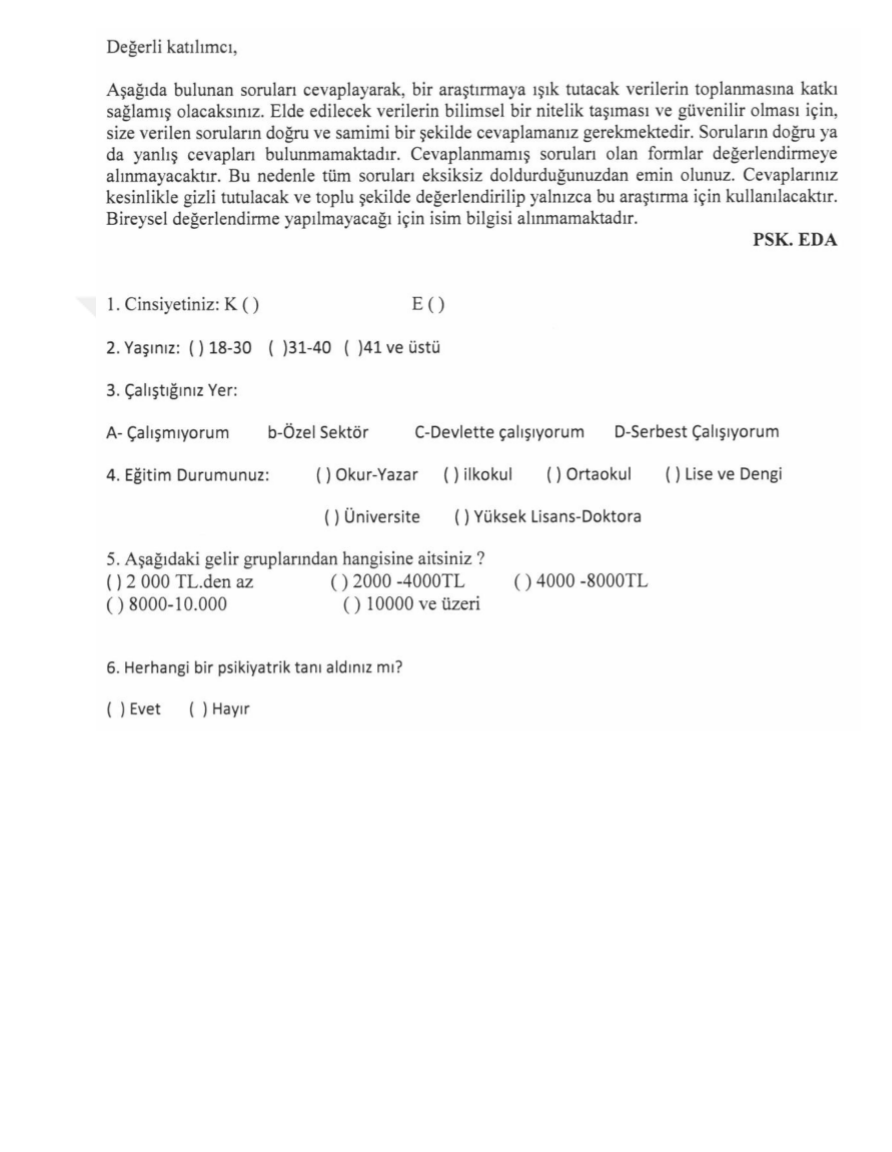
APPENDIX 2: Young Schema Questionnaire Short Form-3 (YSQ-SF3)
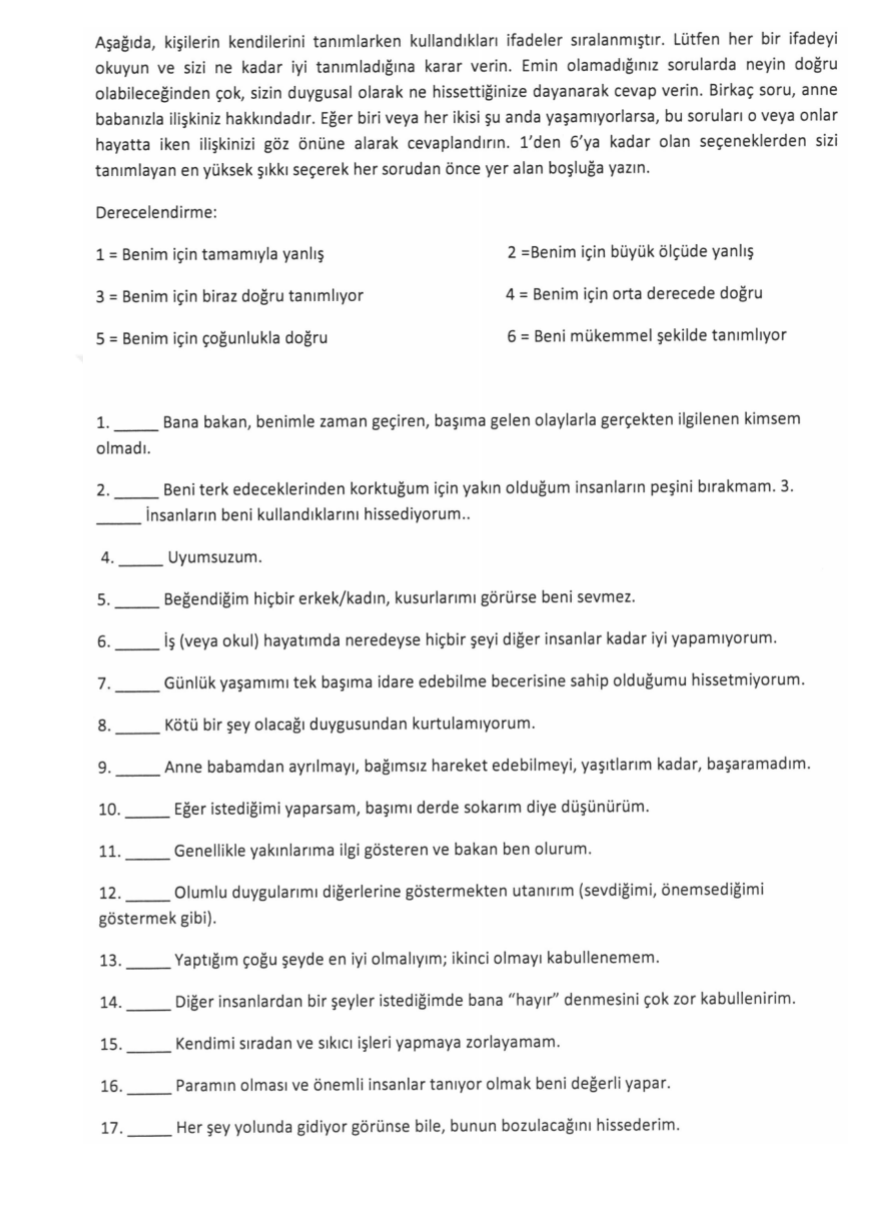
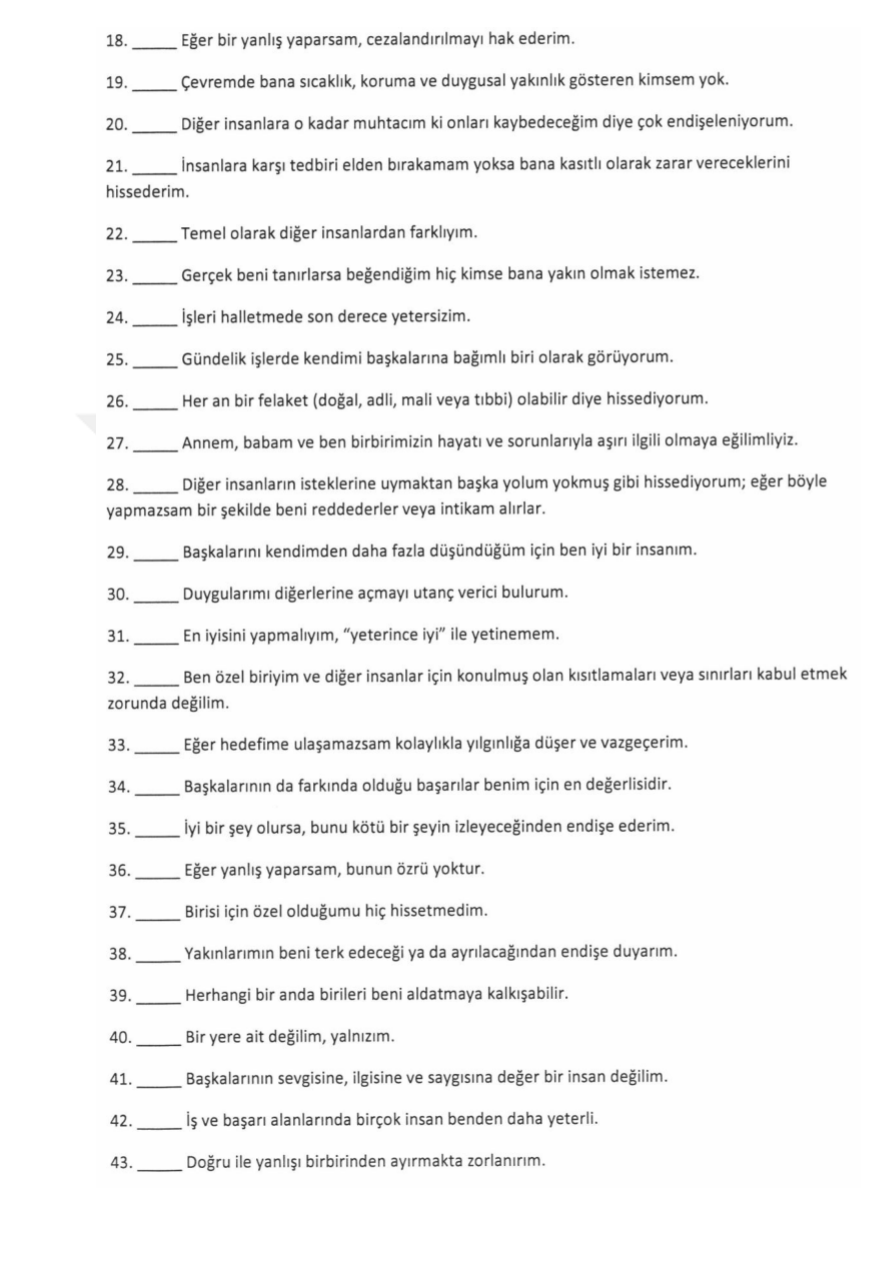
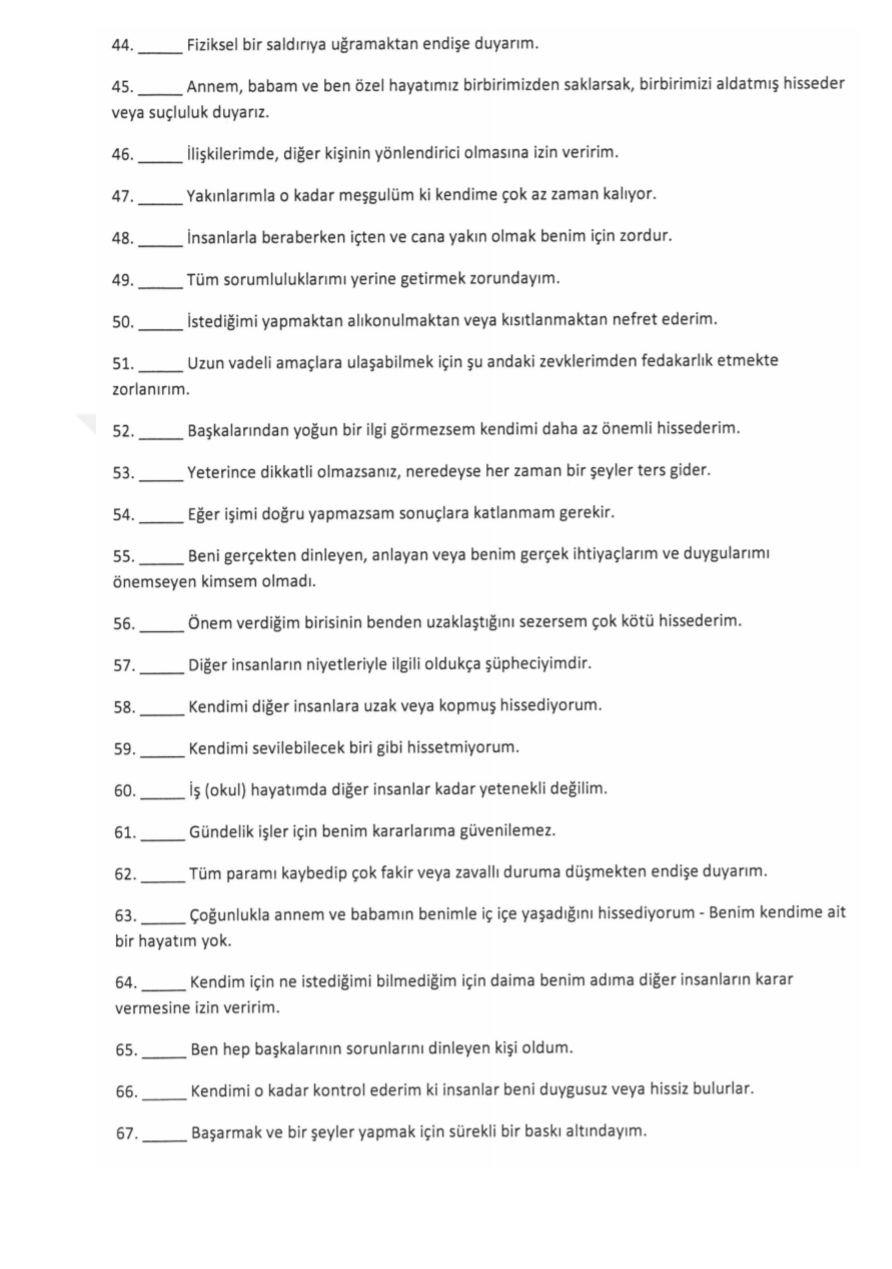
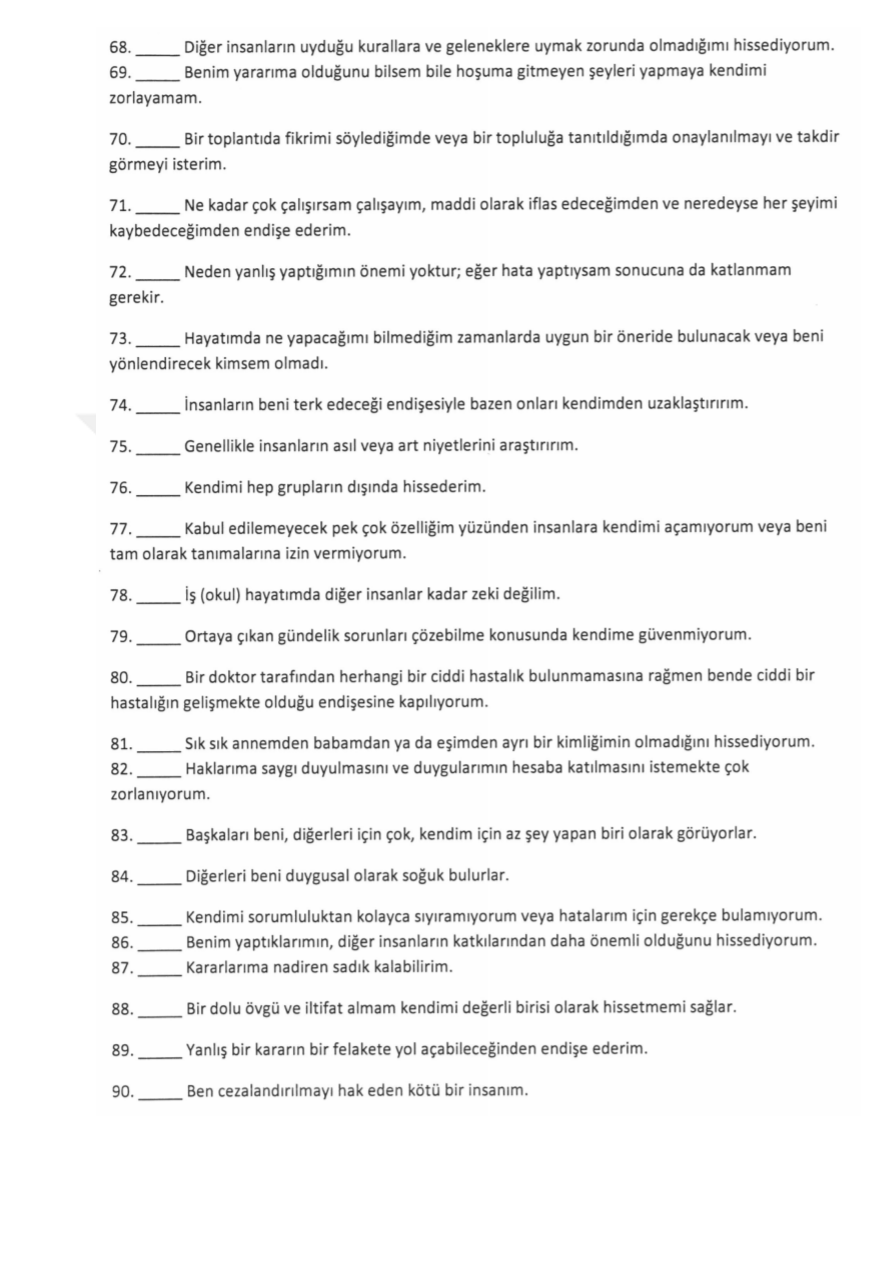
APPENDIX 3: Resilience Scale for Adults
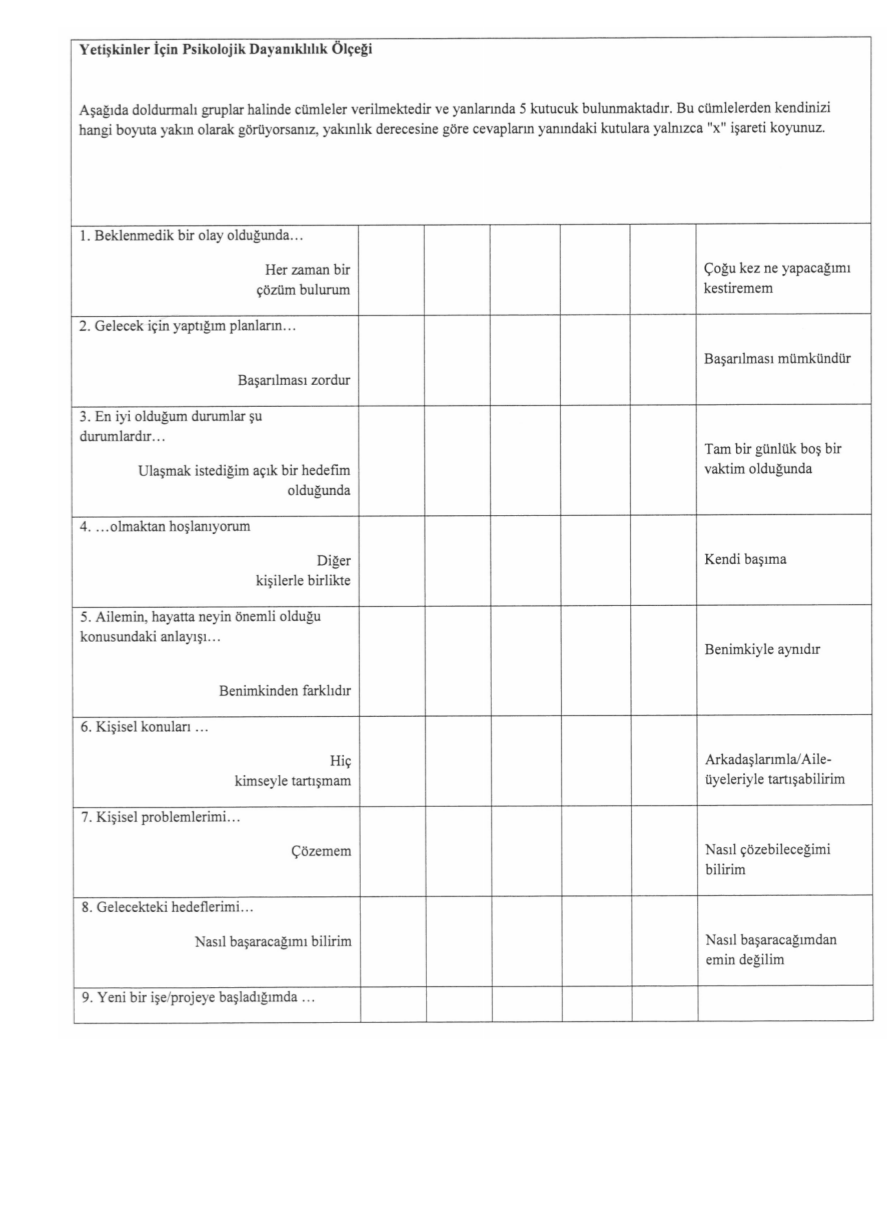
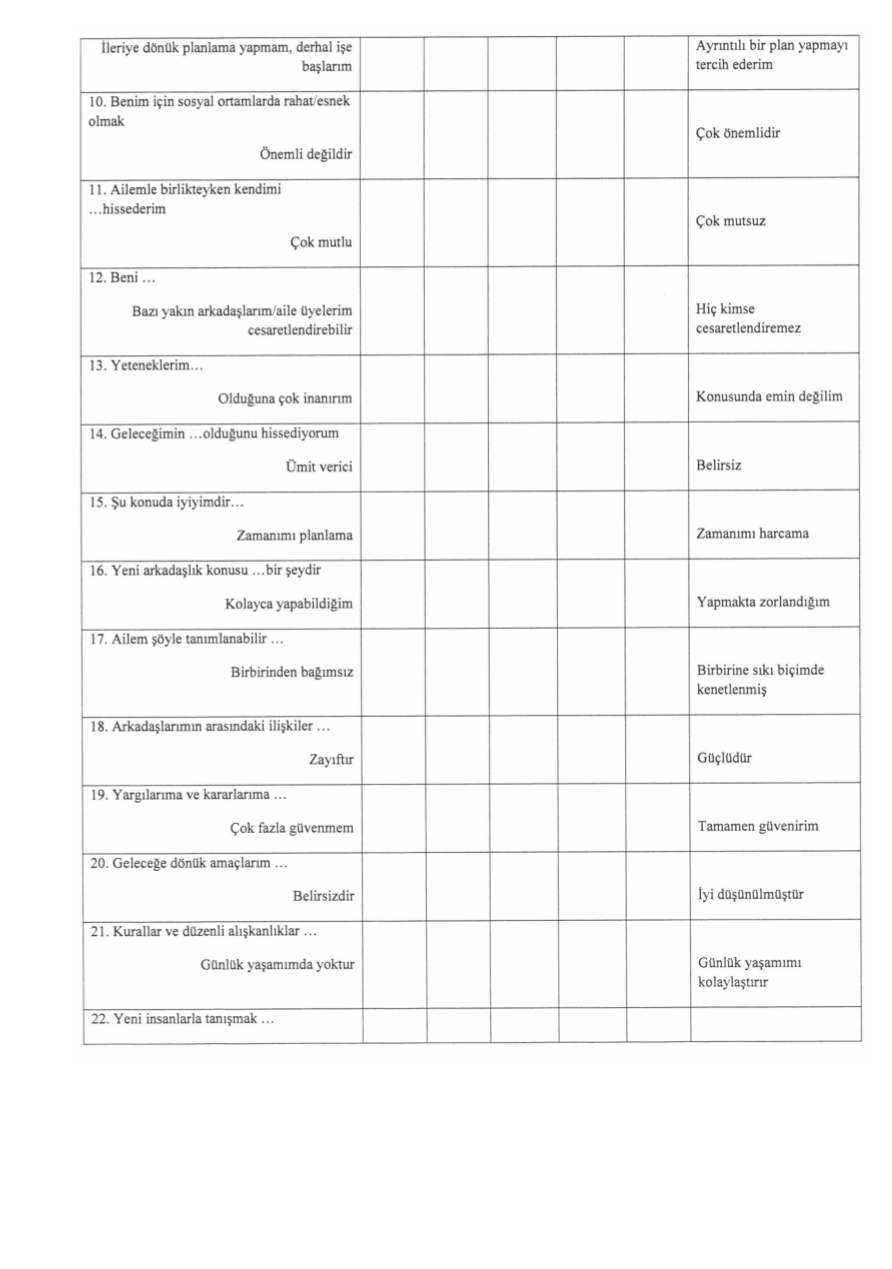
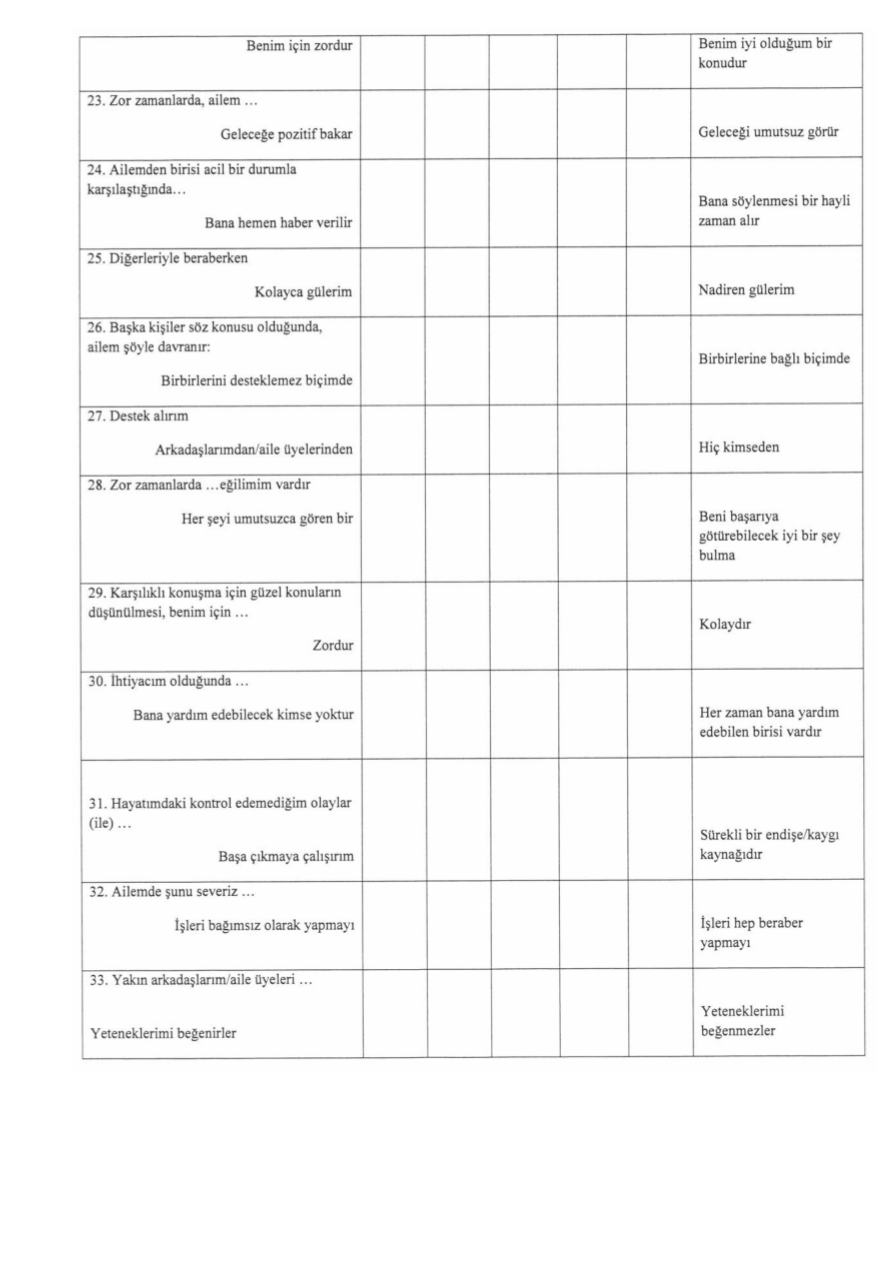
APPENDIX 4: Stress Coping Styles Scale (SCSS)
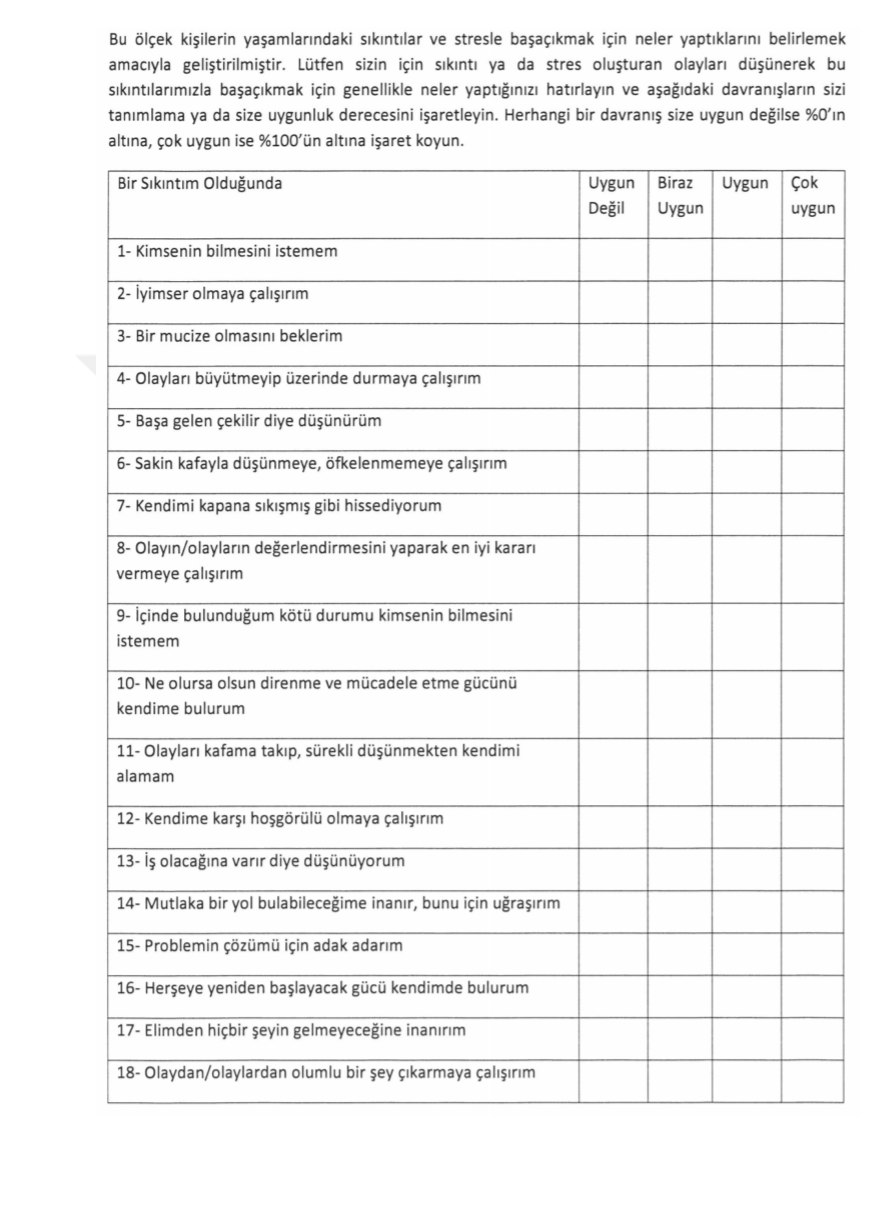
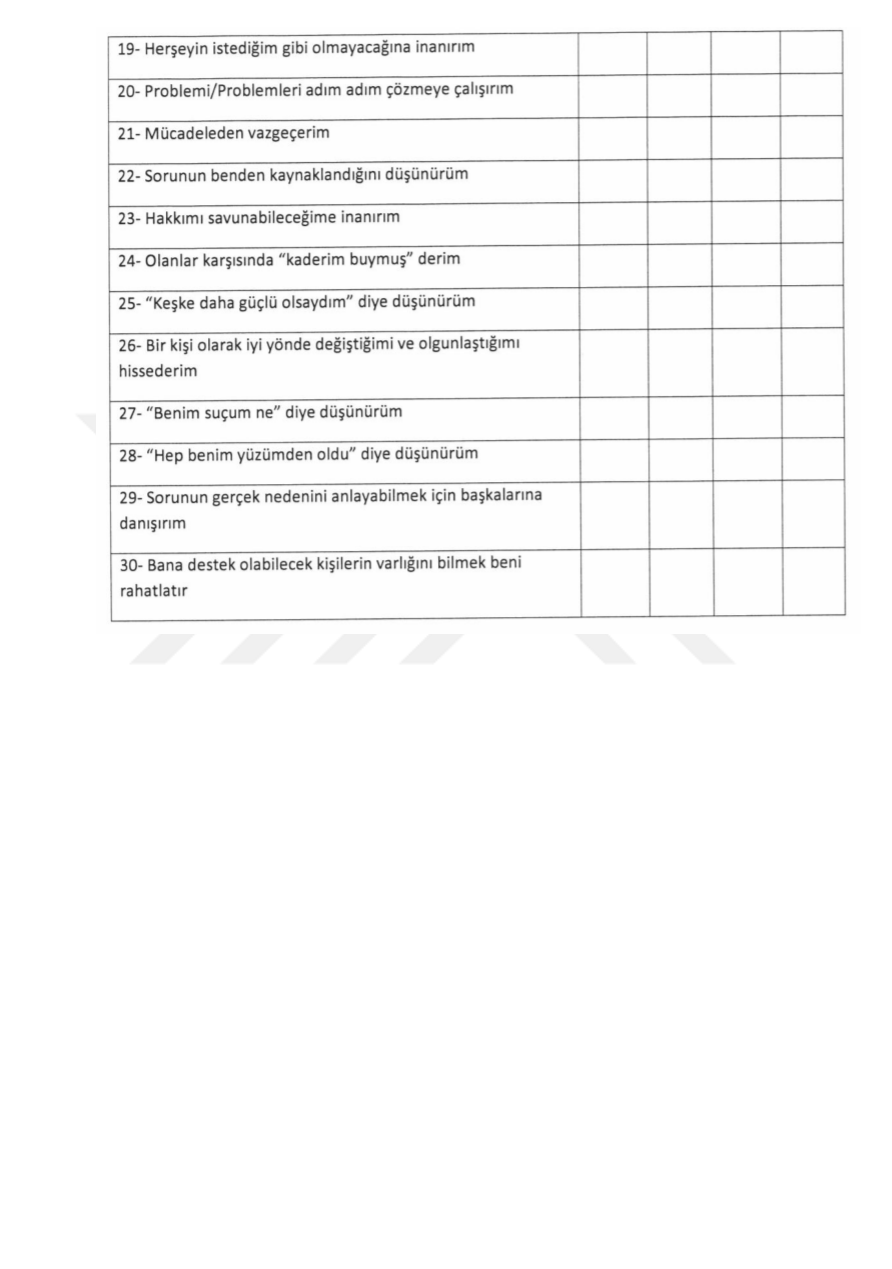
CURRICULUM VITAE
Eda ERKAN graduated from the Department of Psychology at Acıbadem University in 2018. She began the thesis-based master's programme at Istanbul Kent University in September 2019. Since 2019, she has continued to receive Cognitive Behavioural Therapy training from the Association for Cognitive and Behavioural Therapies (KDTD).
Bu yazı genel bilgilendirme amaçlıdır; tanı veya tedavi yerine geçmez. Yaşadığınız güçlükler için bir ruh sağlığı uzmanına başvurmanız önerilir. Acil bir durumda lütfen 112'yi arayın.

Eda Erkan Alapala
Klinik Psikolog. İstanbul Kent Üniversitesi Klinik Psikoloji Tezli Yüksek Lisans mezunu; bilişsel davranışçı terapi, çocuk merkezli oyun terapisi ve çocuk-ergen psikoterapisi alanlarında eğitimlerini tamamlamıştır.
Eğitimler